
March 13, 2026

The Mississauga walk-in clinic opened 40 minutes late on its first Monday morning. Twenty-three patients were waiting outside when the staff arrived — a...
Dr. Ahmed Siddiqui had been practising in North York for nine years when the Royal College of Dental Surgeons of Ontario sent an inspector to his practice as part of a Quality Assurance review.
The clinical care was exemplary. His billings were clean, his patient outcomes strong, his hygiene team experienced. But the physical facility told a different story. The sterilization room had been designed in 2014 using a workflow that predated the RCDSO’s 2018 IPAC standard updates — and then the 2024 revisions had added requirements that his current space simply could not satisfy without structural changes. His X-ray room’s lead shielding had never been formally assessed against the current Healing Arts Radiation Protection Act calculation standards. His dental unit waterlines had never been tested for bacterial colony counts since the practice opened.
The RCDSO Quality Assurance review produced a compliance action plan with 14 findings. Some were protocol-based and correctable immediately. But five required physical renovation: sterilization room reconfiguration to achieve proper dirty-to-clean instrument flow, X-ray room barrier assessment and supplemental shielding installation, dental unit waterline system replacement, nitrous oxide scavenging ventilation upgrade to meet current NIOSH 25 ppm occupational exposure limits, and AODA accessibility modifications to the reception counter and accessible washroom.
The total remediation cost: $97,000. The same scope, built correctly during the original construction in 2014, would have cost approximately $22,000 more than the non-compliant build — because correct specifications for these items are not dramatically more expensive upfront. The remediation premium — the cost of doing it wrong — was $75,000.
Ontario dental clinic renovation sits at the intersection of RCDSO regulation, the Ontario Healing Arts Radiation Protection Act, Public Health Ontario’s dental IPAC guidelines, and standard commercial construction requirements — and the compliance cost of getting any of these wrong is, as Dr. Siddiqui discovered, several times higher than the cost of getting them right from the start. This guide covers everything you need to know before your dental office renovation begins.
Four regulatory frameworks govern the physical design and construction of dental offices in Ontario. Each imposes specific requirements on how the space is built, finished, ventilated, and equipped. Understanding all four before design begins is essential — because they interact, and a change made to satisfy one framework can create non-compliance with another.
The Royal College of Dental Surgeons of Ontario (RCDSO) is the regulator for dental practice in Ontario under the Regulated Health Professions Act, 1991 and the Dentistry Act, 1991. Ontario Regulation 205/12 (Infection Prevention and Control) sets the standards that directly affect clinic physical design. The RCDSO’s Infection Prevention and Control (IPAC) Standards were most recently updated in 2022, with supplemental guidance addressing dental unit waterlines published in 2024.
Key O. Reg. 205/12 physical design requirements include:
The Healing Arts Radiation Protection Act and Ontario Regulation 543 govern radiation-producing equipment in dental offices — specifically dental X-ray units and cone beam CT (CBCT) systems. For construction purposes, O. Reg. 543 requires radiation shielding in all areas where X-ray equipment is used, calculated by a Radiation Safety Officer or qualified physicist to protect adjacent occupiable areas to a maximum of 1 mSv/year (controlled areas) or 0.1 mSv/year (uncontrolled areas occupied by the public).
The practical implication: every dental X-ray room — whether a dedicated operatory with intraoral X-ray, a panoramic X-ray room, or a CBCT suite — requires a formal radiation barrier calculation prepared before construction, specifying the lead equivalency of each wall, floor, ceiling, and door. Lead shielding typically means either 1.5–3.2mm of lead sheeting installed within wall assemblies, or equivalent-density concrete or masonry construction. An unshielded or inadequately shielded X-ray room discovered during HARP Act inspection can result in mandatory cessation of X-ray use until remediation is complete.
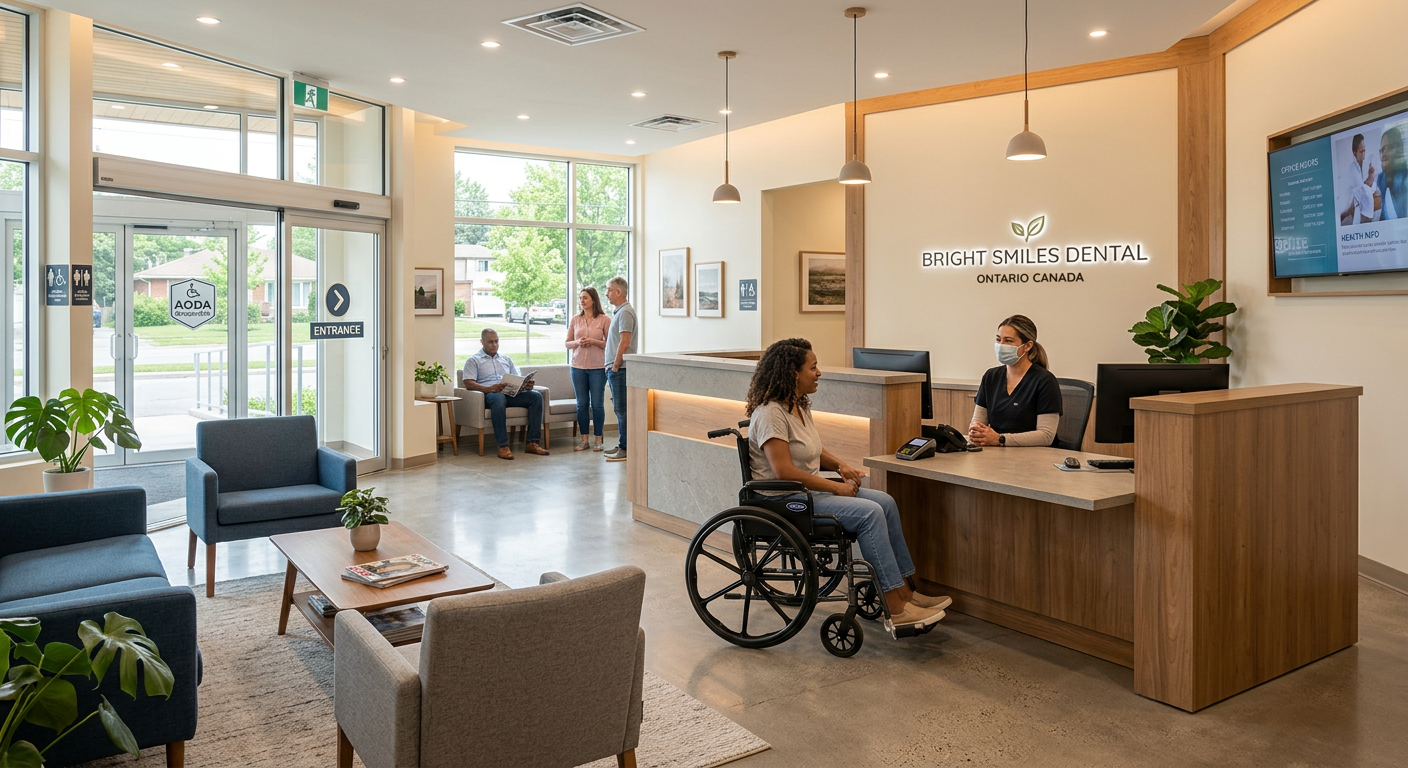
Dental offices are classified as Group D (Business and Personal Services) occupancy under the Ontario Building Code — same as general medical offices. AODA Design of Public Spaces Standards apply to all new construction and major renovations, requiring accessible entrances, reception counters with lowered sections, accessible washrooms, and sufficient clear floor space in treatment areas for wheelchair transfer. Dental operatories specifically must accommodate accessible exam chairs or have at least one operatory with sufficient clear floor space (1,500mm × 1,500mm) for wheelchair users.
Public Health Ontario (PHO) publishes supplemental IPAC guidance for dental practices that informs but does not replace RCDSO requirements. The PHO guidance addresses surface cleaning and disinfection protocols, dental waterline management, instrument reprocessing workflow, and hand hygiene infrastructure — specifically the number and placement of hand-washing sinks in relation to treatment areas and reprocessing zones.
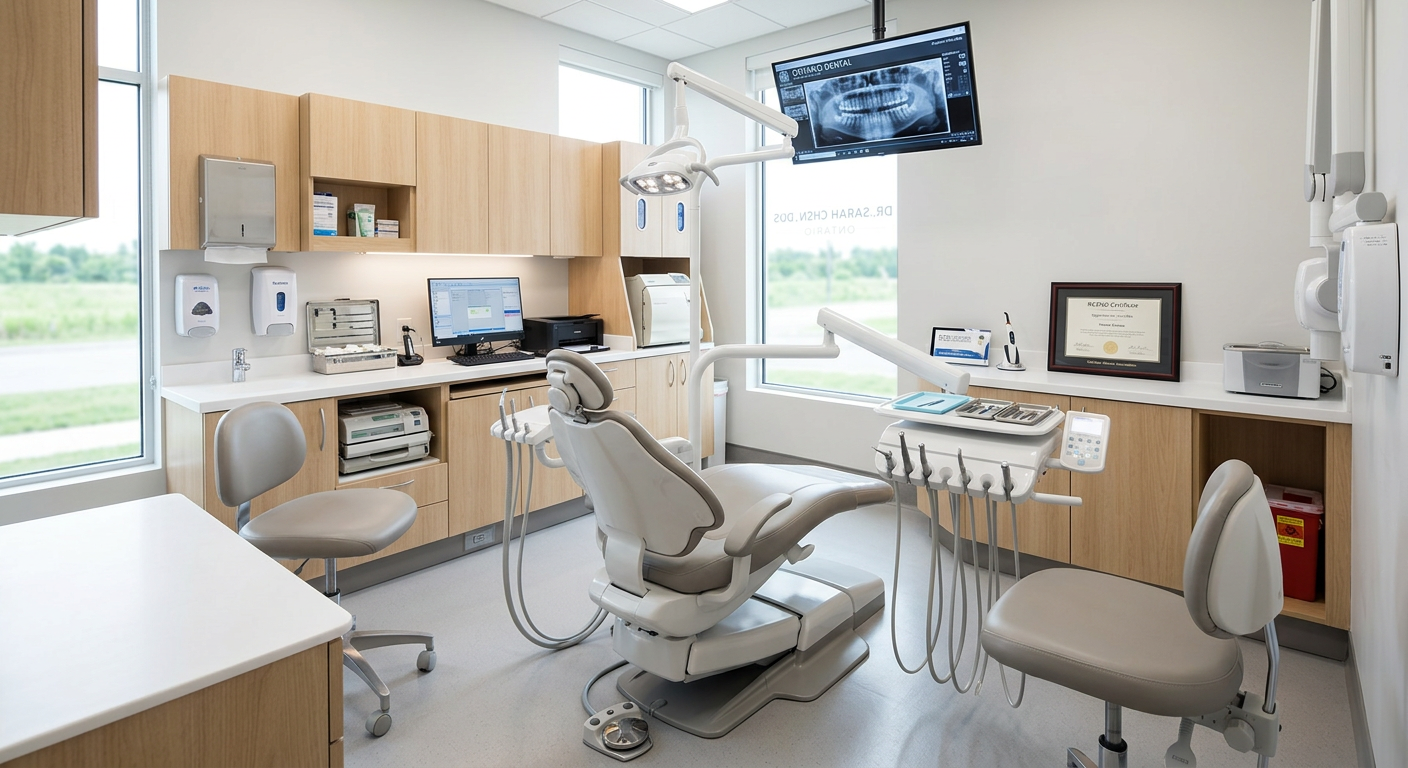
The dental operatory (treatment room) is the core productive unit of any dental practice renovation. Getting the operatory construction right — from rough-in through finishes — determines both daily clinical function and long-term RCDSO compliance. The following specifications apply to each operatory in Ontario dental clinic construction.
Minimum operatory size for a functional single-chair room: 9.3 m² (100 sq ft) floor area, with a clear zone around the dental chair of at minimum 1,200mm on the working side and 900mm on the non-working side. AODA-compliant accessible operatory requires 1,500mm × 1,500mm clear turning radius. An accessible operatory designed to serve wheelchair users typically requires 11.1 m² (120 sq ft) minimum.
Optimal operatory dimensions for a full-complement dental practice in GTA (allowing ergonomic access to all four quadrants and cabinetry placement that does not require the dentist to turn away from the patient): 3.4m × 3.6m (approximately 12.2 sq ft), or 3.6m × 4.2m for larger instruments or pediatric chair requirements.
Each dental operatory requires a specific plumbing rough-in that differs from medical exam rooms. The rough-in specification for a standard operatory includes:
The amalgam separator is a critical and often overlooked plumbing component. Ontario municipalities require amalgam separators meeting ISO 11143 on all dental vacuum systems — at minimum, removing 99% of amalgam particles. Most GTA municipalities require a registered amalgam separator with annual service documentation. The separator is installed on the main vacuum line outside individual operatories, typically in the mechanical room or sterilization area, and connects to the main drain. Installation cost: $1,800–$4,500 for the separator unit plus plumbing integration.
RCDSO IPAC requires surfaces in dental operatories to be smooth, non-porous, and disinfectable. The implication for construction:
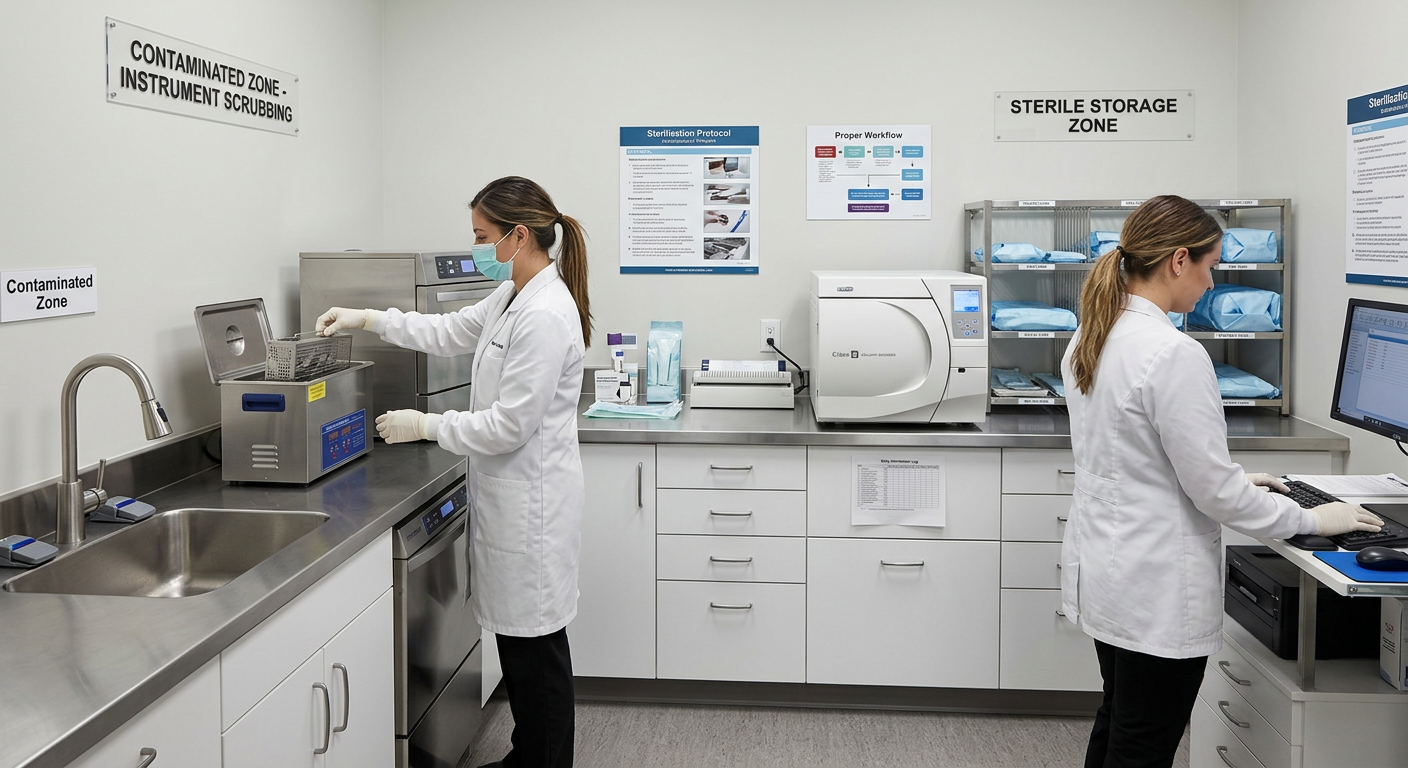
The sterilization room is the highest-scrutiny space in any RCDSO compliance review. Its layout must demonstrate a clear, unidirectional workflow from contaminated instruments to clean sterile instruments — a “dirty-to-clean” flow that physically prevents cross-contamination by design, not just by protocol.
The sterilization room must have physically distinct zones that prevent contaminated instruments from coming into contact with clean or sterile instruments at any point in the reprocessing cycle. The required zones and their physical requirements:
The physical size required for this four-zone sterilization workflow: minimum 7.4 m² (80 sq ft) for a 2–3 operatory practice; 11–14 m² (120–150 sq ft) for a 4–6 operatory practice. Sterilization rooms smaller than 7.4 m² typically cannot achieve compliant dirty-to-clean flow with proper work surface spacing — resulting in a compliance finding regardless of the equipment specified.
The sterilization room must be maintained at negative pressure relative to adjacent operatories and corridors — this prevents steam, chemical disinfectant aerosols, and bioaerosols from the contaminated zone from moving into clean areas. Minimum 10 ACH with dedicated exhaust, not shared with HVAC serving patient areas. The autoclave generates significant heat and humidity during sterilization cycles; the HVAC system must be sized to handle this load to prevent condensation on sterile packs (which can compromise sterility). Sterilization room HVAC is frequently undersized by contractors unfamiliar with dental clinic construction — specify 12+ ACH and discuss autoclave heat load with your HVAC engineer explicitly.
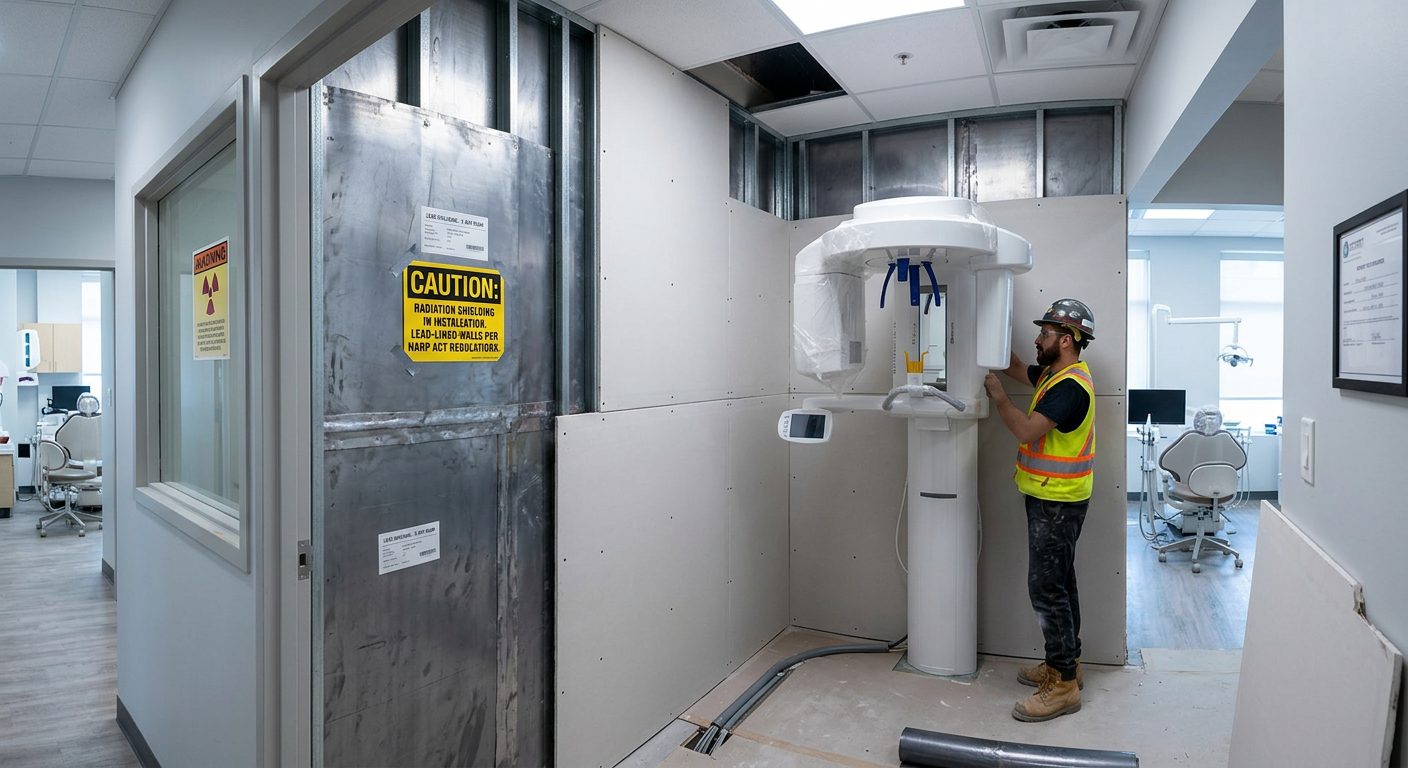
Every Ontario dental clinic that uses radiographic equipment — intraoral X-ray units, panoramic (OPG), or cone beam CT — must have radiation shielding that complies with the Healing Arts Radiation Protection Act. This is a construction requirement, not an equipment purchase: the walls, ceiling, floor, and door of every room where X-rays are produced must be designed to limit radiation exposure in adjacent areas to safe levels.
The process for ensuring HARP Act compliance:
Cost of proper X-ray room shielding in Ontario dental clinic renovation: $12,000–$35,000 per room depending on size, adjacent occupancy, and equipment type. The radiation barrier calculation from a licensed Radiation Safety Officer: $1,500–$4,000 per suite. Total radiation compliance scope for a 3-operatory practice with panoramic unit: $25,000–$55,000 including calculation, lead installation, inspection, and documentation.
Nitrous oxide (N₂O/O₂) sedation is used in a significant proportion of Ontario dental practices — particularly pediatric and anxiety-management practices. The occupational health requirements for nitrous oxide exposure are specific and have direct construction implications.
NIOSH (National Institute for Occupational Safety and Health) establishes a recommended exposure limit (REL) of 25 ppm nitrous oxide as a time-weighted average for dental personnel. Achieving this limit requires:
Construction cost for N2O scavenging rough-in: $3,500–$8,000 per operatory (scavenging exhaust line to exterior exhaust fan, N2O supply line from central manifold, supplemental HVAC for that room). Central N2O manifold installation (cylinders, regulators, manifold): $4,000–$9,000 separate from construction. Retrofitting N2O scavenging after walls are closed is significantly more expensive — $8,000–$18,000 per operatory — because the scavenging exhaust lines run to exterior and require wall penetrations that are difficult to route after construction.
The most common RCDSO compliance issue in Ontario dental clinic renovations: a sterilization room that was designed by a non-dental contractor or architect who did not understand the spatial requirements of compliant dirty-to-clean instrument flow. The result is either a room too small to achieve proper zone separation, or a layout where contaminated and clean zones share common surfaces or pathways.
A Mississauga dental practice built a sterilization room measuring 5.6 m² — adequate for two-sink plumbing and an autoclave, but impossible to configure with proper contaminated/clean zone separation while maintaining the minimum 60cm clearance between zones. The RCDSO Quality Assurance review found the sterilization workflow non-compliant. Remediation required expanding the sterilization room into an adjacent storage closet, reconfiguring the cabinetry, relocating the amalgam separator plumbing, and completing associated drywall and mechanical work. Cost: $67,000. The original sterilization room, built 1.2m wider from the start, would have cost $9,000 more — an $8,000 bigger storage closet versus a $67,000 remediation.
X-ray room shielding errors come in two forms: inadequate shielding (lead equivalency too low for the equipment workload and adjacent occupancy) and undocumented shielding (shielding was installed but not calculated, inspected, or formally documented per HARP Act requirements). Both are equally non-compliant — HARP Act requires documented calculated shielding, not just observed shielding material.
An Etobicoke general dentistry practice renovated its panoramic X-ray room without commissioning a Radiation Safety Officer calculation. The contractor installed what appeared to be adequate lead sheeting — 1.5mm in all walls — but without a formal calculation verifying that 1.5mm was sufficient for the panoramic unit’s actual workload (X-rays per week) and the adjacent area occupancy (a pediatric waiting area directly through one wall). When the practice applied for an updated HARP Act licence, the Ministry of Health required a formal calculation. The calculation found that the pediatric waiting area wall required 2.0mm lead equivalent, not 1.5mm. Opening the wall to add lead, patching, repainting, and obtaining updated HARP Act documentation: $29,000. Proper initial calculation and specification would have cost $2,200.
Dental unit waterlines — the small-diameter water tubing within dental chairs that supply the handpiece, air-water syringe, and ultrasonic scaler — develop biofilms if not properly managed. The RCDSO IPAC standard requires water quality at dental unit outlets to be maintained below 500 CFU/ml. Achieving and maintaining this standard requires either point-of-use water filtration, chemical waterline treatment, or dental units with self-contained water systems. Standard municipal water plumbing connected to dental unit waterlines without a treatment system typically produces 10,000–100,000 CFU/ml — 20–200 times the RCDSO limit.
The renovation implication: dental unit waterline treatment systems must be integrated at the design stage. A central waterline treatment system serving multiple chairs through a dedicated filtered water supply line is the most reliable approach for practices with 3+ operatories and costs $8,000–$20,000 for the system and plumbing. Individual point-of-entry filters on each dental unit ($600–$1,500 per unit with annual cartridge replacement) are the lower-capital alternative but require ongoing maintenance compliance. Retrofitting a central waterline treatment system after dental unit plumbing is completed and walls are closed typically costs 2–3× the initial installation cost due to access difficulties.
| Scope | Low (CAD) | High (CAD) | Key Variables |
|---|---|---|---|
| Single operatory addition (leasehold) | $45,000 | $85,000 | Plumbing run, N2O, cabinetry |
| Sterilization room build (RCDSO-compliant) | $25,000 | $55,000 | Size, HVAC, autoclave count |
| X-ray room with HARP Act shielding | $20,000 | $45,000 | Equipment type, adjacent occupancy |
| Panoramic/CBCT suite | $35,000 | $85,000 | CBCT requires full shielding engineering |
| Waterline treatment system (central) | $8,000 | $22,000 | Chair count, plumbing distance |
| N2O scavenging rough-in (per operatory) | $3,500 | $8,000 | Distance to exterior exhaust |
| Reception and waiting area renovation | $15,000 | $45,000 | AODA scope, millwork, flooring |
| Full dental clinic renovation ($/sq ft) | $185/sq ft | $350/sq ft | Operatory count, CBCT, N2O, AODA |
| Shielding Method | Lead Equivalent | Cost (CAD/sq ft of wall) | Best For |
|---|---|---|---|
| Lead sheet (1.5mm) on drywall | 1.5mm Pb | $18–$28 | Standard intraoral, low workload panoramic |
| Lead sheet (2.0mm) on drywall | 2.0mm Pb | $24–$36 | High workload panoramic, adjacent public |
| Leaded drywall (1.2mm Pb equiv.) | 1.2mm Pb | $12–$18 | Supplemental layer, low-workload intraoral |
| Lead glass panel (door/window) | 2.0–3.0mm Pb | $280–$450 per panel | Observation windows, door windows |
| Dense concrete block wall | Variable by thickness | $8–$15 | New construction, CBCT suites |
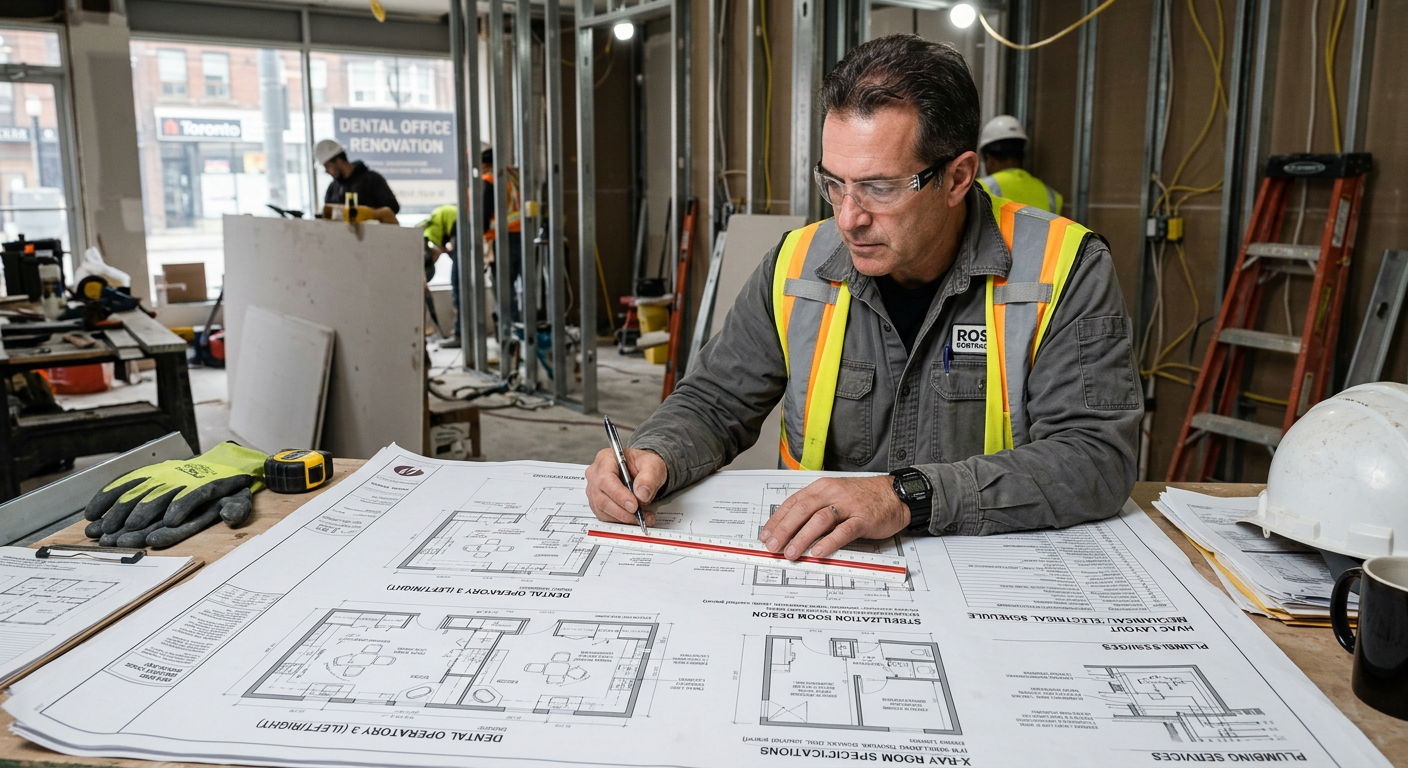
Dental clinic renovation requires a contractor with a distinct skill set that differs from both general commercial construction and general medical clinic renovation. The three technical disciplines that differentiate dental construction specialists are dental unit rough-in coordination, X-ray shielding project management, and sterilization room IPAC compliance design — and finding a contractor who has managed all three successfully in GTA projects is a more selective search than finding a qualified medical clinic contractor.
Dental unit rough-in is often coordinated with the dental equipment supplier — chair manufacturers like A-dec, Pelton & Crane, and Midmark each have specific rough-in dimensions and utility requirement specifications. A contractor who has not managed a dental unit rough-in before typically orders the wrong rough-in dimensions because they source information from the dental chair’s installation guide rather than verifying directly with the equipment technician who will install the chair. An incorrect rough-in discovered when the dental unit technician arrives to install the chair means tearing open the floor or wall to relocate plumbing — a $3,000–$12,000 problem that arises exclusively from the contractor’s inexperience with dental equipment coordination.
The five due diligence questions specific to dental contractor qualification, in addition to the standard medical contractor checklist: Have you worked with an RSO on HARP Act X-ray shielding in a dental renovation? Have you coordinated dental unit rough-in with a dental equipment technician on a recent project? Can you name the correct Class B autoclave requirement and explain why Class S is inadequate for hollow instruments? Have you completed an amalgam separator registration in the relevant municipality? Have you managed a central dental waterline treatment system installation? A contractor who answers all five questions specifically and with references, and can provide dental-specific project documentation, is qualified for Ontario dental renovation work and worth adding to your short list for site visits and detailed proposals.
Commission a regulatory pre-check covering RCDSO IPAC compliance gaps in the existing space, HARP Act documentation status for all current X-ray equipment, current waterline testing results, and AODA compliance gaps. This pre-check typically takes 3–5 hours for a Certified Dental IPAC Trainer or healthcare compliance consultant and costs $800–$2,500 — the most valuable pre-design investment for any dental renovation. Simultaneously, engage a Radiation Safety Officer to inventory X-ray equipment and begin barrier calculations. X-ray barrier calculation must be complete before architectural drawings are finalized, because the shielding requirements affect wall construction throughout the X-ray zones.
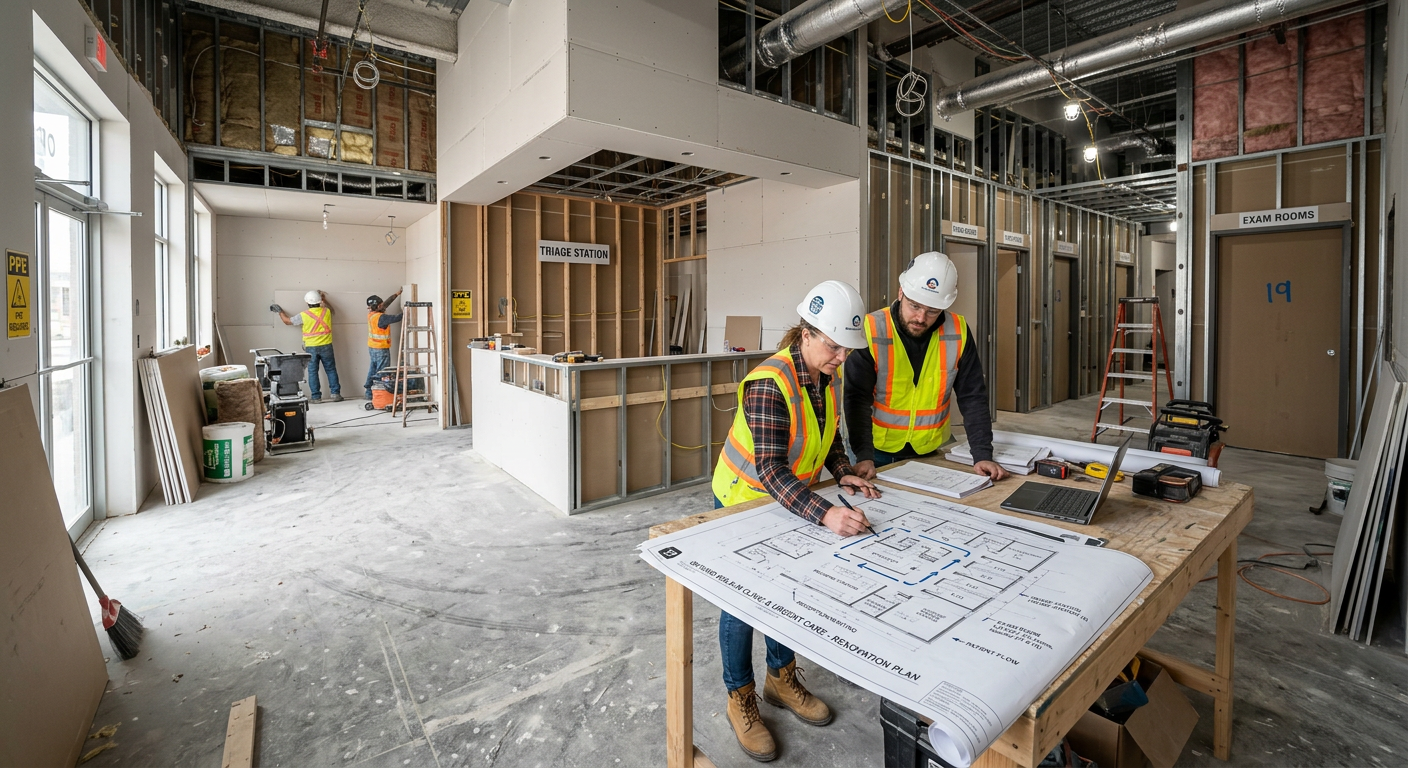
Architectural design must address all findings from the regulatory pre-check and incorporate the Radiation Safety Officer’s barrier specifications. Permit applications for GTA dental clinic renovations include building permit (2–8 weeks depending on municipality), mechanical permit, plumbing permit (including amalgam separator discharge registration), and electrical permit. HARP Act does not require a municipal building permit but does require a Ministry of Health notification of change in X-ray facility before equipment is used in the renovated space. Begin HARP Act notification process during design phase.
Dental rough-in is more complex than general medical construction because of the combined plumbing, vacuum, compressed air, N2O, and electrical requirements at each chair location — plus the X-ray shielding installation that must be completed before walls are closed. Sequencing: X-ray room lead installation must be inspected before drywall closure; dental unit rough-in (plumbing, vacuum, air, N2O) must be inspected before operatory floors are poured or finished; sterilization room plumbing (including amalgam separator connection) must be pressure-tested before walls close.
Dental cabinetry is typically custom millwork — lead time of 8–14 weeks from design approval. Cabinet delivery and installation must be coordinated with flooring completion (cabinets go in after flooring, with appropriate toe kick clearance). Dental units are installed and connected by a certified dental equipment technician — confirm the technician’s schedule and chair delivery lead time during design phase, not at construction completion. Central vacuum pump, compressor, and waterline treatment system are installed in mechanical space during this phase.
Before opening, three parallel commissioning processes must complete: HVAC commissioning (ACH measurement, sterilization room negative pressure verification, N2O exhaust flow verification), dental unit waterline baseline testing (sample from each operatory outlet and send to ISO-accredited lab — 10–14 days for results), and HARP Act documentation update (RSO inspection of lead installation, formal report to Ministry). None of these can be rushed — budget 4–6 weeks for commissioning and documentation. Plan your opening date 6 weeks after construction completion, not 2.
GTA dental clinic permit processes follow the same municipal structure as other medical clinic renovations, with one specific addition: the amalgam separator registration requirement varies by municipality. Toronto and York Region municipalities (Richmond Hill, Markham, Vaughan) require amalgam separators to be registered with the local sewer use by-law authority separately from the building permit process. Failure to register results in non-compliance with municipal sewer discharge limits — a regulatory issue separate from RCDSO compliance. Your dental-specialist renovation contractor should manage this registration as part of the standard scope; verify it is included before signing any contract.
CBCT (cone beam CT) installation in Toronto triggers an additional notification to the radiation safety program of Toronto Public Health, separate from the Ontario Ministry of Health HARP Act requirements. This dual notification is unique to Toronto among GTA municipalities and is frequently missed by contractors without dental-specific GTA permit experience.
The primary construction-relevant RCDSO standard is Ontario Regulation 205/12 (Infection Prevention and Control for Dental Practices), which requires specific physical infrastructure for IPAC compliance. The key construction requirements: sterilization room must have distinct contaminated and clean zones with appropriate workflow separation; dental units must have waterline treatment capable of maintaining below 500 CFU/ml; treatment room surfaces must be smooth, non-porous, and disinfectable. The RCDSO also publishes detailed IPAC guidelines as supplemental documents to O. Reg. 205/12 — these guidelines provide more specific implementation guidance, including instrument reprocessing workflow requirements that affect sterilization room sizing and layout. When planning your renovation, the RCDSO IPAC standards document (available on the RCDSO website) should be a primary design reference, not an afterthought review at the end of design.
Yes — for any dental clinic renovation that creates, modifies, or relocates X-ray-producing equipment spaces in Ontario, a Radiation Safety Officer (RSO) licensed by the Canadian Nuclear Safety Commission must perform a barrier adequacy calculation before construction and an inspection after installation. This is a legal requirement under the Healing Arts Radiation Protection Act. You cannot simply assume that standard wall construction provides adequate shielding — the calculation must account for your specific equipment workload, the geometry of adjacent spaces, and the occupancy of those spaces. The RSO’s final report documents the shield design and becomes part of your HARP Act facility licence. Without this report, the Ministry of Health may require suspension of X-ray use in the space. RSO services for a typical 3-operatory dental practice with one panoramic unit cost $3,500–$6,500 for the full engagement: site visit, calculations, construction review, post-installation inspection, and documentation. This is a non-optional cost for any Ontario dental renovation involving X-ray spaces.
Ontario dental office renovation costs in 2025–2026 range from $185 to $350 per square foot for leasehold improvement in the GTA. The wide range is driven primarily by the specialized trades involved: dental unit rough-in (plumbing, vacuum, compressed air, N2O, electrical per chair), X-ray shielding scope, and sterilization room compliance requirements all have significant cost variability. A 2-operatory practice renovation without CBCT or N2O in a straightforward leasehold space typically falls in the $185–$225/sq ft range. A full-scope renovation with 4–6 operatories, CBCT suite, N2O in all operatories, RCDSO-compliant sterilization room, and full AODA compliance typically falls in the $280–$350/sq ft range. These figures do not include dental equipment (chairs, units, X-ray equipment, autoclave, compressor, vacuum) which adds $35,000–$120,000 per operatory depending on equipment specification and manufacturer.
Phased operatory renovation while maintaining practice operation is feasible but requires careful infection control management during construction. The critical constraints: the central vacuum system and compressed air lines typically run through a single mechanical room and serve all operatories — work on these systems requires full practice closure during the specific mechanical work, regardless of which operatory is being renovated. Sterilization room renovation requires practice closure for the duration of the sterilization room work, since reprocessing must cease when the sterilization room is out of service. Individual operatory renovation (cabinetry, flooring, paint) can proceed while adjacent operatories operate, provided 6 mil poly dust barriers are constructed between the construction zone and operating clinical areas, HVAC is isolated between zones, and contractor traffic does not pass through operating clinical areas. Budget 20–30% additional cost for phased construction vs. full closure renovation — and plan for 2–4 days of full practice closure at minimum for mechanical rough-in work regardless of phasing strategy.
Custom dental cabinetry from GTA suppliers typically has an 8–14 week lead time from design approval to delivery. Semi-custom cabinetry from national dental supply distributors (Patterson Dental, Henry Schein) runs 6–10 weeks. Off-the-shelf modular dental cabinetry (A-dec, Pelton & Crane, Royal) runs 4–8 weeks from order. All lead times can extend by 2–6 weeks during high-demand periods (spring and fall renovation seasons). The practical implication: dental cabinetry must be specified, approved, and ordered within the first 4 weeks of the design phase — not at construction completion when you’re ready to install. A contractor who doesn’t raise cabinetry lead time as a critical-path item in the first project meeting has not managed dental clinic renovations before.
A complete dental office renovation in Ontario requires: building permit (covering structural changes, occupancy, fire separations, and major mechanical modifications); mechanical permit (HVAC modifications); plumbing permit (new drain lines, supply lines, vacuum system modifications); electrical permit (new circuits for dental units, sterilization equipment, X-ray); TSSA permit for any pressure vessel work (compressed air storage tanks, N2O manifold systems); amalgam separator registration with the local municipality’s sewer use by-law authority; and HARP Act facility update notification to the Ontario Ministry of Health for any X-ray space changes. Toronto additionally requires notification to Toronto Public Health for CBCT installations. This is the most complex permit profile of any medical specialty in Ontario construction — and the most common reason dental clinic renovations are delayed is an incomplete initial permit submission missing one or more of these streams.
The qualification criteria for a dental renovation contractor are specific: they must have documented experience with RCDSO IPAC compliance (specifically dirty-to-clean sterilization room workflow), HARP Act X-ray shielding projects (working with an RSO and submitting HARP documentation), dental unit rough-in plumbing (handpiece water supply, vacuum lines, amalgam separator integration), N2O scavenging ventilation, and Ontario dental clinic permit management (including amalgam separator registration). Ask for three dentist references from GTA renovation projects completed in the past three years — specifically asking whether the RCDSO Quality Assurance review post-renovation produced any compliance findings. A contractor with documented clean RCDSO compliance outcomes on previous dental clinic renovations is demonstrably qualified. A contractor with general medical or healthcare experience who has not specifically completed dental renovations lacks the dental-specific trade knowledge that dental construction requires. The difference in practice — specifically in dental unit rough-in plumbing, sterilization room HVAC, and X-ray shielding coordination — is material to your compliance outcome.
Dental unit waterlines are the small-diameter (3–5mm) polyethylene tubing inside dental units that supply water to the handpiece, air-water syringe, and ultrasonic scaler. These thin lines develop biofilm — a bacterial community attached to the inner tube wall — because they experience intermittent flow patterns and low flow volumes that allow stagnation. Left untreated, biofilm in dental unit waterlines can produce water quality at clinical outlets in the range of 10,000–500,000 CFU/ml — far exceeding the RCDSO’s 500 CFU/ml limit. Waterline management is an ongoing IPAC operational requirement, but the renovation planning decision is whether to install a central waterline treatment system (dedicated filtered water supply to all dental units, typically using continuous chemical treatment like Alpron or BluTab) or to rely on per-unit point-of-entry filters. The central system costs $8,000–$22,000 to install but is significantly easier to maintain at compliance with routine monitoring. The per-unit filter approach costs $600–$1,500 per unit initially but requires consistent replacement adherence and individual testing of each unit’s water output. New construction is the ideal time to install a central system — doing so after construction is complete requires reopening wall and floor assemblies to route the filtered supply line. If you are renovating, specify central waterline treatment in the design phase and have your contractor include it in the scope.
Written by the RenoEthics construction team — specialists in Ontario medical and dental clinic renovation. Last updated March 2026. RenoEthics has completed dental office and medical clinic renovations across Richmond Hill, Markham, Vaughan, Newmarket, Aurora, Toronto, and the broader GTA. Schedule a complimentary facility assessment or request a quote for your dental office renovation.
The Mississauga walk-in clinic opened 40 minutes late on its first Monday morning. Twenty-three patients were waiting outside when the staff arrived — a...
The most common question Ontario clinic owners ask when planning a renovation is: “What should this cost per square foot?” It is also the...
The Brampton family medicine clinic closed completely for its renovation. The decision seemed straightforward at the time: a complete 10-week closure would allow the...