
March 13, 2026

The Mississauga walk-in clinic opened 40 minutes late on its first Monday morning. Twenty-three patients were waiting outside when the staff arrived — a...
The most common question Ontario clinic owners ask when planning a renovation is: “What should this cost per square foot?”
It is also the most commonly misanswered question in healthcare construction. The problem is that “medical office renovation cost per square foot” is not a single number — it is a range that varies by a factor of 3 to 5 depending on the type of clinic, the renovation scope, the existing condition of the space, the location within Ontario, and the specific clinical requirements that govern construction standards. A walk-in clinic renovation costs $125–$200 per square foot. A surgical suite fit-out costs $350–$600 per square foot. A cosmetic refresh of an existing clinic costs $60–$95 per square foot. Quoting any of these numbers to a clinic owner planning a different type of renovation produces a misleading expectation that generates either shocking change orders (when the owner budgets the walk-in clinic rate for a surgical suite) or wasted budget (when a practice budgets the surgical suite rate for a basic GP refresh).
A Scarborough specialist clinic planned a $650,000 renovation budget for a 3,200 square foot space — a rate of approximately $203 per square foot — based on a per-square-foot estimate from a general contractor who had quoted similar-sized commercial office renovations. The clinic was a complex multi-specialty space with a minor procedure room, a dedicated sterilization room, specialized HVAC requirements for an infectious disease suite, and extensive medical gas rough-in. The completed project cost $1,140,000 — $356 per square foot. The $490,000 overrun was not from scope creep; it was from a $203/sq ft estimate applied to a $356/sq ft project type. The mistake was in choosing a cost benchmark without understanding what clinical factors drive the cost.
This guide provides Ontario’s most comprehensive per-square-foot benchmarking for medical office renovation — by clinic type, by room type, by renovation scope level, and by GTA location — so that every clinic owner can build a budget that reflects the actual cost of their specific project.
Before any per-square-foot number is meaningful, five factors must be understood — they are the variables that explain the 3–5× cost range across medical office renovation types.
Clinical intensity is the primary cost driver in medical office renovation. A space with low clinical intensity — an administrative office within a clinic, a staff break room, a waiting area — costs $80–$140 per square foot to build. A space with moderate clinical intensity — a standard physician exam room with a sink, cabinetry, and clinical-grade flooring — costs $150–$250 per square foot. A space with high clinical intensity — a procedure room with medical gas, HEPA HVAC, seamless flooring, and specialized casework — costs $280–$450 per square foot. A space with very high clinical intensity — a surgical suite or isolation room with positive/negative pressure control, laminar flow, and full sterile field infrastructure — costs $350–$600+ per square foot. The average cost per square foot for a mixed-use medical clinic is determined by the proportion of each intensity level in the total footprint.
The existing condition of the space dramatically affects cost per square foot. Three conditions span the range:
| Starting Condition | Description | Cost Impact (vs. mid-grade existing space) |
|---|---|---|
| Shell space (raw) | Bare concrete floors, exposed structure, no mechanical, electrical, or plumbing | +$75–$120/sq ft (full MEP rough-in required) |
| Basic commercial fit-out | Standard office with HVAC, electrical, plumbing — not clinical grade | +$30–$60/sq ft (upgrade to healthcare grade) |
| Existing medical space | Previously a clinic — some clinical infrastructure in place | Baseline — depends on what is being retained vs. replaced |
| Recent clinical renovation | Clinic renovated in last 5–8 years — infrastructure generally usable | -$20–$50/sq ft (some systems reused) |
| Outdated clinical space | Clinic renovated 15+ years ago — systems at or beyond end of useful life | +$20–$45/sq ft (MEP replacement, asbestos/lead risk) |
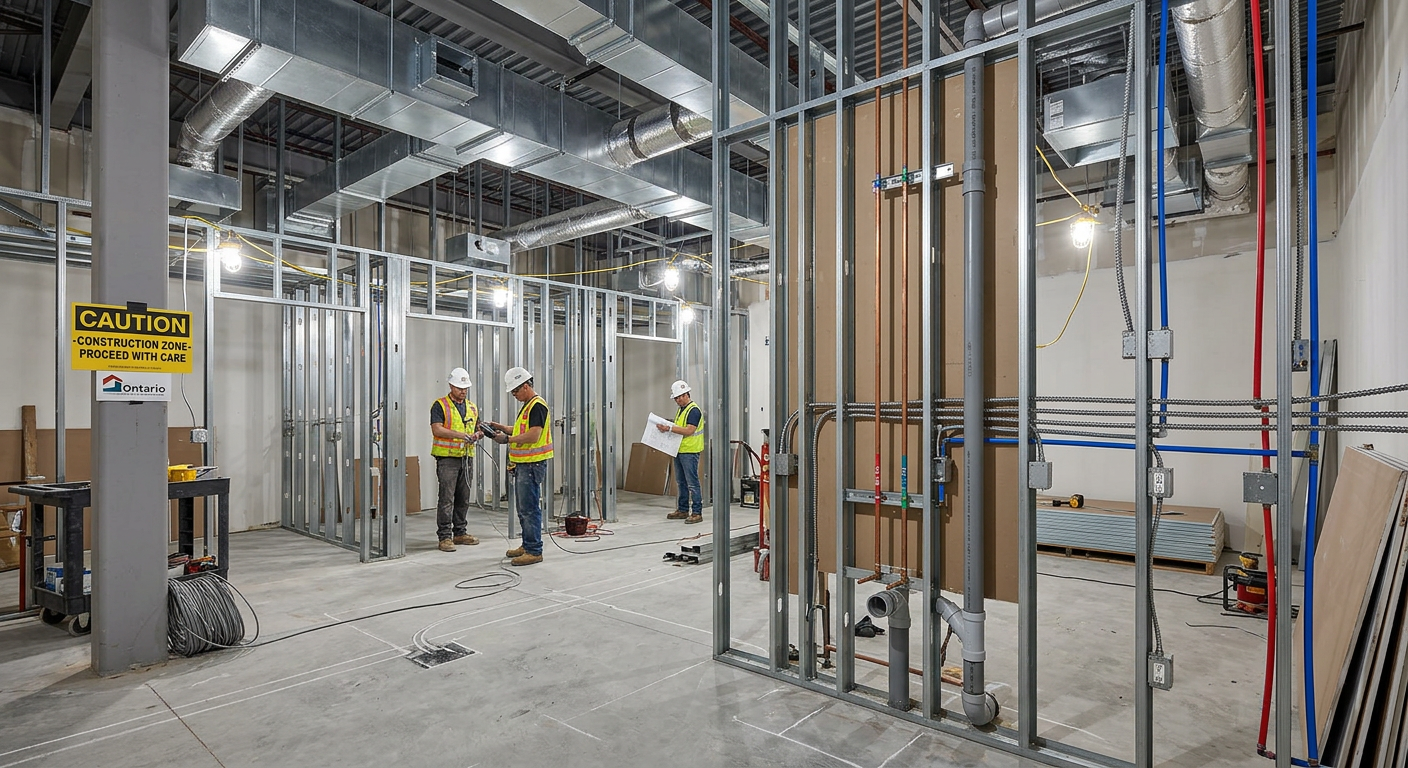
MEP systems account for 30–45% of total healthcare renovation cost — a proportion that is significantly higher than in standard commercial renovation (typically 20–30%). Healthcare-specific MEP costs that drive above-average cost per square foot include: individual HVAC zones per exam room (versus open-plan commercial HVAC), medical gas systems (piped oxygen and suction), specialized electrical for therapeutic equipment (isolated circuits, clean power for audiometry, high-draw circuits for HVAC and imaging), and plumbing for clinical sinks in every exam room (versus one kitchen and a washroom per floor in a standard commercial office). Clinics with extensive MEP scope — multiple procedure rooms, medical gas, specialized HVAC — have MEP costs of $90–$180 per square foot, which alone represent a significant portion of the total renovation cost.
Regulatory compliance requirements specific to the clinic type add cost that does not appear in standard commercial construction. Examples: RCDSO X-ray room shielding costs $35,000–$75,000 per room (dental); CSA Z8000 sterile processing room requirements add $60,000–$150,000 to a surgical suite; CASLPA audiometric room acoustic construction costs $45,000–$120,000 (audiology). When the regulatory compliance cost is spread over the clinic’s total square footage, it appears as an elevated cost per square foot that may seem inexplicable without understanding its source. A 1,500 square foot audiology clinic with a $90,000 acoustic testing room has a $60/sq ft cost premium attributable entirely to that single compliance requirement.
Labour costs vary across the GTA — unionized trades in the City of Toronto command higher wages than non-unionized trades in suburban municipalities, and the urban premium for City of Toronto construction is estimated at 8–18% above comparable suburban construction costs. Material costs are broadly consistent across the GTA for standard materials; specialty healthcare materials are typically sourced from the same suppliers regardless of municipality. The GTA location premium is most pronounced for high-labour-intensity projects (acoustic room construction, complex MEP installation, detailed millwork) and minimal for material-intensive projects (structural work, standard flooring).
| Clinic Type | Low ($/sq ft) | Mid ($/sq ft) | High ($/sq ft) | Primary Cost Driver |
|---|---|---|---|---|
| GP / Family Medicine (standard) | $155 | $210 | $290 | Exam room count, sink rough-in, AODA |
| Walk-In Clinic (high volume) | $130 | $180 | $240 | Patient flow efficiency, high traffic durability |
| Physiotherapy & Rehabilitation | $150 | $220 | $330 | Gym flooring/anchors, accessible shower, modality electrical |
| Dental Office | $220 | $295 | $420 | Dental unit rough-in, X-ray shielding, sterilization room |
| Audiology Clinic | $195 | $275 | $380 | Acoustic testing room construction |
| Veterinary Clinic | $175 | $245 | $360 | Surgical HVAC, species separation, kennels |
| Ophthalmology | $210 | $290 | $410 | Dark room, specialized equipment rough-in, precision lighting |
| Minor Surgical Suite | $280 | $370 | $520 | HEPA HVAC, medical gas, positive pressure, sterile field |
| Pharmacy (dispensing + clinical) | $170 | $235 | $320 | Dispensary casework, controlled substance storage, consultation room |
| Specialist Medical (general) | $185 | $255 | $375 | Varies by specialty — procedure rooms drive cost |
When planning a mixed-use clinic, room-by-room cost per square foot benchmarks allow a more accurate bottom-up budget than applying a single per-square-foot rate to the whole space. The following table provides 2026 GTA benchmarks for each major room type in a medical clinic.
| Room Type | Typical Size (sq ft) | Cost per Sq Ft | Total Room Cost (mid-range) |
|---|---|---|---|
| Standard physician exam room | 120–170 | $195–$260 | $28,000–$45,000 |
| Minor procedure room | 150–200 | $280–$400 | $50,000–$80,000 |
| Sterile processing / sterilization room | 80–120 | $320–$480 | $32,000–$58,000 |
| Reception and check-in | 100–200 | $130–$200 | $17,000–$40,000 |
| Waiting area | 150–400 | $100–$165 | $18,000–$66,000 |
| Nurses’ station / central work core | 100–200 | $180–$280 | $22,000–$56,000 |
| Clean utility room | 60–100 | $220–$320 | $16,000–$32,000 |
| Dirty utility / soiled holding | 60–100 | $240–$360 | $17,000–$36,000 |
| Staff washroom (standard) | 50–80 | $200–$300 | $12,000–$24,000 |
| Accessible patient washroom | 80–120 | $240–$380 | $22,000–$46,000 |
| Physiotherapy gym (per sq ft) | 600–2,000 | $130–$200 | $96,000–$400,000 total |
| Audiometric test room (built-in) | 120–200 | $380–$600 | $55,000–$120,000 |
| Dental operatory | 120–160 | $320–$450 | $46,000–$72,000 |
| Dental sterilization room | 80–120 | $300–$420 | $28,000–$50,000 |
| Corridor (clinical-grade finishes) | N/A | $90–$140 | Per linear foot × width |
Not every clinic needs a complete renovation to every room simultaneously. Understanding what each budget level delivers helps clinic owners prioritize investment and avoid over-building spaces that are not yet needed for their clinical program.
| Scope Level | $/sq ft Range | What’s Included | What’s Excluded |
|---|---|---|---|
| Level 1: Cosmetic Refresh | $60–$95 | Paint, flooring replacement, lighting upgrades, millwork refinishing | No MEP changes, no structural changes |
| Level 2: Functional Upgrade | $110–$165 | New finishes, minor MEP updates, reception redesign, AODA fixtures | No structural changes, minimal HVAC |
| Level 3: Standard Renovation | $160–$240 | Full finishes, clinical MEP (sinks, electrical), HVAC zone update, AODA compliance | No medical gas, no specialized HVAC |
| Level 4: Full Medical Fit-Out | $240–$350 | All Level 3 plus medical gas rough-in, specialized HVAC, procedure room | No surgical-grade positive pressure |
| Level 5: Specialty/Surgical Grade | $350–$600+ | All Level 4 plus laminar flow HVAC, HEPA filtration, X-ray shielding, acoustic rooms | Nothing — this is full clinical grade |
Most GTA clinic owners budget at the mid-range benchmark for their clinic type — only to encounter cost growth during construction. Understanding what specific items drive cost above the mid-range allows clinic owners to identify and manage the risk factors before contracting.
Older GTA commercial buildings — particularly those built or renovated before 1990 — frequently contain asbestos in floor tile adhesive, pipe insulation, and ceiling tile, and lead paint on trim surfaces. Discovery during construction triggers mandatory abatement under Ontario Regulation 278/05 (Designated Substance — Asbestos) and O. Reg. 490/09 (Designated Substances — Lead). Abatement costs in a typical GTA medical clinic renovation: $12,000–$65,000 depending on the extent of contamination and the scope of removal required. A building environmental assessment (Phase 1 and hazardous materials assessment) before demolition begins costs $2,500–$8,000 and eliminates construction-phase surprises. For any building constructed before 1990, this assessment is standard practice in healthcare renovation — and its cost is trivially small relative to the abatement surprise it prevents.
Leased commercial spaces in multi-tenant buildings frequently have structural constraints that limit medical clinic renovation options — and add cost when those limits are encountered. The most common constraints: insufficient load-bearing capacity for heavy dental or audiology equipment (the structural slab may not support an autoclave, dental chair, or acoustic booth without reinforcement), concrete slab that cannot be penetrated for floor drains or medical gas penetrations without structural engineer approval, and HVAC shafts that are positioned in locations that conflict with the medical clinic layout. Structural constraint discovery costs $3,000–$12,000 to assess and an additional $15,000–$80,000 to remediate, depending on scope. A pre-construction structural assessment by a structural engineer costs $1,500–$4,000 and identifies constraints before commitments are made to floor plans that cannot be built as designed.
The existing building HVAC system may lack the capacity to serve a medical clinic’s airflow requirements. Standard commercial HVAC systems are designed for 1 person per 100–200 square feet in an office environment; medical clinics with high patient density, procedure rooms requiring specific air change rates, and individual exam room zone control require significantly higher airflow capacity. If the building HVAC cannot be upgraded to medical clinic standards, a supplementary dedicated HVAC system for the clinic is required — an additional cost of $45,000–$120,000 that was not in the original budget. A mechanical engineer’s assessment of the building HVAC system before lease signing costs $2,000–$5,000 and determines whether the existing system can accommodate the clinical program. For clinics with specialized HVAC requirements — procedure rooms, audiology booths, dental operatories — this assessment is not optional.
The most accurate pre-tender budget for a medical clinic renovation is built from the bottom up — starting with the specific rooms in the renovation scope, applying the appropriate per-square-foot rate for each room type, and adding the MEP scope estimate separately rather than averaging it across the whole footprint.
List every room in the renovation scope with its area in square feet, its clinical intensity level (waiting area, exam room, procedure room, utility room), and the renovation scope level for that room (cosmetic refresh, functional upgrade, full medical fit-out). This becomes the framework for the budget.
Apply the per-square-foot benchmark from the room-type table above to each room in the inventory. Use the mid-range figure for budgeting — not the low end (which represents ideally priced projects with no complications) and not the high end (which represents complex urban projects with specialty requirements). The mid-range is the realistic planning figure for a GTA clinic renovation with typical complexity.
Medical gas rough-in, X-ray shielding, acoustic room construction, and other specialty systems should be line-itemed separately rather than averaged into the per-square-foot rate. Each has a project-specific cost that is more accurately estimated from the system’s scope than from the clinic’s square footage. Add these as fixed project costs to the room-by-room subtotal.
A 15% contingency on the total of steps 2 and 3 is the minimum appropriate contingency for a medical clinic renovation. Clinics in buildings built before 1990 (asbestos risk) or with known MEP constraints should use 20%. The contingency is not a padding that will necessarily be spent — it is a risk reserve for the cost items described in the previous section. Projects that finish under budget have their contingency returned; projects that encounter discoveries without contingency generate financial distress and change order conflicts.
Soft costs — architectural fees, engineering fees, permit fees, specialty consultant fees (IPAC, acoustics, structural), and furniture/equipment — typically add 18–28% to the construction cost of a medical clinic renovation. Architecture and engineering fees alone are 8–14% of construction cost for a well-scoped medical renovation. Include these as a separate line in the budget; they are frequently omitted in early-stage budgeting and create surprise when invoices arrive from the design team.
| Municipality | Labour Premium | $/sq ft Adjustment (vs. York Region base) | Notes |
|---|---|---|---|
| City of Toronto (416) | +8–18% | +$15–$35/sq ft | Unionized trades, higher overhead, traffic/access premiums |
| Mississauga | +3–8% | +$5–$15/sq ft | Competitive contractor market; good labour pool |
| Brampton | +0–5% | +$0–$10/sq ft | Growing construction market; strong competition |
| Markham / Richmond Hill | Baseline | $0 adjustment | Benchmark municipality for comparison |
| Vaughan | +0–5% | +$0–$10/sq ft | Active development corridor; competitive |
| Newmarket / Aurora | -0–5% | -$0–$10/sq ft | Lower overhead costs north of 407 |
Per-square-foot benchmarks are more useful when grounded in complete project examples. The following scenarios represent composite GTA renovation projects from 2024–2026, showing how all-in costs (construction plus soft costs plus contingency) are built from the room-by-room approach.
| Component | Area / Unit | Rate | Cost |
|---|---|---|---|
| 2 exam rooms (functional upgrade) | 300 sq ft | $200/sq ft | $60,000 |
| Reception and waiting area | 350 sq ft | $140/sq ft | $49,000 |
| Accessible patient washroom | 90 sq ft | $300/sq ft | $27,000 |
| Staff washroom | 60 sq ft | $220/sq ft | $13,200 |
| Corridors and support areas | 400 sq ft | $110/sq ft | $44,000 |
| Construction subtotal | 1,200 sq ft | $160/sq ft avg | $193,200 |
| 15% contingency | — | — | $29,000 |
| Architecture + engineering (10%) | — | — | $19,300 |
| Permit fees | — | — | $4,800 |
| Furniture and equipment | — | — | $28,000 |
| TOTAL ALL-IN | — | $229/sq ft | $274,300 |
| Component | Area / Unit | Rate | Cost |
|---|---|---|---|
| 6 exam rooms (full medical fit-out) | 900 sq ft | $235/sq ft | $211,500 |
| Minor procedure room | 160 sq ft | $340/sq ft | $54,400 |
| Nurses’ station and central core | 180 sq ft | $240/sq ft | $43,200 |
| Reception and waiting area | 400 sq ft | $150/sq ft | $60,000 |
| Clean and dirty utility rooms | 140 sq ft | $280/sq ft | $39,200 |
| Accessible washroom (1) | 100 sq ft | $320/sq ft | $32,000 |
| Corridors and support areas | 520 sq ft | $120/sq ft | $62,400 |
| Construction subtotal | 2,400 sq ft | $210/sq ft avg | $502,700 |
| 15% contingency | — | — | $75,400 |
| Architecture + engineering (12%) | — | — | $60,300 |
| Permit fees | — | — | $8,500 |
| IPAC consultant | — | — | $4,200 |
| Furniture and equipment | — | — | $45,000 |
| TOTAL ALL-IN | — | $290/sq ft | $696,100 |
| Component | Area / Unit | Rate | Cost |
|---|---|---|---|
| 4 dental operatories (full fit-out) | 600 sq ft | $385/sq ft | $231,000 |
| Sterilization room (RCDSO compliant) | 110 sq ft | $390/sq ft | $42,900 |
| X-ray room (1) with HARP Act shielding | Fixed scope | Fixed | $55,000 |
| Reception and waiting area | 350 sq ft | $155/sq ft | $54,250 |
| Accessible washroom | 90 sq ft | $310/sq ft | $27,900 |
| Corridors and support areas | 650 sq ft | $120/sq ft | $78,000 |
| Shell space MEP base rough-in premium | 1,800 sq ft | +$95/sq ft | $171,000 |
| Construction subtotal | 1,800 sq ft | $367/sq ft avg | $660,050 |
| 20% contingency (shell space + dental risk) | — | — | $132,000 |
| Architecture + engineering (10%) | — | — | $66,000 |
| RCDSO permit and dental equipment coordination | — | — | $6,500 |
| Dental equipment (chairs, unit rough-in) | — | — | $180,000 |
| Permit fees + radiation safety consultant | — | — | $9,200 |
| TOTAL ALL-IN | — | $585/sq ft | $1,053,750 |
The most common budget error Ontario clinic owners make is using residential renovation cost benchmarks — or general commercial office benchmarks from online sources — as the starting point for a medical office renovation budget. Residential bathroom renovation costs ($350–$900 per square foot including all fixtures and finishes) bear no relationship to medical exam room costs. Commercial office renovation costs ($100–$180/sq ft for a standard office) are systematically lower than medical office costs because they exclude the clinical MEP, infection control materials, regulatory compliance, and specialized contractor overhead that define healthcare construction. The Scarborough specialist clinic case study at the opening of this guide — a $490,000 overrun — resulted entirely from applying a commercial office benchmark ($203/sq ft) to a medical specialty clinic project ($356/sq ft actual). The solution: use only medical office renovation benchmarks for medical office renovation budgeting, even if the clinic looks similar to a regular office from the outside.
Soft costs — architecture, engineering, permits, specialty consultants, and clinical equipment — add 25–35% to the construction cost of a medical office renovation and are frequently omitted in early-stage budget presentations. A $500,000 construction budget becomes a $625,000–$675,000 total project budget when soft costs are added. Clinic owners who approve renovations based on construction-only quotes and then encounter $80,000–$120,000 in architecture, engineering, and permit costs on top of the contractor price experience the omission as a surprise cost overrun — even though the costs were entirely predictable. Always build the budget including all soft costs from the first planning estimate. If the architecture and engineering team is not yet engaged, use 25% of the expected construction cost as a soft cost placeholder — it is conservative enough to absorb actual costs in most projects.
Construction costs include the physical structure — walls, floors, ceilings, MEP systems — but not the furniture, medical equipment, and technology that make the clinic functional. For a GP office, furniture and equipment add $25,000–$80,000 (exam tables, reception desk, patient seating, EMR hardware, diagnostic equipment). For a dental office, the dental chairs, digital X-ray systems, and cabinetry add $150,000–$350,000 — a cost that rivals the construction budget for a smaller clinic. For an audiology clinic, the audiometer, immittance equipment, and hearing aid dispensary display add $60,000–$150,000. Clinic owners who plan renovation budgets without these line items consistently discover that the total project cost is 25–45% higher than their construction budget. The business case for a clinic renovation investment must be built on total project cost, not construction cost alone.
Requesting contractor bids before architectural drawings are complete — based on a description or a sketch — produces bids that are not comparable and not accurate. Each bidding contractor makes different assumptions about specification level, MEP scope, and compliance requirements, producing a range of bids that cannot be compared on a like-for-like basis. The lowest bid in a vague-scope tender process almost always reflects the most optimistic assumptions about what is included — generating the change orders that produce project cost overruns. The solution: complete architectural and engineering drawings before requesting bids. Bids on complete drawings are comparable (bidders see the same scope), accurate (drawings define what is included and excluded), and produce fewer change orders (changes are identified during design, not during construction). The architecture and engineering fee spent on complete drawings before tendering is recovered many times over in reduced change order exposure.
When a contractor quotes a per-square-foot price before seeing complete drawings, the number is an estimate — and estimates vary by what assumptions the contractor makes. Asking these questions when receiving a per-square-foot quote reveals whether the number is a realistic estimate or an optimistic opening bid.
Ask the contractor: “Does this per-square-foot rate include individual HVAC zone control per exam room, clinical-grade seamless flooring in all exam rooms, and a clinical sink in every exam room?” A contractor who says “yes” to all three and whose rate is $150/sq ft is making assumptions that will generate change orders. A contractor who says “yes” to all three with a rate of $210–$250/sq ft is reflecting realistic clinical construction costs. A contractor who hedges these three items is excluding clinical-specific costs from the estimate — costs that will appear as change orders when the drawings reveal the actual requirements.
MEP scope is the most variable element in a medical office per-square-foot quote. Ask specifically: “Does this rate include the cost of upgrading from the existing HVAC to individual zone control for each exam room?” and “Does it include new plumbing rough-in for sinks in every exam room, or just the existing plumbing connections?” Answers that include full MEP upgrade reflect accurate medical clinic costs. Answers that assume the existing systems will be reused reflect an optimistic estimate that may not match the actual site conditions. A mechanical engineer’s site assessment before tendering ($2,000–$5,000) confirms existing system capacity and eliminates this variable from the bid comparison.
Ask: “Does this rate include IPAC-compliant flooring and wall finishes in all clinical rooms?” and, for applicable clinic types, “Does this include the X-ray shielding installation?” or “Does this include the acoustic room construction to STC-60?” Contractors who have managed compliant healthcare renovations will immediately recognize these questions and answer specifically. Contractors who have not managed these compliance requirements will give vague answers — a signal that their per-square-foot estimate does not include the compliance costs and will generate change orders when the regulatory requirements are clarified during design. The goal of these questions is not to catch the contractor; it is to ensure that the estimate being compared includes the same scope as the actual project will require.
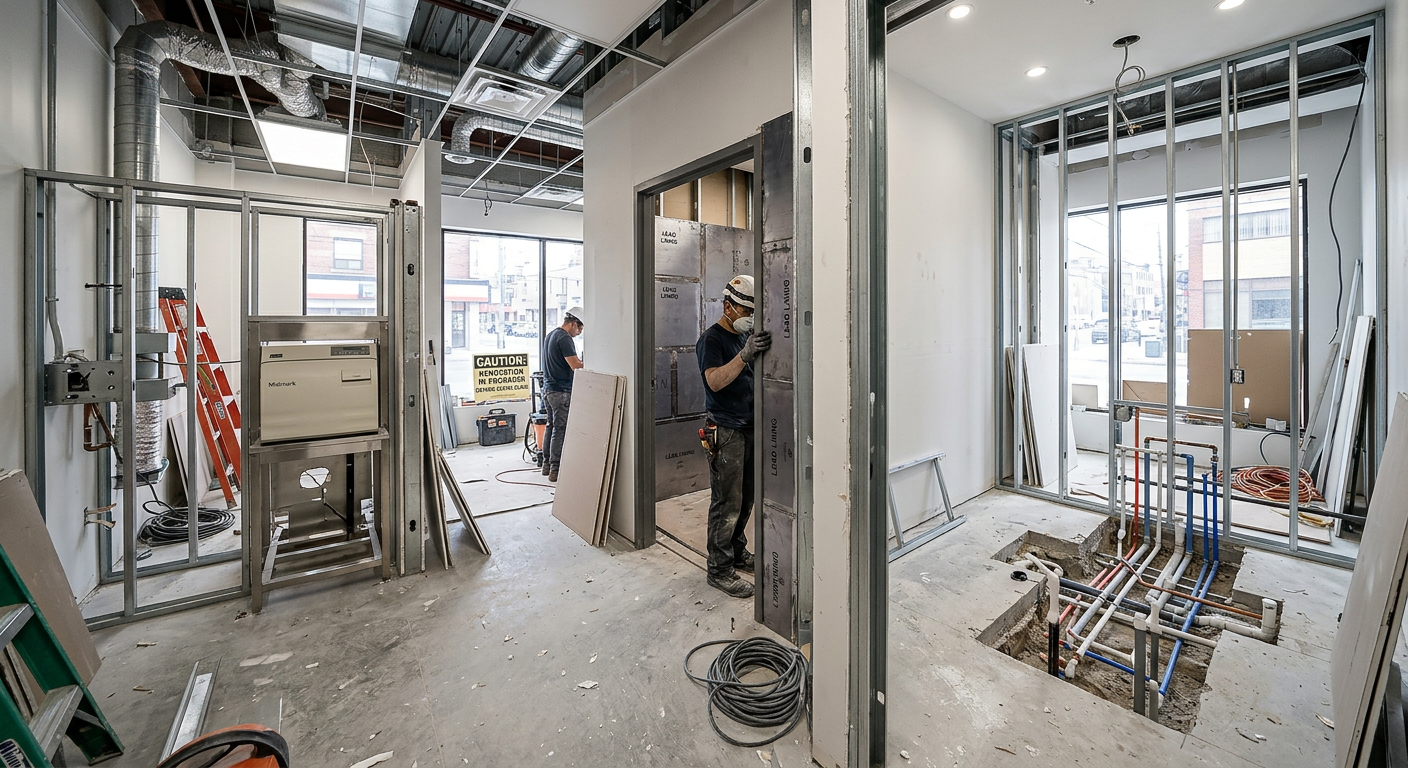
Ontario clinic owners who select the lowest per-square-foot quote consistently experience total project costs that exceed what the mid-range bidder would have delivered. The pattern is consistent across the GTA: the lowest bidder’s omissions and exclusions generate change orders that close the gap between their initial quote and the mid-range bidder’s price — while adding the disruption, delay, and stress of change order negotiation during active construction. Three representative GTA case studies illustrate the pattern.
A Vaughan walk-in clinic selected a contractor bidding $145/sq ft over a mid-range bidder at $190/sq ft for a 2,200 square foot renovation. The low bid “excluded HVAC zone modifications” and assumed “existing plumbing connections will be reused.” The existing plumbing connections were not in the exam room locations required by the new layout, and the HVAC system had no individual zone capability. Change orders for HVAC zone control and plumbing relocation: $68,000. Final project cost per square foot: $176/sq ft. Higher than the $190/sq ft mid-range bidder’s base price — and the project took 6 additional weeks to complete due to subcontractor scheduling conflicts after the change orders were approved. The clinic owner estimates the 6-week delay cost approximately $55,000 in lost revenue from the opened but under-equipped clinic.
A Mississauga dental office selected a contractor bidding $240/sq ft for a 1,600 square foot renovation, over a dental construction specialist bidding $295/sq ft. The low bidder had no specific dental renovation experience. Major change orders: dental unit rough-in required relocation ($14,000) because the contractor did not verify dimensions with the dental equipment technician before roughing in; X-ray room shielding required additional lead lining ($22,000) because the initial shielding spec was based on the wrong HARP Act calculation; sterilization room required a second sink (clean/dirty zone requirement) not in the original scope ($8,500). Total change orders: $44,500. Final cost: $268/sq ft — only $27/sq ft below the dental specialist’s bid, without any of the dental-specific project management the specialist would have provided. RCDSO compliance inspection found two deficiencies at first inspection.
A Richmond Hill physiotherapy clinic selected a contractor at $155/sq ft for a 1,800 square foot renovation including a gym. The contractor had general medical clinic experience but no physiotherapy gym background. Change orders: gym flooring specification upgrade from 6mm standard rubber tile to 12mm vulcanized rubber roll after the clinic owner read the liability implications ($12,000 materials cost increase, $4,000 additional installation cost); equipment anchor engineering review and anchor replacement after contractor installed standard anchor bolts ($8,200 structural engineer review plus anchor replacement); accessible shower reconstruction after AODA consultant identified non-compliant slope and missing fold-down seat ($28,000 full shower demolish and rebuild). Total change orders: $52,200. Final cost: $184/sq ft — only $16/sq ft less than the experienced healthcare contractor’s $200/sq ft bid, with six weeks of additional construction time, a demolished and rebuilt shower, and an equipment anchor liability scare that required the clinic’s insurer to be notified.
Not all renovation decisions cost the same per square foot, but some decisions deliver disproportionate value relative to their cost. Understanding which investments offer the best return — in clinical productivity, regulatory compliance, and long-term facility quality — helps clinic owners prioritize within a fixed renovation budget.
Individual HVAC zone control per exam room ($3,500–$8,000 per room additional cost over shared zone) delivers immediate operational return through improved patient thermal comfort, better acoustic isolation between rooms, and individual room temperature control that reduces staff complaints and patient satisfaction scores. This investment costs $7,000–$16,000 additional for a 2-exam-room renovation and saves $15,000–$30,000 if it must be retrofitted post-construction. The return is both immediate (clinical operations) and financial (avoidance of retrofit cost). Clinical sinks in every exam room ($4,500–$8,500 per room plumbing rough-in) are similarly high-return: they satisfy IPAC requirements, eliminate mid-renovation change orders, and save the $6,000–$12,000 retrofit cost if discovered post-construction to be non-compliant.
AODA compliance elements specified during the renovation — accessible counter, power door operator, accessible washroom with blocking — cost 40–60% less than retroactive installation after construction. The power door operator ($3,500–$6,500 installed) at the reception counter is a clear example: installing blocking and rough conduit during renovation for a future power door operator costs $400–$800; adding the power door operator later at full installation cost is $3,500–$6,500. Installing the blocking costs $400. Not installing it costs $3,500 when a non-compliant entrance is identified. All AODA compliance elements that can be anticipated should be built in during the renovation, even if the AODA deadline for the element has not yet passed — the construction-time cost is always lower than the retrofit cost.
Premium finish upgrades — higher-end flooring materials, custom millwork finishes, feature walls, designer lighting fixtures — have a lower cost-per-dollar-of-patient-impression than clinical infrastructure investments. A $15,000 premium on reception millwork versus standard millwork is visible to patients for the few seconds they interact with the reception desk; a $15,000 investment in better acoustic partitions between exam rooms is felt by every patient for the duration of their consultation. Clinical facilities research consistently shows that acoustic privacy in clinical rooms has higher patient satisfaction impact than aesthetic finishes in common areas — yet most clinic renovation decisions allocate premium budget to visible finishes rather than invisible infrastructure. Prioritize clinical infrastructure (MEP, HVAC, acoustic) over aesthetic premium before allocating any remaining budget to finishes.
| Surface Category | Standard Commercial | Healthcare Baseline | Healthcare Premium |
|---|---|---|---|
| Flooring (per sq ft installed) | $6–$14 (LVT, carpet) | $12–$22 (welded vinyl, rubber) | $18–$35 (poured epoxy, MMA resin) |
| Wall finish (per sq ft) | $1–$3 (latex paint) | $2–$5 (alkyd paint, semi-gloss) | $8–$18 (FRP panels, solid surface) |
| Ceiling (per sq ft installed) | $4–$8 (lay-in tile) | $8–$16 (vinyl-faced tile, drywall) | $14–$28 (medical-grade cleanroom) |
| Countertops (per linear ft installed) | $35–$65 (laminate) | $90–$160 (solid surface) | $120–$280 (stainless steel, quartz) |
| Doors (per unit installed) | $800–$1,500 (hollow metal) | $1,200–$2,500 (antimicrobial HM) | $4,500–$9,000 (acoustic STC-50+) |
| Hardware (per door set) | $80–$200 (standard lever) | $180–$400 (antimicrobial coating) | $350–$800 (hands-free, wave sensor) |

Legitimate cost-saving strategies in medical office renovation reduce construction cost without creating IPAC compliance risk, AODA non-compliance, or regulatory deficiencies that generate remediation costs. Three strategies consistently deliver meaningful savings without downstream risk.
Rather than renovating the entire clinic to full medical fit-out standard simultaneously, a priority-zone approach renovates the high-clinical-intensity spaces (exam rooms, procedure room) to full standard while deferring lower-intensity spaces (waiting area, staff offices) to a second phase. This approach concentrates the budget where clinical compliance requires it, and defers cosmetic upgrade costs to a later phase when the practice’s revenue from the newly compliant clinical spaces can fund the second phase. A 2,400 square foot clinic that renovates its 6 exam rooms and procedure room in Phase 1 ($350,000) and defers its reception and waiting area refresh to Phase 2 ($80,000 in 18 months) spends $430,000 total instead of $520,000 upfront — a $90,000 deferral that allows the practice to open faster with a smaller initial capital commitment.
The single most effective cost-saving strategy in medical office renovation is completing full architectural and engineering drawings before tendering to contractors. Complete drawings produce competitive bids that are comparable on a like-for-like basis, eliminate the change order risk that inflates project costs by 15–30% when scope is undefined, and give the clinic owner negotiating leverage because multiple contractors are bidding the same defined scope. The architecture and engineering investment (8–12% of construction cost) is recovered through reduced change orders and competitive pricing that full-scope bidding produces. Clinic owners who invest in complete drawings consistently report final project costs that are closer to their initial budgets than clinic owners who bid on sketches or descriptions.
The average cost per square foot for a medical office renovation in Ontario — across all clinic types and renovation scopes — is approximately $185–$265 per square foot for construction costs (excluding furniture, equipment, architecture, and permits). This average obscures the wide range by clinic type: walk-in clinics renovate at $130–$240/sq ft, GP offices at $155–$290/sq ft, and surgical suites at $350–$600+/sq ft. The average is a useful planning order of magnitude for a mixed-use GP or specialist clinic renovation, but should be replaced by a room-by-room bottom-up estimate as soon as the renovation scope is defined.
Building a medical office from a shell space (bare concrete floor, exposed structure, no mechanical, electrical, or plumbing) costs $220–$380 per square foot in the GTA for a standard primary care clinic (GP, family medicine, specialist). The shell space premium — the additional cost over renovating an existing medical space — is approximately $75–$120 per square foot, reflecting the full MEP rough-in required from the base building connection points. A 2,000 square foot GP office built from shell space costs $440,000–$760,000 all-in including soft costs, versus $320,000–$560,000 for the same clinic renovated from an existing medical space with clinical infrastructure in place.
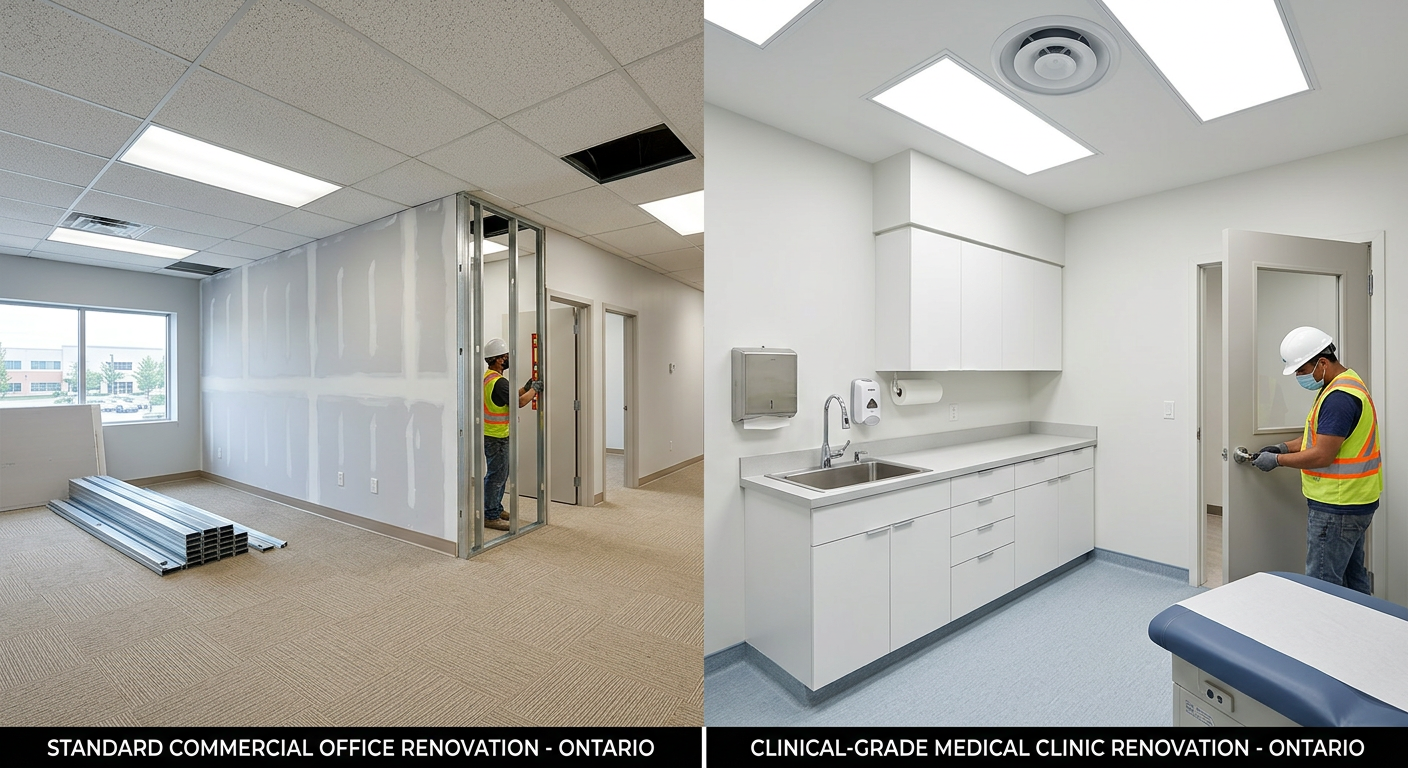
Medical office renovation costs 40–80% more per square foot than standard commercial office renovation of equivalent size. The premium is accounted for by: clinical-grade flooring (seamless, non-porous surfaces cost $22–$45/sq ft vs. $6–$15/sq ft for standard commercial), individual HVAC zones per exam room (clinical privacy and air change requirements), clinical sinks in every exam room (plumbing rough-in that a commercial office does not have), medical-grade electrical (isolated circuits, GFCI in clinical areas), regulatory compliance costs (IPAC, AODA, college-specific standards), and a smaller contractor market with specialized skills that commands higher overhead. The cost premium is not inefficiency — it reflects the genuine additional technical requirements of a clinical environment.
Before engaging an architect, you can obtain a rough order-of-magnitude estimate using the benchmarks in this guide: inventory your rooms, apply the mid-range per-square-foot rate for each room type, add estimated specialty system costs, add 20% contingency, and add 25% for soft costs. This gives a rough total within 20–35% of the actual project cost — accurate enough for business case purposes and space planning decisions. For any figure above $300,000, engage a healthcare architect or quantity surveyor to produce a conceptual estimate with a 15% accuracy range before committing to a lease, a space purchase, or a contractor selection process. The $3,000–$8,000 cost of a professional pre-design estimate on a $500,000+ renovation is always recovered in the accuracy of the budget and the confidence it provides in the business case.
The per-square-foot costs in this guide represent construction costs only — labour, materials, subcontractor work, and general contractor overhead and profit. They exclude: furniture and built-in millwork that is custom-designed and ordered separately (exam tables, reception desks, waiting room seating — budget $15,000–$80,000 separately depending on scope), medical equipment and technology (EMR hardware, diagnostic equipment, modality devices — budget separately from renovation), architectural and engineering fees (8–14% of construction cost), permit fees (1–3% of construction cost in most GTA municipalities), and specialty consultant fees (IPAC, acoustic, structural, accessibility — $5,000–$20,000 cumulative depending on scope). A total project budget for a medical clinic renovation adds all of these to the construction cost estimate.
GTA medical clinic renovation costs in 2026 are approximately 6–9% higher than 2024 costs, reflecting continued construction labour cost inflation in Ontario (wage agreements negotiated in 2024–2025 across most trades), moderate materials price increases (particularly mechanical and electrical materials), and persistent strong demand for healthcare construction in the GTA market. The 2024–2026 period has been characterized by a high volume of post-pandemic clinic expansion and renovation activity across Ontario, which has kept contractor backlogs elevated and maintained upward pressure on pricing. Clinic owners who planned their renovation budgets in 2023–2024 should apply a 10–15% escalation factor to those estimates before using them for 2026 planning purposes.
The Mississauga walk-in clinic opened 40 minutes late on its first Monday morning. Twenty-three patients were waiting outside when the staff arrived — a...
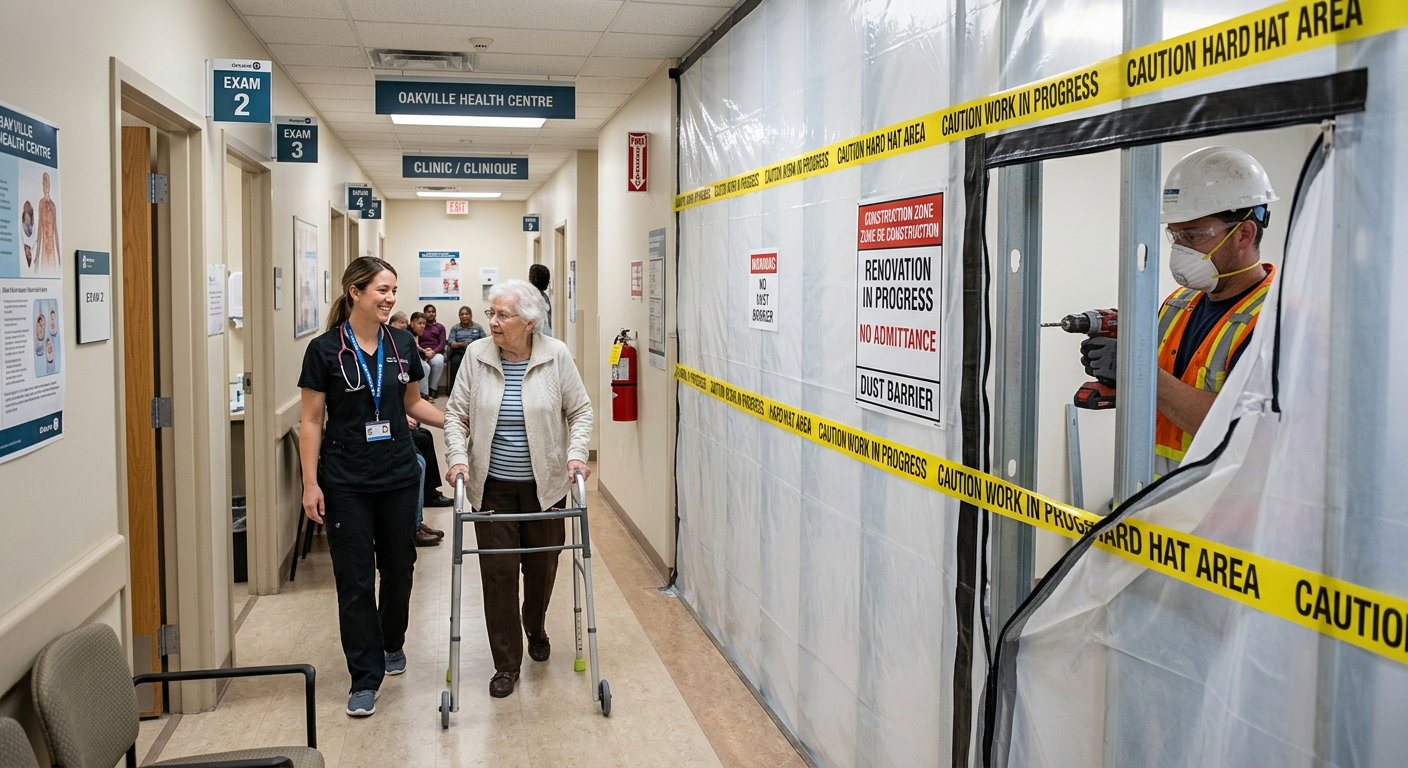
The Brampton family medicine clinic closed completely for its renovation. The decision seemed straightforward at the time: a complete 10-week closure would allow the...
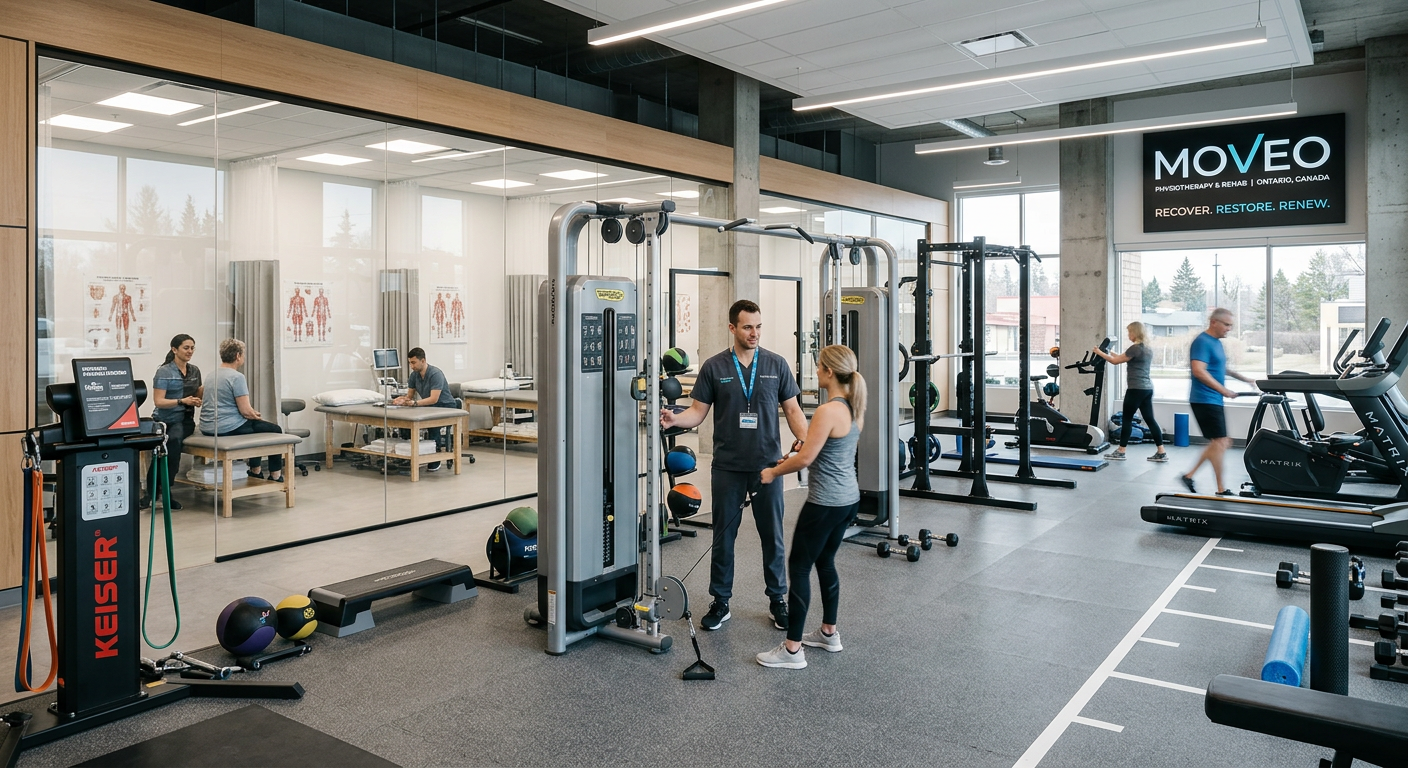
The Newmarket physiotherapy clinic had a problem that its owner did not discover until the first patient used the exercise gym. The clinic had...