
March 13, 2026

The Mississauga walk-in clinic opened 40 minutes late on its first Monday morning. Twenty-three patients were waiting outside when the staff arrived — a...
The Newmarket physiotherapy clinic had a problem that its owner did not discover until the first patient used the exercise gym.
The clinic had opened after a $280,000 renovation that the physiotherapist-owner had commissioned from a contractor with general medical clinic experience. The renovation looked excellent: clean private treatment rooms, a new modality suite, a modern reception area. But the gym floor — a standard 6mm rubber flooring product installed over a concrete slab — began to show seam lifting within three months in the high-traffic zone near the cable machine. More significantly, the cable machine anchor bolts that had been installed into the concrete slab were pulling under load — the contractor had used standard anchor bolt specifications without accounting for the dynamic loading of patients performing resisted cable exercises. An 82-year-old patient performing a cable row exercise had the handle and cable snap free when the anchor pulled, causing a shoulder injury. The subsequent litigation cost the clinic $127,000 in legal fees and settlement. The anchor retrofit — proper sleeve anchors at correct depth and spacing for dynamic equipment loading — cost $4,200. The insurance premium increase following the claim cost $8,400 per year for three years. Total cost of using an unqualified contractor for a physiotherapy gym fit-out: $152,000 above the original renovation budget. The physiotherapist-owner describes the experience as “the most expensive lesson in contractor qualification I could have received.”
This guide covers the technical, regulatory, and design requirements for physiotherapy and rehabilitation clinic renovation in Ontario — CASLPO considerations, gym space engineering, treatment room specifications, modality room electrical requirements, accessible shower and change room design, and GTA cost benchmarks for 2026.
Physiotherapy clinic renovation in Ontario is governed by four regulatory frameworks: the College of Physiotherapists of Ontario (CPO), which licenses physiotherapists and sets practice standards; the Ontario Building Code (OBC), which governs construction; the Accessibility for Ontarians with Disabilities Act (AODA), which mandates accessible design; and Public Health Ontario’s IPAC guidelines, which establish infection control standards for clinical spaces. Unlike dental offices or medical clinics, physiotherapy clinics are not subject to routine facility inspections by the CPO — but CPO practice standards set expectations for treatment environment standards that create liability exposure if not met.
The CPO’s practice standards address treatment environment quality through requirements for: patient privacy during treatment (private treatment rooms or partitioned treatment spaces with adequate visual and acoustic privacy), infection prevention and control standards consistent with PHO IPAC guidelines, safe patient handling (surfaces and equipment that do not create slip, trip, or fall hazards), and equipment safety (exercise equipment that is properly anchored, rated for patient loads, and regularly inspected). While the CPO does not prescribe specific construction specifications, its privacy and safety requirements translate into construction standards that a physiotherapy clinic renovation must meet. CPO standards also reference Ontario Regulation 856 (Physiotherapy Act, 1991) which governs the use of designated acts — including specific treatment modalities — in ways that influence the spatial and equipment requirements of the clinic.
AODA compliance in physiotherapy clinics has heightened significance relative to other healthcare settings because physiotherapy patients disproportionately include individuals with mobility impairments, post-surgical limitations, and chronic conditions that affect ambulation. A physiotherapy clinic that is not fully wheelchair accessible is inaccessible to a substantial portion of its target patient population — a business failure as much as a regulatory one. Specific AODA requirements for physiotherapy clinics include: accessible entry and accessible route through all patient areas, accessible reception counter, accessible washroom, accessible change room with a turning radius sufficient for a powered wheelchair (minimum 1,500mm clear), and accessible shower if showers are provided for patients. The accessible shower specification for a physiotherapy clinic is more demanding than a standard accessible washroom: it requires a roll-in shower (no threshold), a fold-down shower seat, grab bars, and a handheld showerhead with adjustable bracket.
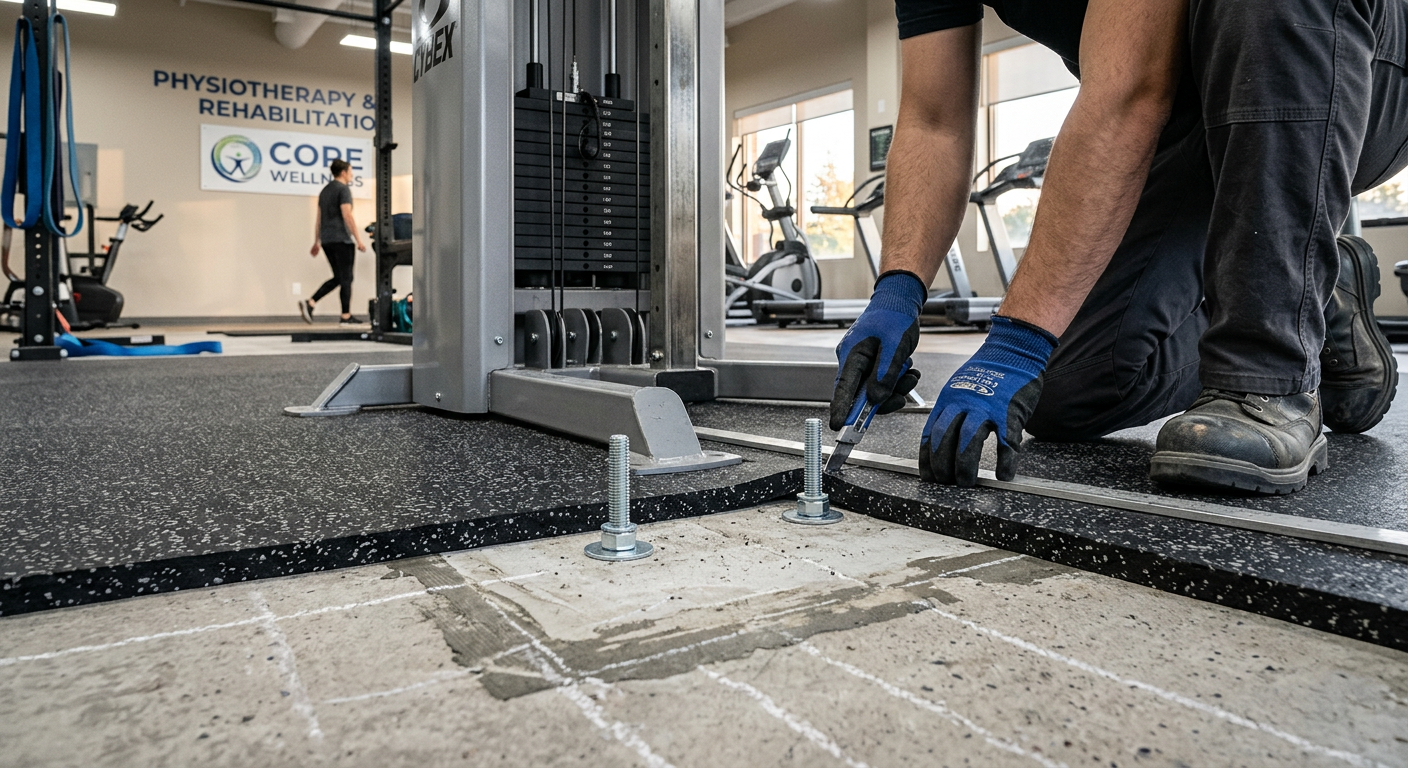
The exercise gym in a physiotherapy clinic is the highest-specification — and highest-risk — space in the facility. It is the space where construction decisions with the greatest consequence for patient safety are made. Three engineering dimensions of the gym space are critical.
Physiotherapy gym flooring must simultaneously meet four requirements that are difficult to satisfy with standard commercial flooring products: durability under heavy equipment loads (cable machines, treadmills, free weights up to 200kg), shock absorption for patient safety during exercises involving jumping or falling, cleanability for infection control between patients, and dimensional stability under the dynamic loads that cause seam lifting in standard rubber tile products. The flooring solutions that meet all four requirements in Ontario physiotherapy clinic environments are:
| Flooring Type | Thickness | Cost per sq ft (installed) | Best For | Limitations |
|---|---|---|---|---|
| Vulcanized rubber roll (12mm+) | 12–25mm | $8–$18 | High-load areas, free weight zones | Limited colour options; requires professional installation |
| Interlocking rubber tile (20mm+) | 20mm min for PT use | $6–$14 | Modular layouts, equipment islands | Seam lifting under dynamic load — must be glued perimeter |
| Poured polyurethane (athletic) | 6–12mm poured | $12–$22 | Full-gym seamless, multi-surface use | Higher cost; longer installation time (curing period required) |
| Commercial vinyl sheet (6mm, welded) | 6mm | $7–$12 | Treatment corridors, non-equipment zones | Not rated for free weight drop or wheeled equipment without protection |
| Standard 6mm rubber tile | 6mm | $4–$8 | Light-use fitness space | NOT suitable for PT gym — seam failure under dynamic load (Newmarket case) |
The Newmarket case study that opens this guide involved 6mm standard rubber flooring — the minimum acceptable specification for a light-use fitness facility, but inadequate for a physiotherapy rehabilitation gym where heavier equipment and greater patient effort loads are applied. The Ontario physiotherapy flooring standard is: minimum 12mm vulcanized rubber roll flooring in equipment zones, with glued installation (not loose-lay or loose-tile) and taped or welded seams in high-traffic areas. The cost premium over 6mm standard rubber tile is $2–$6 per square foot — a $2,000–$6,000 difference for a 1,000 square foot gym that prevents the liability exposure documented above.
Exercise equipment in a physiotherapy clinic is subject to loads that differ fundamentally from commercial gym equipment loads: patients in rehabilitation are often using compensatory movement patterns, applying asymmetric loads, and working with instability that creates dynamic force vectors that gym equipment is not typically designed to resist. The anchor specification for physiotherapy clinic gym equipment must account for: patient load (weight of heaviest expected patient plus dynamic loading factor — typically 2.5× static weight for cable and pulley systems), equipment geometry (anchor position relative to equipment moment arm), and slab substrate (concrete slab at a minimum of 28 MPa, with anchor embedment appropriate for the calculated pull-out force). A structural engineer’s review of the anchor plan is not required by OBC for equipment in fitness occupancies, but represents best practice for a physiotherapy clinic where the patient population includes post-surgical and elderly individuals with elevated fall risk. The cost of a structural engineer’s review and anchor specification: $1,500–$4,000 — approximately 1% of the total renovation budget for a mid-size clinic. The cost of the Newmarket cable anchor failure: $152,000 including legal fees.
Standard commercial building ceiling heights of 2.7–3.0 metres are insufficient for many physiotherapy rehabilitation exercises and equipment types. Overhead pulley systems, tall exercise frames, and ceiling-mounted suspension systems (TRX-type slings) require minimum 3.5 metres of clear ceiling height; ideally 4.0 metres for a full-range physiotherapy gym. In leased commercial spaces, available ceiling height is a fixed constraint that cannot be changed by renovation. Physiotherapy clinic owners selecting a leased space should verify that the structural ceiling height (slab to slab, not just to suspended ceiling) accommodates the rehabilitation equipment program planned for the space. A space with 2.7 metres of clear height can function as a physiotherapy gym with equipment selection constraints — eliminating overhead suspension systems and tall multi-station frames — but will require a different equipment program than a 3.5-metre space.
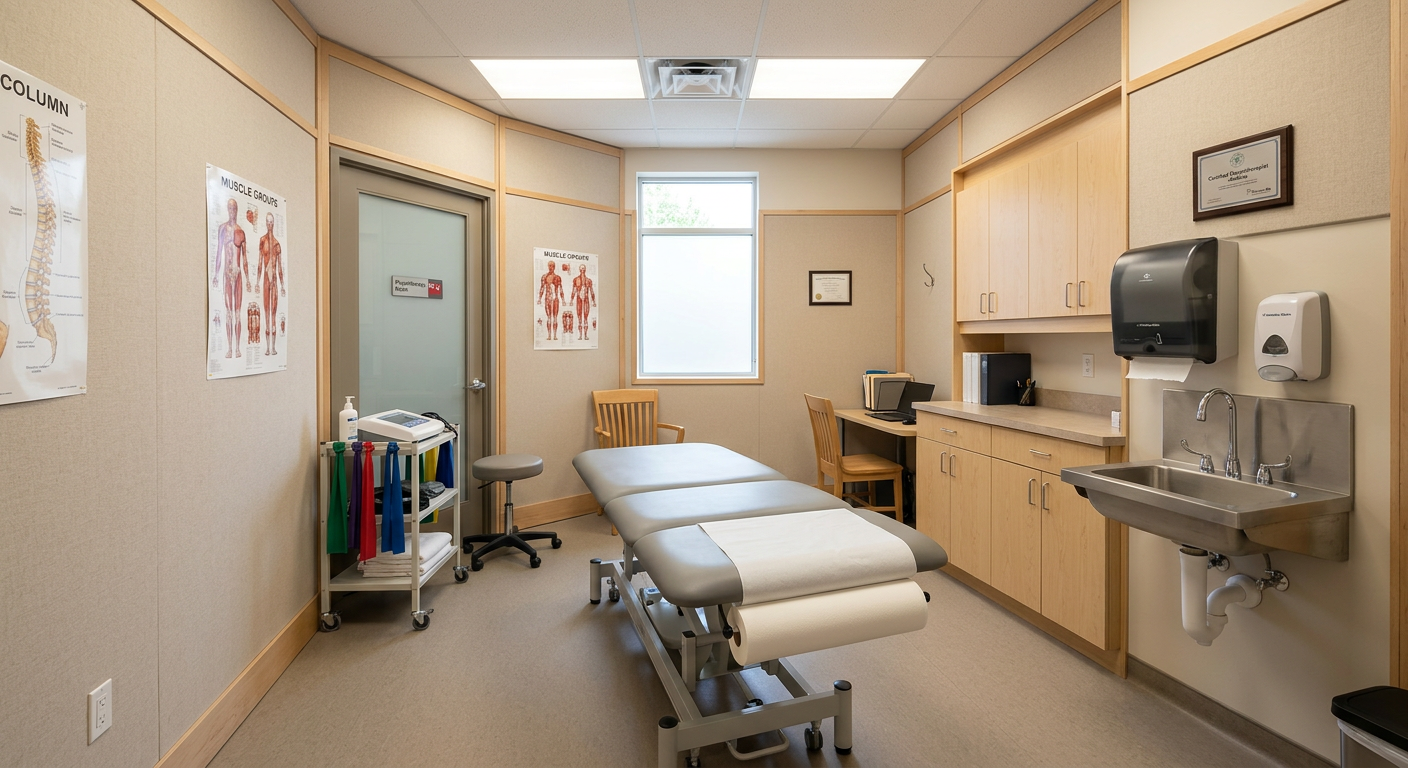
Physiotherapy treatment rooms differ from physician exam rooms in specific ways: they are larger (to accommodate the treatment table plus therapist access on all four sides), they involve a higher frequency of body contact requiring draping and privacy, and they generate more frequent hand hygiene events (before and after each treatment contact) than a physician examination. These differences translate into specific construction requirements.
A single-table physiotherapy treatment room requires minimum 10’×12′ (3.05m×3.66m) clear floor area — the same minimum as a GP exam room, but for a different reason: the physiotherapy treatment table requires full access on three sides (head, foot, and one long side) for manual therapy techniques, with the remaining side against a wall for equipment storage. AODA compliance requires that a wheelchair-accessible path be maintained to the table with the table in its lowest position, which at minimum 10’×12′ is achievable but tight. A 12’×14′ room is the functional standard in new construction physiotherapy clinic design: it accommodates the table, full access, therapist workspace, and an AODA-compliant approach path without forcing the table against a wall on both long sides.
PHO IPAC guidelines apply to physiotherapy treatment rooms as point-of-care settings where skin contact and some risk of blood and body fluid exposure (post-surgical wound management, taping, acupuncture) occurs. IPAC requirements for treatment rooms include: a hand hygiene sink inside the room (or ABHR dispenser if plumbing is not practical, with PHO IPAC assessment confirming adequacy), non-porous cleanable surface materials in the treatment zone (table, adjacent cabinetry, and floor in the contact zone), and an ABHR dispenser at the room entrance. Treatment tables must be covered with single-use barrier protection (paper roll) between patients, requiring a paper roll holder integrated into the table or cabinetry design. Laundry handling for treatment blankets and towels must meet PHO IPAC requirements — a clinical laundry area with IPAC-compliant separation of clean and soiled items.
Physiotherapy treatment involves discussion of patient health history, treatment plans, and sometimes pain responses that patients do not want shared between rooms. CPO practice standards for patient privacy require acoustic separation between treatment rooms that prevents intelligible speech transmission. Standard STC-35 partitions (single-stud gypsum wall) allow intelligible speech transmission at normal conversation volumes — insufficient for PHIPA and CPO privacy standards. Treatment room partitions should achieve STC-45 minimum: staggered-stud or double-stud framing with acoustic batt insulation, acoustically sealed penetrations. The cost premium for STC-45 versus STC-35 partitions is $12–$18 per linear foot of partition — a modest investment given the privacy obligation it satisfies.
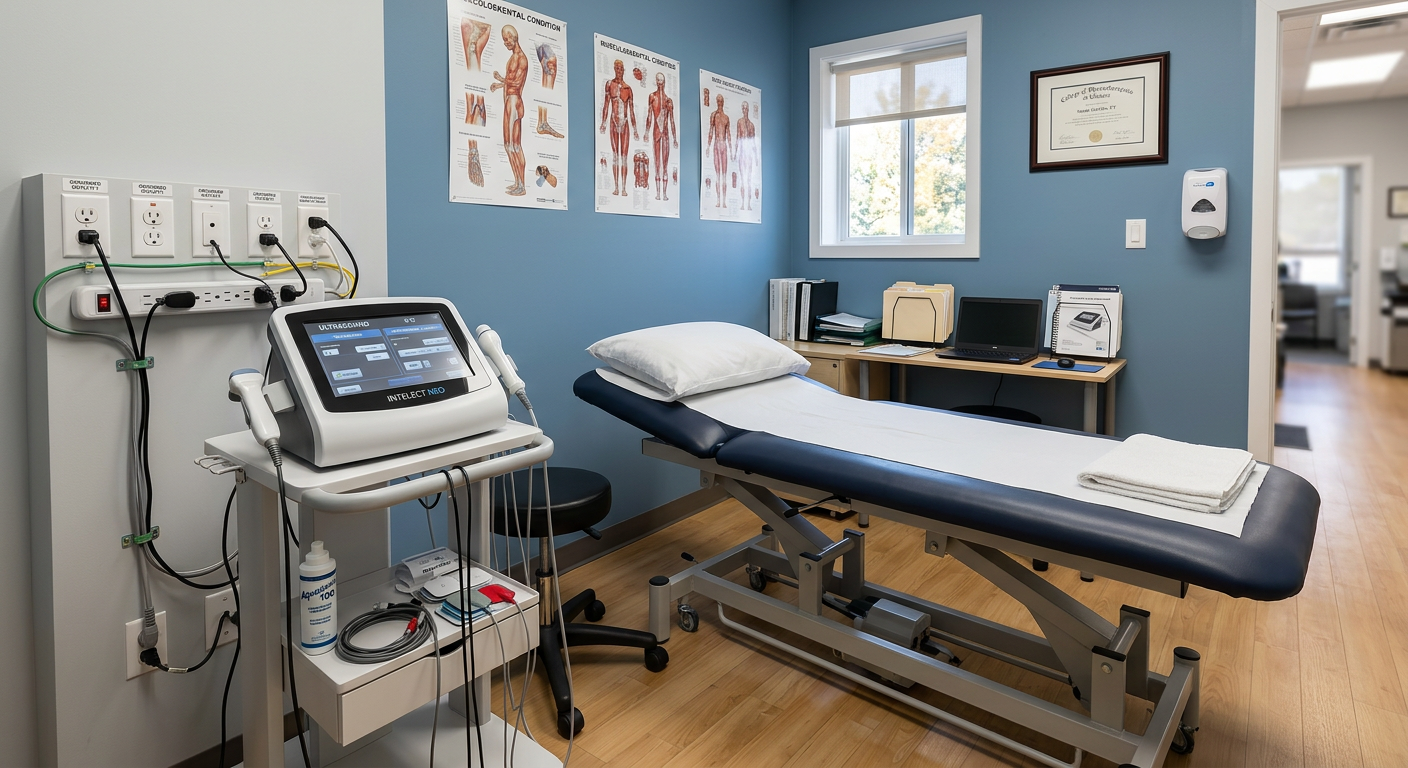
Physiotherapy modality treatment rooms — using ultrasound, interferential current (IFC), transcutaneous electrical nerve stimulation (TENS), laser therapy, shockwave therapy, and hot/cold packs — have specific electrical requirements that standard commercial electrical systems do not anticipate. Modality rooms that lack appropriate electrical infrastructure require post-construction electrical work that is significantly more expensive than specifying it at renovation time.
Electrotherapy modality equipment (IFC, TENS units, neuromuscular electrical stimulation) requires isolated electrical circuits to prevent interference between units and to ensure patient safety from stray current. ESA (Electrical Safety Authority) requirements for therapeutic medical electrical equipment under CSA C22.2 No. 601.1 (medical electrical equipment safety standard) mandate: isolated grounded circuits for each therapeutic electrical device, ground fault circuit interrupter (GFCI) protection in wet areas, and proper bonding of all patient contact surfaces. A modality room with 4–6 therapeutic devices should have 4 dedicated 15A or 20A circuits minimum — one per device group with margin for future equipment additions. Specifying dedicated circuits at rough-in: $400–$800 per circuit. Adding dedicated circuits post-construction: $1,800–$4,500 per circuit (wall opening, new conduit run, panel addition).
High-power shockwave therapy units (radial and focused) draw 10–15A at 120V during peak operation and require dedicated 20A circuits. Class IV laser therapy units require dedicated circuits with proper electrical isolation. Both technologies are increasingly prevalent in Ontario physiotherapy clinics — practices that are adding these modalities post-renovation consistently find that their existing electrical systems do not accommodate the load without panel upgrades. A panel upgrade required after occupancy — including service entrance modification — costs $4,500–$12,000. Specifying a 200A panel with four additional breaker positions at initial renovation costs $1,200–$2,500 incremental over a minimum 100A panel and provides the capacity for any foreseeable modality addition in the clinic’s operational life.
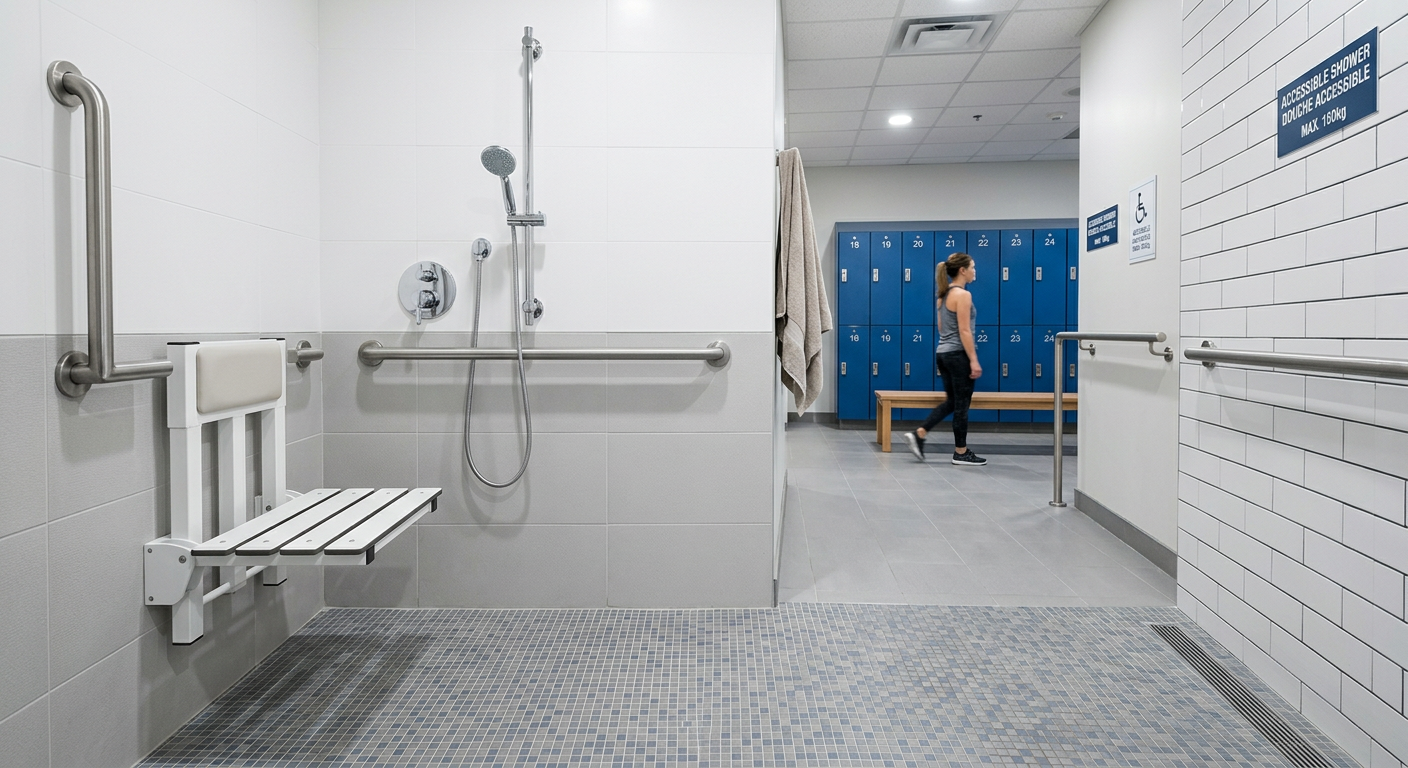
Physiotherapy clinics that provide aquatic therapy, hydrotherapy, or post-exercise showering facilities must design change room and shower spaces to meet AODA DOPS requirements for accessible shower facilities — the most demanding accessible design standard in Ontario healthcare construction.
| Element | AODA DOPS Requirement | Standard (Non-Accessible) | Cost Premium |
|---|---|---|---|
| Shower entry | Threshold-free (roll-in) entry, 900mm minimum clear width | Standard shower with threshold | $2,000–$5,000 for threshold-free drain system |
| Shower floor | 2% maximum slope to drain, slip-resistant finish | 4–5% slope standard | Included in threshold-free specification |
| Shower seat | Fold-down wall-mounted seat, 43–48 cm height, 400mm minimum depth | No standard requirement | $400–$900 per seat installed |
| Grab bars | Horizontal bar at 30–34 inches, vertical bar at shower entry | None typically | $200–$500 per bar installed (blocking required during construction) |
| Showerhead | Adjustable-height handheld showerhead (minimum 1.8m hose length) | Fixed height standard | $150–$400 incremental |
| Change area | 1,500mm turning radius clear floor area, fold-down bench 43–48 cm height | Bench or hook only | $600–$1,200 for fold-down bench and blocking |
The blocking for all shower grab bars must be installed during the wall framing phase — retrofitting blocking into a tiled shower wall requires tile removal, wall demolition, blocking installation, patching, re-tiling, and regrouting. A shower that requires retroactive grab bar blocking costs $3,500–$7,500 to retrofit correctly. The same blocking installed during framing costs $180–$400. Physiotherapy clinics that are planning a renovation should specify blocking in all shower and accessible washroom walls as a standard item — the cost is trivial and the alternative is prohibitively expensive.
| Space Component | Low Cost | High Cost | Notes |
|---|---|---|---|
| Exercise gym (per sq ft) | $95 | $175 | Includes flooring, anchors, mirrors, HVAC, lighting |
| Private treatment room (each) | $25,000 | $50,000 | Includes STC-45 walls, sink, flooring, lighting |
| Modality room (complete) | $35,000 | $75,000 | Includes dedicated circuits for 4–6 devices |
| Reception and waiting area | $30,000 | $70,000 | AODA counter, seating, check-in area |
| Accessible change room and shower | $22,000 | $55,000 | Full AODA roll-in shower + change area |
| Full fit-out (1,500 sq ft clinic) | $250,000 | $450,000 | 3 treatment rooms, small gym, modality, reception |
| Full fit-out (2,500 sq ft clinic) | $400,000 | $750,000 | 5 treatment rooms, full gym, aquatic/hydro, reception |
A growing number of Ontario physiotherapy clinics are adding hydrotherapy pools or aquatic therapy tanks to differentiate their service offering and provide rehabilitation modalities not available in standard clinic environments. Hydrotherapy facility renovation is among the most technically complex healthcare construction projects — it involves waterproofing systems, pool mechanical engineering, barrier-free access requirements, and HVAC systems for natatorium humidity control that most healthcare contractors have never managed. Understanding the scope before committing to aquatic therapy as a service line prevents catastrophic renovation overruns.
An in-ground therapy pool in a physiotherapy clinic requires: excavation and concrete pool shell construction (if ground-level), or structural assessment and reinforcement for above-grade pool tanks (if installed on an upper floor of a multi-storey building — a structural engineering requirement that eliminates above-grade options in many commercial buildings without significant structural upgrades). Pool waterproofing uses either fibreglass shell or reinforced concrete with crystalline waterproofing membrane — not standard tile grout, which cracks under pool thermal cycling. Therapy pool construction in Ontario: $120,000–$350,000 depending on pool size (typically 12’×20′ to 16’×32′ for physiotherapy use), depth range (most therapy pools are 3.5–5 feet for standing therapy), and lift system specification (pool hydraulic lift for patients with mobility limitations is an AODA requirement if the pool is used by patients who cannot use steps independently).
A pool environment generates significant evaporative moisture load — an indoor therapy pool evaporates 0.4–0.8 litres of water per hour per square metre of pool surface area. Without dedicated natatorium HVAC — a dehumidification system designed for pool environments — the moisture load will condense on all building surfaces, causing mould growth, structural damage, and deterioration of all surface finishes within 6–18 months of pool opening. Standard commercial HVAC systems cannot manage natatorium humidity loads. The natatorium HVAC system for a therapy pool in a physiotherapy clinic costs $45,000–$120,000, representing 20–40% of the total pool addition budget. This cost is non-negotiable — physiotherapy clinic owners who have attempted to use standard HVAC to manage pool humidity have universally experienced building envelope damage requiring remediation more expensive than the HVAC system they skipped.
Physiotherapy practice management technology — EMR systems, video analysis platforms, wearable rehabilitation monitoring, and telehealth infrastructure — is increasingly integrated into the physical clinic environment. Addressing technology infrastructure at the renovation design stage prevents the expensive retrofit additions that are common in clinics that did not plan for this integration.
Movement analysis video systems — used for gait analysis, return-to-sport assessments, and biomechanical evaluations — require specific lighting conditions (no strong shadows, even illumination across the movement capture zone) and camera mounting infrastructure (ceiling or wall mounts at specified heights and angles). A movement analysis zone in the gym area requires: flush LED panels providing 750–1,000 lux even illumination across the capture zone, camera mounting conduit with cable management to a workstation, and a background wall in a neutral colour (typically light grey or green for some systems). Specifying this infrastructure at construction: $2,500–$6,000 including lighting, conduit, and background treatment. Adding it post-construction: $8,000–$18,000 including lighting replacement, ceiling penetrations for conduit, and background wall painting/covering.
Telehealth physiotherapy — real-time video consultation for follow-up care and exercise coaching — became a permanent service modality for many Ontario physiotherapy clinics following the COVID-19 pandemic and OHIP telehealth billing expansion. A treatment room equipped for telehealth requires: a wall-mounted display at 50–65 inches (for patient and therapist to view shared images and exercise demonstrations), camera at eye level (approximately 160cm height from floor), adequate ambient lighting without strong backlight from windows, and acoustic isolation adequate for video conference clarity (the STC-45 treatment room partition specification meets this requirement). Specifying telehealth infrastructure in a treatment room at renovation time costs $1,800–$4,000 for display mount, camera mount, networking, and power. A treatment room without telehealth infrastructure that the therapist attempts to use for telehealth sessions produces low-quality video and audio — reducing the perceived quality of service and affecting patient satisfaction scores.
| Municipality | Building Permit (weeks) | ESA Permit | Pool Addition Notes |
|---|---|---|---|
| Toronto | 8–12 | Filed separately with ESA | Pool addition requires pool electrical permit and additional review |
| Mississauga | 6–9 | Filed separately with ESA | Pool permit requires Health Department notification |
| Vaughan/Markham | 5–8 | Filed separately with ESA | York Region pool permit concurrent with building permit |
| Richmond Hill | 4–7 | Filed separately with ESA | Pre-application consultation available for clinic pools |
| Newmarket/Aurora | 3–5 | Filed separately with ESA | Most efficient permit process for pool additions in York Region |
The Newmarket case study that opens this guide illustrates why contractor qualification for a physiotherapy clinic renovation requires a specific checklist — medical clinic experience alone is not sufficient. The anchor failure that generated $152,000 in liability cost was caused by a contractor who had successfully built physician offices and a dental clinic, but had never built a space with dynamic gym equipment loading. The qualification questions specific to physiotherapy clinic renovation:
Question 1: “Have you built a physiotherapy clinic gym with equipment anchors, and did you work with a structural engineer on the anchor specification?” A qualified contractor names the structural engineer and the clinic — you can verify. A general contractor says they used “standard anchor bolts.”
Question 2: “What rubber flooring system do you specify for a physiotherapy clinic gym, and why?” A qualified contractor specifies 12mm+ vulcanized rubber roll, glued full-surface installation, and explains why 6mm tile is inadequate. An unqualified contractor recommends the same product they’d install in a commercial gym for healthy adults.
Question 3: “How do you approach AODA accessible shower specification, and what is your experience with threshold-free drain systems?” A qualified contractor describes the drain rough-in sequence (threshold-free drain must be set before concrete pour or slab penetration, then built up with properly sloped mud bed) and has done it before. An unqualified contractor installs a standard shower and adds a grab bar — which is not AODA compliant.
Question 4: “What is your process for modality room electrical rough-in coordination?” A qualified contractor works with an electrical engineer on dedicated circuit planning and has ESA permit experience. An unqualified contractor runs standard commercial circuits and discovers the inadequacy when the physiotherapist tries to plug in four devices on one 15A circuit.
A contractor who answers all four questions correctly with specific references is qualified for physiotherapy clinic renovation. The qualification bar is meaningfully higher than for a standard medical clinic renovation — the gym engineering and accessible shower requirements are niche enough that most healthcare contractors who have not built physiotherapy gyms specifically do not know the requirements.
Physiotherapy clinic renovation budgets are frequently insufficient because the budget is built around the clinical spaces — treatment rooms and gym — without fully accounting for the supporting infrastructure costs that are specific to the physiotherapy environment.
Physiotherapy clinic owners who price gym flooring from fitness supply retail sources — where 6–8mm rubber tile is sold at $3–$5 per square foot — consistently underestimate their actual flooring budget. The appropriate specification (12mm+ vulcanized rubber roll, full-surface glued installation) costs $8–$18 per square foot installed, plus 20–30% above the product cost for professional installation including seam treatment. A 1,000 square foot gym floor budgeted at $8,000 (retail price for 6mm tile) actually costs $18,000–$28,000 with the correct specification and professional installation. The equipment anchoring budget — often estimated at $1,000–$2,000 based on hardware costs — should include the structural engineer’s review ($1,500–$4,000), professional anchor installation ($800–$2,500), and pull-test documentation ($500–$1,500). Total anchor budget: $3,800–$8,000 versus the $1,000–$2,000 often assigned. The difference between the guessed budget and the correct budget in these two line items alone is $12,000–$25,000 — a gap that becomes a change order conflict midway through construction.
AODA compliance deficiencies discovered during or after construction are among the most expensive remediation categories in physiotherapy clinic projects, because the accessible shower and change room specifications are complex and the tile and fixture installation is difficult to undo. An accessible shower built without a threshold-free drain, without proper slope, or without blocking for grab bars requires complete demolition to the substrate and rebuild — a $25,000–$45,000 remediation for a shower that should have been built correctly for $22,000–$35,000. The prevention: hire a certified AODA accessibility consultant to review accessible shower and change room drawings before construction begins ($1,500–$3,000 for a drawing review) and again after installation but before tiling ($800–$1,500 for an on-site inspection). This $2,300–$4,500 investment in professional accessibility review prevents the $25,000–$45,000 remediation that follows an AODA non-compliant shower installation.
Physiotherapy clinics require multiple distinct HVAC zones — the gym (high airflow for exercise ventilation), treatment rooms (individually controlled for patient comfort and acoustic privacy), modality rooms (odour and heat management for electrotherapy equipment), and patient change rooms and showers (humidity management). Each zone requires a separate VAV zone, thermostat, and balancing damper. A physiotherapy clinic with 4 treatment rooms, 1 gym, 1 modality room, and 1 change room needs 7 independent HVAC zones minimum — a system that costs $35,000–$85,000 more than a single-zone commercial HVAC system of equivalent capacity. Budgets built around commercial HVAC quotes from contractors who have not managed multi-zone healthcare HVAC consistently underestimate this line item by $20,000–$50,000. The mechanical engineer engaged for the project must be briefed on each zone’s specific airflow and thermal requirements from the beginning of design — retrofitting zone dampers and controls into a single-zone system already installed costs 2–3 times the original multi-zone specification cost.
Document the rehabilitation equipment program planned for the clinic: exercise machines, free weight systems, suspension systems, assessment equipment, electrotherapy modalities, and any aquatic or hydrotherapy equipment. Each piece of equipment has specific spatial, structural, and electrical requirements that must be established before space planning begins. Engage a physiotherapy clinic designer or healthcare architect who has completed physiotherapy clinic projects — not a general medical clinic designer who has not dealt with equipment anchor engineering or gym flooring specifications. Obtain a structural engineer’s written anchor specification for all heavy gym equipment before the design is finalized — this is the most cost-effective single investment in patient safety the clinic will make.
Architect produces construction drawings with: structural anchor plan reviewed by engineer, full AODA accessibility documentation, modality room electrical single-line diagram, accessible shower and change room details. ESA (Electrical Safety Authority) permit application concurrent with building permit — ESA permits are required for all new electrical work in Ontario and must be filed before electrical rough-in begins. Building permit timeline in GTA: 3–10 weeks depending on municipality. Equipment suppliers should provide rough-in specification sheets for all major equipment — these sheets are the primary input for the electrical engineer’s circuit design and the structural engineer’s anchor analysis.
Concrete drilling and sleeve anchor installation for gym equipment — completed during the rough-in phase before flooring is installed. All blocking for grab bars, fold-down benches, and shower seats installed during wall framing. Plumbing rough-in for treatment room sinks, accessible shower (threshold-free drain rough-in is particularly critical), and modality room hand washing sinks. Dedicated electrical circuits rough-in for modality room devices, gym equipment (if electrically powered), and panel expansion. HVAC rough-in with individual zone dampers for treatment rooms (patient privacy and comfort control).
Gym flooring installation — the most sequence-sensitive element: flooring must be installed before equipment, but after all concrete penetrations for anchors are complete. Treatment room millwork and equipment. Accessible shower tiling with threshold-free drain detail and 2% slope verification before tiling. Grab bar, fold-down seat, and fold-down bench installation. Modality room equipment installation and ESA inspection of electrical work. HVAC commissioning with individual zone verification. AHU final adjustment for gym air change rate (minimum 6 ACH for an occupied gym space).
Building inspection for OBC compliance. ESA inspection and approval certificate for electrical work. Accessible shower and washroom verification against AODA DOPS specifications — measure all heights, turning radii, grab bar placements. Gym equipment anchor load testing — each anchor verified to manufacturer’s pull-out specification before patients use the equipment. Modality equipment safety inspection per CSA medical electrical equipment standards. Staff IPAC orientation for treatment room protocols. Insurance broker notification of new facility — some insurers require an independent safety inspection before coverage begins at a new physiotherapy clinic location.
The College of Physiotherapists of Ontario does not have a formal facility approval process for physiotherapy clinics, unlike CPSO for some physician procedures or RCDSO for dental offices. CPO inspects individual registrant practice through its Quality Assurance program, not facilities. However, CPO’s practice standards create professional accountability for treatment environment quality — a physiotherapy clinic with inadequate patient privacy, unsafe flooring, or improperly anchored equipment creates CPO practice standard compliance risk for the physiotherapist-owner. CPO’s Practice Advisor service is available to physiotherapists planning a renovation who want to confirm their plans are consistent with practice standards before committing to construction.
A functional physiotherapy exercise gym for a 2–3 therapist practice requires minimum 800–1,000 square feet of clear exercise floor space — enough for 4–6 exercise stations, a free weight area, and adequate patient circulation between stations. A 1,200–1,500 square foot gym accommodates group exercise classes (which are an increasingly common revenue stream for Ontario physiotherapy practices) and creates adequate social distance between simultaneous patients. Smaller dedicated treatment clinics with minimal gym requirements can function in 400–600 square feet of gym space with appropriate equipment selection — cable machines and multi-functional trainers use space more efficiently than linear equipment like treadmills and cycles for a rehabilitation context.
Standard commercial gym flooring — including the 6mm or 8mm rubber tile products available from fitness supply retailers — is inadequate for physiotherapy clinic gym use. These products are rated for fitness club use where equipment is used by healthy adults following manufacturer instructions; they are not rated for the dynamic loads created by rehabilitation exercises, the asymmetric loading of patients with movement disorders, or the wheeled patient equipment (wheelchairs, walkers, knee scooters) that physiotherapy gym patients use. Minimum specification for a physiotherapy clinic gym: 12mm vulcanized rubber roll flooring in equipment zones, glued full-surface installation (not loose-lay), with welded or taped seams in high-traffic areas. The case study at the opening of this guide is the consequence of using a 6mm standard product in a physiotherapy environment.
The industry standard for physiotherapy clinic treatment room allocation is 1.5–2 rooms per physiotherapist — higher than the GP exam room ratio because physiotherapy sessions are typically 30–60 minutes (longer than GP appointments) and room preparation time between patients is shorter. A 3-therapist practice needs 4–5 treatment rooms. A 5-therapist practice needs 6–8 rooms. Practices that provide concurrent exercise gym supervision — where the therapist moves between treatment room patients and gym patients — can sometimes function at 1.25 rooms per therapist, but this requires careful scheduling and gym layout that provides clear sightlines from the treatment room area. Building additional treatment rooms during the original renovation is significantly less expensive than adding them post-construction — plan for the practice’s 5-year growth trajectory, not its current size.
The physiotherapy gym is an exercise environment where patients generate body heat and perspiration at rates comparable to a commercial fitness facility. ASHRAE Standard 62.1 ventilation requirements for exercise facilities specify: minimum 0.18 cfm/sq ft of floor area plus 0.06 cfm per person for the gym space. Translated to air changes per hour for a typical 1,000 sq ft gym with 10 simultaneous patients: approximately 6–10 ACH of supply air. This is significantly higher than the 4 ACH minimum for medical clinic common areas and requires a dedicated HVAC zone for the gym that is independent of the clinical zone. Gyms with inadequate ventilation develop odour and elevated CO2 concentration — both of which affect patient satisfaction and are health concerns for staff working in the space for extended periods. Specify the gym HVAC zone explicitly in the mechanical drawings with supply air volumes calculated to ASHRAE 62.1 requirements.
An accessible shower is required under AODA DOPS if the physiotherapy clinic provides showering facilities for patients. If the clinic does not provide patient showers — the majority of Ontario physiotherapy clinics do not — then an accessible shower is not required. However, if aquatic therapy, hydrotherapy, post-exercise showering, or any other service requires patients to shower at the clinic, the shower facility must be accessible under AODA DOPS regardless of the patient population served. The roll-in shower specification required for AODA compliance costs $22,000–$35,000 to build correctly; a shower designed for non-accessible use and then retrofitted for accessibility post-construction costs $35,000–$65,000. Physiotherapy clinic owners who anticipate adding hydrotherapy or other shower-requiring services within five years should specify the roll-in shower at initial construction even if it is not immediately required.
Gym equipment anchor safety in a physiotherapy clinic should be verified in three steps. First, obtain the equipment manufacturer’s anchor specification — pull-out load requirements and anchor type recommendations for the specific concrete slab substrate. Second, have a structural engineer review the anchor plan and specify the anchor type, size, depth, and spacing for the actual slab composition at your site (a 100mm residential slab requires different anchors than a 200mm commercial slab). Third, after installation, conduct a documented pull test on representative anchors using a torque wrench to the manufacturer’s specified torque — or hire a testing firm to conduct a certified pull test. Maintain the documentation of the anchor specifications and pull test results in the clinic’s facility file. In the event of an equipment anchor failure resulting in patient injury, this documentation demonstrates that appropriate due diligence was exercised — a critical defence in any liability proceeding.
The Mississauga walk-in clinic opened 40 minutes late on its first Monday morning. Twenty-three patients were waiting outside when the staff arrived — a...
The most common question Ontario clinic owners ask when planning a renovation is: “What should this cost per square foot?” It is also the...
The Brampton family medicine clinic closed completely for its renovation. The decision seemed straightforward at the time: a complete 10-week closure would allow the...