

March 13, 2026

The most common question Ontario clinic owners ask when planning a renovation is: “What should this cost per square foot?” It is also the...
The Brampton family medicine clinic closed completely for its renovation.
The decision seemed straightforward at the time: a complete 10-week closure would allow the contractor to work without clinical scheduling constraints, finish faster, and deliver a higher-quality result than a phased renovation with patients in adjacent rooms. What the clinic’s physician partners had not fully calculated was the financial reality of 10 weeks at zero OHIP revenue for a four-physician practice billing $1.3 million annually — a $250,000 revenue hole. Nor had they calculated the patient attrition: three months after reopening, 18% of their active roster had transferred to other practices during the closure. At an estimated lifetime revenue value of $4,200 per patient in a family practice, the lost 340 patients represented $1.4 million in projected revenue that would not be recovered. The renovation itself cost $480,000. The total economic impact of the decision to close completely: an estimated $1.65 million when revenue loss and patient attrition are included. The contractor’s estimate for phased construction — keeping two exam rooms operational throughout the renovation — had been $65,000 higher. The clinic’s partners chose the lower immediate cost. It was the most expensive decision in the practice’s history.
This guide covers every strategy for reducing clinic downtime during renovation in Ontario — phased construction sequencing, IPAC requirements for active construction adjacent to clinical operations, patient communication protocols, temporary clinic options, insurance considerations, and contractor scheduling approaches that allow clinical operations to continue at reduced but functional capacity throughout most renovation projects. It is the guide those Brampton partners needed before they made their decision.
The decision between complete closure and phased renovation cannot be made rationally without first calculating the actual cost of downtime for your specific practice. Most Ontario clinic owners underestimate downtime cost because they focus on direct revenue loss (OHIP billing, fee-for-service procedures, dispensing revenue) while underweighting indirect cost (patient attrition, staff disruption, referral relationship interruption, and reputation impact).
Direct revenue loss is straightforward to calculate: total annual clinical revenue divided by 52 weeks, multiplied by the number of weeks of complete closure. A two-physician family medicine practice billing $620,000 annually loses approximately $11,923 per complete closure week. A 10-week closure costs $119,230 in direct OHIP revenue. A phased closure that maintains 50% capacity costs approximately $59,615 over the same period — a savings of $59,615 that directly offsets the premium cost of phased construction.
Patient attrition during clinic closure is a function of closure duration and patient transfer ease in the local market. In the GTA, where multiple alternative family medicine practices exist in most neighbourhoods, patient attrition during closure follows a consistent pattern: closures of 4 weeks or less see minimal transfer (2–5% of roster); closures of 6–10 weeks see moderate transfer (8–18% of roster); closures exceeding 10 weeks see significant transfer (15–30% of roster). These transferred patients do not return in most cases — patients who establish a relationship with a new physician during a clinic closure typically remain with that physician. The lifetime value of a primary care patient — accounting for OHIP billing, laboratory requisitions, specialist referrals, and ancillary services — is estimated at $3,800–$5,500 in a GTA family medicine practice. A practice with 2,000 active patients losing 12% during a 10-week closure loses 240 patients with a total lifetime value of $912,000–$1,320,000. This is not lost immediately — it is lost over years — but it is real economic impact that the practice will not recover.
Phased renovation costs more than complete closure renovation for three reasons: phasing requires more contractor mobilization and demobilization events, IPAC compliance for construction adjacent to active clinical operations requires additional temporary enclosures and negative pressure systems, and the constraint of clinical scheduling limits the hours and work zones available to the contractor. The typical phased construction premium in GTA medical clinic renovations is 12–25% above the equivalent complete closure project cost. For a $400,000 renovation, the phased premium is $48,000–$100,000. Compare this to the Brampton clinic’s estimated $1.65 million in combined revenue loss and patient attrition from complete closure — the phased premium is 3–6% of the cost it prevents.
There is no single “phased renovation” approach — there are five distinct strategies, each appropriate for different renovation scopes, clinical volume levels, and facility configurations. Understanding which strategy applies to your renovation determines whether phased construction is feasible and how much downtime reduction is achievable.
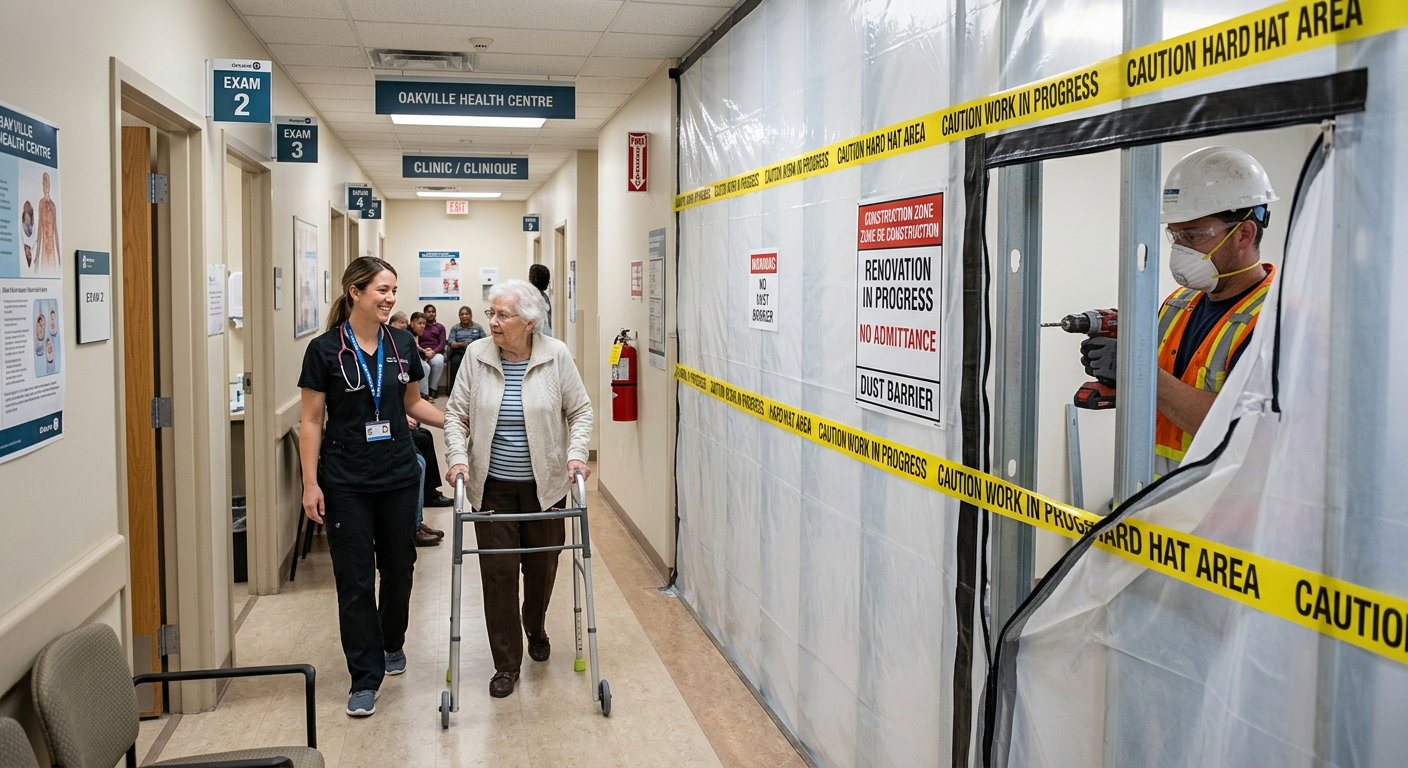
Zone-by-zone sequencing divides the clinic into distinct construction zones that are renovated sequentially while clinical operations continue in the remaining zones. This strategy works best in clinics where the clinical spaces are naturally divisible — a clinic with four exam rooms on one corridor and reception/waiting on another can renovate the reception zone while maintaining clinical operations in the exam rooms, then renovate the exam rooms while maintaining reception operations. The minimum viable clinical capacity during zone renovation is approximately 60% of normal — enough to maintain patient relationships and prevent significant roster attrition. Zone-by-zone sequencing adds 40–60% to total project duration compared to complete closure, but typically reduces revenue loss by 70–80% compared to complete closure. GTA example: A Richmond Hill walk-in clinic completed a full renovation in 18 weeks with zone phasing, maintaining 65% appointment capacity throughout — versus an estimated 10-week complete closure. Total direct revenue loss under phasing: $38,000. Estimated complete closure loss: $145,000. Net benefit of phasing after accounting for the $28,000 phasing premium: $79,000.
Weekend and after-hours construction allows clinical operations to continue on a normal schedule during the week while construction occurs outside clinical hours. This strategy eliminates direct revenue loss almost entirely — the only revenue impact is from any preparatory moves or equipment protections required at the end of each clinical day before construction begins. The constraints: not all construction activities can be performed in weekend/after-hours windows (HVAC work requires system shutdowns that affect the following clinical day, loud demolition creates noise issues in shared buildings, and some finishing work requires cure times that limit next-day clinical use). Weekend/after-hours construction adds 50–100% to project duration compared to a continuous-hours complete closure project. For a 10-week complete closure project, the after-hours equivalent is 18–22 weeks. The strategy is most appropriate for renovations with limited mechanical scope — cosmetic refreshes, flooring replacement, millwork updates — where extended cure times and HVAC shutdowns are not required.
Swing space strategy uses temporary relocation of clinical operations to adjacent space within the same building — a vacant suite on the same floor, a shared space with another tenant, or a temporarily reconfigured common area — while the primary clinic space is renovated completely. This allows full renovation without the constraints of active construction adjacent to clinical operations, at the cost of temporary relocation. Swing space costs: $4,500–$15,000 per month for temporary space lease, plus moving costs ($3,000–$12,000 each way) and temporary fit-out for clinical use ($8,000–$25,000). For a 10-week renovation, total swing space cost: $18,000–$57,000. This is typically less expensive than the revenue loss from complete closure when the practice’s daily revenue exceeds $4,000 — which is true for most multi-physician GTA practices. The additional benefit: full renovation quality without phasing constraints on the contractor, achieved without patient attrition.
Partial floor strategy sequences the renovation to complete all non-clinical zones (reception, waiting area, corridors, utility rooms) before touching clinical spaces (exam rooms, procedure rooms). Clinical operations continue normally during Phase 1, which typically represents 30–40% of the total renovation scope. Clinical spaces are then renovated in the shortest possible concentrated period at the end. For a clinic with significant non-clinical renovation scope (lobby, reception redesign, corridor reconfiguration, new patient washrooms), this approach eliminates downtime for the first half of the project and concentrates the unavoidable downtime into the minimum possible period. A North York specialty clinic used this approach for a $380,000 renovation: 8 weeks of reception and common area renovation with zero clinical downtime, followed by a 3-week concentrated exam room renovation at 40% capacity. Total downtime compared to a 10-week complete closure scenario: clinical revenue impact reduced from $130,000 to $28,000.
Staggered room renovation renovates exam rooms two at a time while the remaining rooms remain operational. A six-room clinic operates on four rooms while two are under renovation — maintaining 67% capacity throughout the project. This strategy is most appropriate for clinics where exam rooms are the primary renovation scope, where rooms can be isolated from each other with IPAC-compliant barriers, and where HVAC zones are isolatable per-room (required for negative pressure in the construction zone). The staggered approach is the most operationally disruptive for staff — it requires daily coordination between clinical scheduling and construction scheduling — but maintains the highest patient capacity of any phasing strategy and virtually eliminates roster attrition. A Vaughan family health team successfully completed an eight-room renovation in 14 weeks using staggered two-room sequencing, maintaining 75% clinical capacity throughout and recording less than 3% patient transfer during the project.
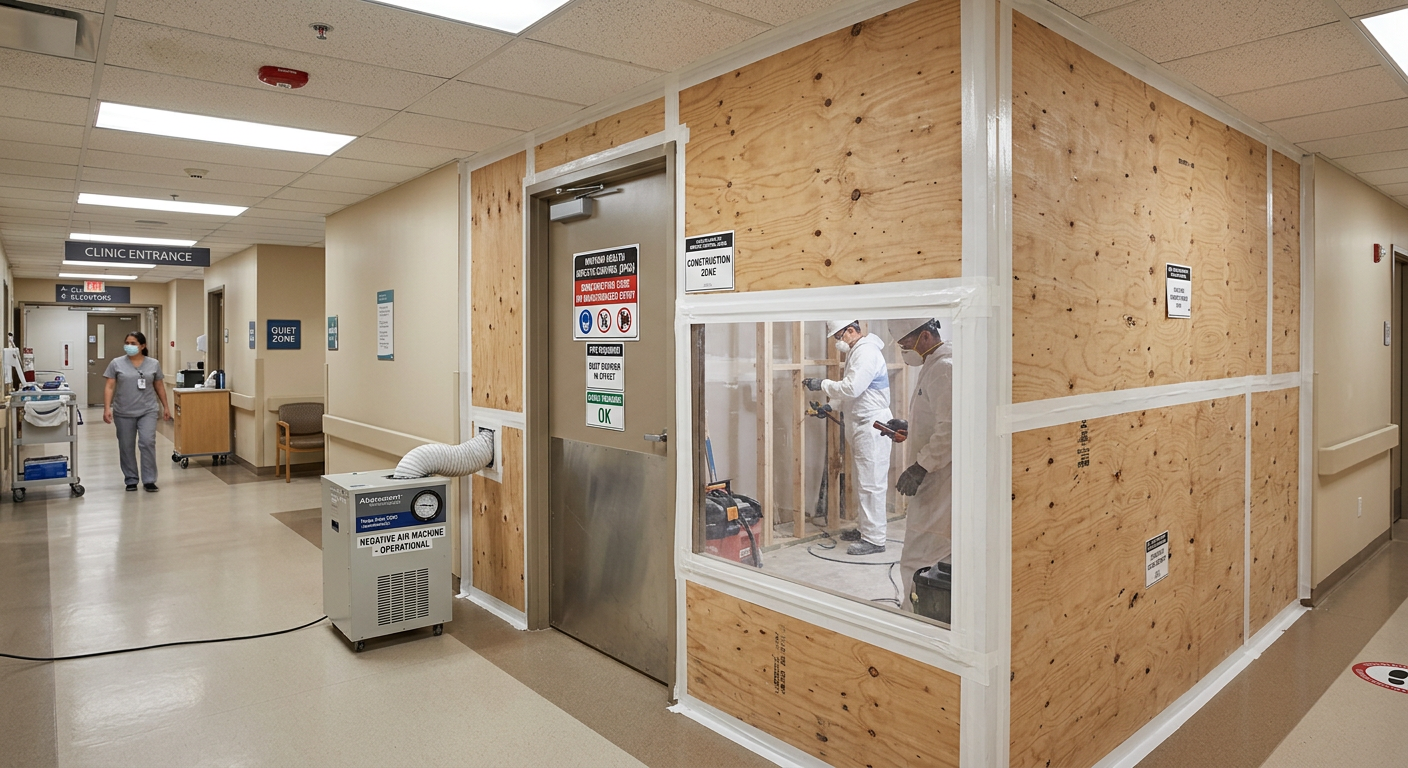
The most critical enabler of any phased clinic renovation is an IPAC-compliant construction zone that protects patients and staff in adjacent clinical areas from construction-related contamination. This is not an optional courtesy — PHO IPAC guidelines for healthcare facility renovation explicitly require infection control measures for construction activities adjacent to occupied healthcare spaces. Failure to implement these measures during a phased renovation creates the same IPAC compliance risk as the material failures described in other guides — and in an active clinical setting, the risk to patients is immediate rather than eventual.
Construction dust barriers for healthcare facilities must exceed the plastic sheeting barriers used in residential construction. PHO guidelines for construction in occupied healthcare settings specify: hard barriers (typically temporary walls using rigid plywood or drywall panels sealed to the structural floor and ceiling) for any construction activity generating significant dust or debris, with self-closing doors and an anteroom configuration if the construction zone is accessed frequently. Soft barriers (heavy polyethylene sheeting on rigid frames) are acceptable for lower-risk activities such as painting and millwork installation where dust generation is minimal. All barrier edges must be taped with construction tape to prevent air infiltration. The barrier must include a dedicated access point that does not route construction workers through the clinical zone. The cost of an appropriate hard barrier installation for a zone renovation: $3,000–$12,000 depending on barrier length and configuration — a cost that must be included in the phased renovation budget.
PHO IPAC guidance requires negative pressure in the construction zone — meaning that air flows from the clinical zone into the construction zone, not the reverse. This prevents construction dust and bioaerosols from migrating from the construction zone into areas where patients are present. Negative pressure is achieved by: isolating the construction zone HVAC from the clinical zone, introducing a portable HEPA negative air unit (NAM — Negative Air Machine) into the construction zone that exhausts through a HEPA filter to the building exterior, and verifying negative pressure with a differential pressure gauge before clinical operations resume each day. The NAM must run continuously during construction hours and until construction zone cleaning is complete at the end of each day. HEPA portable units: $800–$2,500 per unit, available on rental basis from construction supply companies in the GTA. A 500 square foot construction zone typically requires one NAM unit; larger zones require additional units. The rental cost for HEPA NAM units during a 10-week phased renovation: $3,000–$7,500 — another cost that must be included in the phased renovation budget.
Construction workers and material deliveries must use access paths that do not route through clinical patient areas. In clinics where the only building access is through the main patient entrance, a dedicated construction entrance must be established — typically through a service corridor, a secondary building entrance, or through a temporary exterior access point if structural conditions allow. If construction workers must pass through any area used by patients, the pass-through must occur outside clinical hours or the path must be protected with a sealed corridor barrier. Contractor workers must not use patient washrooms — a requirement that mandates either a temporary construction washroom (portable unit rented at $150–$300/month) or access to a designated building washroom that patients do not use during construction hours.

The single most effective strategy for preventing patient attrition during a clinic renovation is proactive, frequent, and honest communication with the patient roster. Patients who understand what is happening, why it is happening, and what their options are during the renovation period are far more likely to maintain their patient relationship than patients who encounter construction chaos without explanation.
Patient notification 4–6 weeks before construction begins should include: the renovation start and estimated completion date, the reason for the renovation (frame it positively — “we’re expanding our exam rooms to serve you better”), the impact on clinical operations during construction (reduced appointment availability, access changes, noise), and alternative arrangements (swing space location if applicable, after-hours options, how to reach the clinic during disruption). The notification channel matters: EMR-generated email notifications reach approximately 60% of an active roster; SMS notifications reach 75–85%; a posted notice in the clinic reaches nearly 100% of patients who visit in the weeks before construction begins. Use all three channels. Patients who receive advance notice are 40% less likely to transfer their care than patients who encounter construction without prior notification.
During construction, maintain a weekly update via the clinic’s patient communication system — even if the update is simply “construction is on schedule, we expect to reopen the additional exam rooms on [date].” Patients who receive updates feel connected to the process rather than abandoned by it. Post clear signage at the clinic entrance explaining the renovation, the expected completion date, and the access route during construction. If appointment availability is reduced, add a note to the appointment booking system explaining why and encouraging patients to book ahead for routine care. Staff verbal communication is also critical: train reception staff to answer patient questions about the renovation with consistent, accurate, positive messaging. Staff who communicate uncertainty or frustration to patients amplify the attrition risk.
After renovation completion, send a clinic-wide notification to all active patients announcing the reopening — ideally with photographs of the new space. Invite patients who may have visited other providers during the renovation to return for their routine care. Some practices offer a small incentive (priority booking window for returning patients, extended appointment slots for patients who had difficulty during the renovation period) to reinforce re-engagement. The goal is to convert the renovation completion into an active relationship renewal event rather than passively assuming that all patients will return automatically. Practices that actively communicate renovation completion recover 60–70% of transferred patients within 6 months; practices that send no reopening communication recover 30–40%.
Operating a clinical space adjacent to an active construction site creates liability exposure that must be addressed explicitly with the clinic’s professional liability and commercial general liability insurers before construction begins. Two specific coverage questions must be answered before any phased renovation proceeds.
Most professional liability insurance policies for Ontario healthcare practitioners do not explicitly exclude coverage during renovation — but some policies contain clauses that require notification of the insurer when the practice environment changes substantially. A phased renovation that alters the clinical environment (even temporarily) may constitute a “material change” under the policy terms that requires insurer notification. Failing to notify the insurer of a significant renovation before a patient incident during the renovation period could result in a coverage dispute. The notification is typically simple and does not result in a premium increase for a standard renovation — but it must be made before construction begins, not after an incident occurs.
The renovation contractor’s commercial general liability (CGL) policy must specifically cover work adjacent to active clinical operations — this is not a standard CGL provision and some contractor policies exclude it. Request a certificate of insurance from the contractor that specifically identifies the renovation project as the insured work and confirms that the policy covers work in occupied healthcare facilities. The minimum CGL limit for a contractor working in a GTA medical clinic is $5,000,000 per occurrence — the same standard that applies to any healthcare facility renovation. A contractor carrying $2,000,000 CGL is inadequately insured for a healthcare renovation where a construction incident could trigger a patient injury claim, a regulatory compliance order, and a business interruption claim simultaneously.
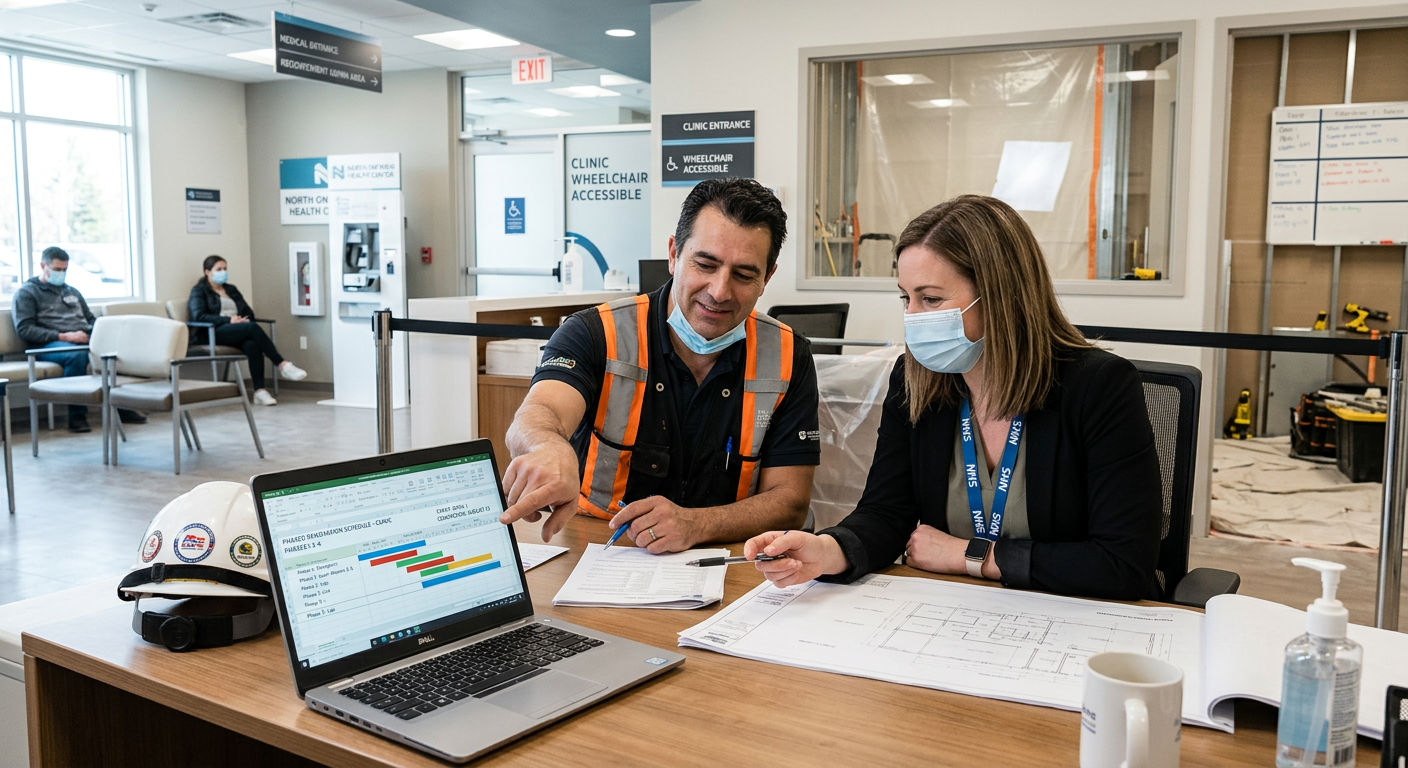
The scheduling relationship between clinical operations and construction activities is the most important operational variable in a phased clinic renovation. A contractor who has managed phased healthcare renovations before understands how to sequence work to minimize clinical disruption; a contractor who has not managed this scenario will create unnecessary disruption through poor sequencing.
Demolition, concrete drilling, and heavy equipment use are the highest acoustic impact construction activities. In a phased renovation with active clinical operations adjacent to the construction zone, these activities must be scheduled outside clinical hours — before 8:00 AM and after 6:00 PM on weekdays, and all day on weekends and holidays. The contractor’s schedule must identify “acoustic impact events” explicitly and confirm that clinical scheduling is aware of each event. Clinical staff should not schedule audiometric testing, sensitive patient consultations, or procedures requiring patient cooperation in rooms adjacent to acoustic impact events. A shared weekly schedule between the clinic’s scheduling coordinator and the contractor’s project manager — a 15-minute call at the start of each week — prevents the majority of acoustic conflicts that erode the clinical relationship with a renovating contractor.
HVAC work in a phased renovation frequently requires system shutdowns that affect both the construction zone and adjacent clinical areas. A system shutdown that occurs during a clinical afternoon in July — when the clinic temperature rises to 29°C within 90 minutes — is both a patient discomfort issue and a potential safety concern for elderly or medically fragile patients. HVAC shutdowns must be pre-approved by the clinic’s operations manager at least 48 hours in advance, scheduled for the lowest-impact clinical window, and limited to the minimum duration necessary. If the HVAC system cannot be restored before the next clinical day, the clinic needs advance notice to cancel or reschedule appointments and communicate with patients. A contractor who cannot commit to HVAC shutdown scheduling protocols of this precision is not ready for phased healthcare construction.
| Practice Type | Annual Revenue | Cost of 10-Week Closure | Phasing Premium (15%) | Net Benefit of Phasing |
|---|---|---|---|---|
| Solo GP (1 physician) | $350,000 | $67,000 | $45,000–$75,000 (on $300K reno) | Marginal — evaluate case by case |
| 2-physician family practice | $650,000 | $125,000 | $60,000–$100,000 | $25,000–$65,000 net benefit |
| 4-physician FHT | $1,300,000 | $250,000 | $75,000–$125,000 | $125,000–$175,000 net benefit |
| Walk-in clinic (high volume) | $900,000 | $173,000 | $50,000–$80,000 | $93,000–$123,000 net benefit |
| Specialty clinic (physiotherapy) | $600,000 | $115,000 | $42,000–$70,000 | $45,000–$73,000 net benefit |
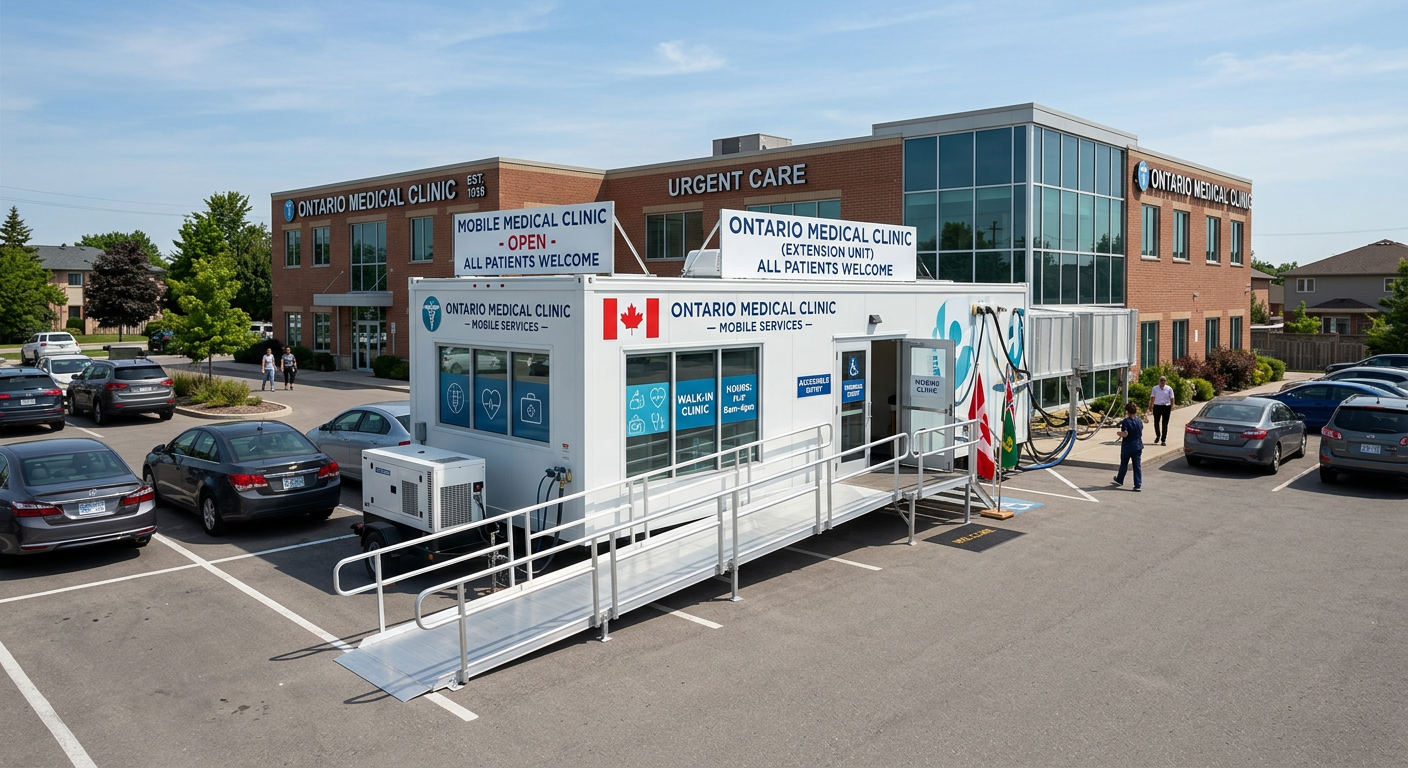
Some renovations cannot be phased at all — a complete structural reconfiguration, a foundation or HVAC replacement, or a ground-up fit-out of a new space requires full clinical evacuation. In these cases, a temporary clinic provides the alternative to complete closure — maintaining patient relationships and revenue generation while the permanent space is under full construction.
Modular medical clinic units — prefabricated, portable clinic structures that can be delivered to a parking lot or vacant outdoor area adjacent to the permanent clinic — are the fastest temporary clinic option available in Ontario. Leading providers of medical modular units in the GTA: ModSpace, Williams Scotsman, and BOXX Modular. A basic medical modular unit suitable for GP practice: 40-foot trailer with two exam rooms, a reception area, and accessible entry, delivered and connected in 3–5 days. Monthly lease cost: $4,500–$9,000 per month including delivery, setup, and site utilities connection. Requirements: an accessible parking area or open ground, temporary electrical and water connection (HVAC is typically self-contained in the unit), and municipal temporary structure permission (City of Toronto requires a site plan amendment for modular structures occupying parking areas; most 905 municipalities require only a building permit for temporary structures). For a 10-week renovation, total modular unit cost: $11,000–$22,500 plus $3,000–$6,000 for site preparation and utilities. Far less than the $125,000–$250,000 revenue loss from complete closure.
Another Ontario-specific temporary clinic option is a temporary practice sharing arrangement with a peer practice — using exam rooms at another family medicine or specialty clinic during their off-hours (evenings, early mornings, or weekend slots when the host practice is not using the space). This arrangement is most common between practices in the same building or medical complex, where existing EMR connectivity and familiarity with the physical space makes the transition straightforward. A shared space agreement for temporary practice accommodation typically costs $800–$2,500 per week in room rental, access fees, and administrative support from the host practice — significantly less than a modular unit for short renovations (4–6 weeks). The shared space approach also eliminates the municipal permitting process required for a modular unit. The limitation: shared space availability is constrained by the host practice’s own scheduling and may not provide the number of exam rooms needed for full practice capacity.
For Ontario family medicine practices with OHIP telehealth billing authorization (available to all Ontario physicians since the 2020 OHIP telehealth expansion), telehealth appointments can absorb a significant portion of routine appointments that do not require in-person examination during a renovation period. A practice that shifts 30–40% of its appointment load to telephone or video consultations during a renovation can operate at 80–90% of normal appointment volume from a reduced in-person footprint — requiring fewer physical exam rooms. This approach is most effective for: medication management appointments, mental health follow-up, test result review, referral coordination, and prescription renewal — all routine family medicine activities that are clinically appropriate for telephone or video. Telehealth augmentation is not appropriate for acute illness assessment, physical examination-dependent diagnoses, or any appointment where hands-on assessment is clinically indicated. A Mississauga solo GP maintained 85% appointment capacity during a 12-week clinic renovation by converting all routine follow-up appointments to telephone, requiring only one exam room on-site for acute and physical examination appointments. Revenue loss during the 12-week period: $22,000. Comparable complete closure loss: $81,000.
A Richmond Hill walk-in clinic completed a $290,000 renovation using zone-by-zone phasing over 18 weeks in 2024. Phase 1 (weeks 1–8): reception, waiting area, and two washrooms renovated while 6 of 8 exam rooms remained operational at 75% appointment capacity. Phase 2 (weeks 9–14): four exam rooms renovated while reception and remaining four exam rooms operated at 50% capacity. Phase 3 (weeks 15–18): final four exam rooms renovated, reception fully operational, 50% appointment capacity. Direct revenue loss across 18 weeks: $43,000. Patient transfer: less than 4% of active roster. Phasing premium over complete closure estimate: $35,000. Net benefit of phasing versus complete closure (estimated at 10 weeks): revenue savings of $67,000 minus phasing premium of $35,000 = $32,000 net benefit, plus the avoided patient attrition of 12% estimated for a 10-week closure. Total economic benefit of phasing including attrition prevention: $120,000+.
A 5-physician Markham FHT completed a full 8-room exam room renovation in 2023 using staggered two-room sequencing over 14 weeks. Two rooms were under renovation at all times; six rooms operated at reduced capacity. Appointment capacity maintained: 75% of normal. Direct revenue loss: $98,000. Patient transfer: 2.8% of roster. Complete closure estimate for the same project: 8 weeks, $238,000 revenue loss. Phasing premium: $52,000. Net economic benefit of phasing: revenue savings $140,000 minus phasing premium $52,000 = $88,000 net benefit. The FHT administrator notes that the ongoing IPAC barrier management — weekly HEPA filter check, daily negative pressure verification, barrier integrity inspections — required approximately 3 hours per week of administrative time not included in the original renovation management budget.
The Brampton case at the opening of this guide represents the complete closure outcome. Ten-week complete closure for a $480,000 renovation. Direct revenue loss: $250,000. Patient attrition: 18% (340 patients of 1,900-patient roster). Estimated lifetime value of lost patients: $1.3–$1.9 million. The clinic’s accountant calculated the true economic cost of the closure decision at $1.55 million over the subsequent five years, incorporating both the direct revenue loss and the compounding effect of reduced patient roster on annual billing. The phasing premium they were quoted and declined: $65,000. The ratio of closure cost to phasing premium: 24:1. The Brampton partners do not intend to repeat the calculation when their next renovation is required.
Staff turnover during clinic renovation is an underestimated risk. Administrative staff who have built their workflows around a specific physical environment — desk placement, document storage systems, patient flow patterns — experience significant disruption when that environment is altered for months. Clinical staff who are constrained to fewer rooms, noisier conditions, and reduced patient volume may experience both boredom (if volume drops too low) and stress (if the renovation creates unpredictable daily working conditions). Two staffing strategies that address this risk in phased renovations are job rotation and enhanced communication.
Staff who are temporarily displaced from their usual function by a construction zone — a receptionist whose desk is in the construction zone, a nurse whose exam room is under renovation — can be cross-trained and rotated to other clinical support functions during the construction period. This approach maintains staff hours and income while broadening clinical capabilities — an investment in staff development that the practice benefits from after renovation is complete. Practices that implemented cross-training programs during renovation construction periods in GTA reported 40–60% lower staff turnover than practices that temporarily reduced staff hours due to reduced clinical capacity. The financial cost of replacing a trained medical administrative assistant in a GTA family medicine practice — including recruitment, onboarding, and productivity loss during the learning curve — is estimated at $8,000–$18,000. Cross-training costs a fraction of replacement cost and produces a more versatile staff member who remains with the practice after the renovation is complete.
Creating visible progress milestones — and acknowledging them with the team — maintains staff morale during an extended phased renovation that can feel like it will never end. A weekly 5-minute renovation update at the start of the morning meeting, a team lunch when a construction zone is completed and handed back to clinical use, and a reopening celebration with the full team when the renovation is complete are low-cost, high-impact morale investments. Ontario clinic managers who have managed phased renovations uniformly identify “constant uncertainty about when things will be done and whether the disruption is worth it” as the primary morale challenge. Consistent, honest communication from clinic leadership — including acknowledging setbacks when they occur — addresses this challenge more effectively than optimistic projections that are later contradicted by reality.
This guide has focused heavily on strategies for reducing downtime — but intellectual honesty requires acknowledging that complete closure is sometimes the correct choice. The renovation scope may require simultaneous work across the entire clinical footprint — a structural reconfiguration that opens all walls at once, a slab replacement that makes the floor unusable throughout, or an HVAC system replacement that shuts down the entire building HVAC for weeks. In these cases, phasing is not possible regardless of budget. The correct response is to accept the complete closure, plan the modular or swing space solution, execute the patient communication strategy described above, and manage the project to the shortest possible closure timeline. A complete closure that is planned with patient communication, a temporary clinic solution, and aggressive project scheduling produces far better outcomes than the Brampton case — where the closure was accepted without any of those mitigation steps. The decision is not “phase or close” — it is “minimize total economic impact through whichever approach is available.” Sometimes that means phasing. Sometimes it means closing and managing the closure as actively as possible. The goal in both cases is identical: retain patients, maintain staff, and reopen in the shortest time consistent with renovation quality.
No — phased renovation is not universally superior to complete closure. For solo practitioners billing below $250,000 annually, the phasing premium can exceed the revenue loss from complete closure, making closure the economically rational choice. For practices with easily accessible patient populations that have many alternative providers nearby, patient attrition risk may be high enough that phasing is always justified. The decision requires a specific calculation for each practice based on revenue, attrition risk, and phasing premium — not a general rule. The table in the previous section provides the calculation framework.
A phased GP clinic renovation typically takes 1.5–2.5 times longer than the equivalent complete closure renovation. A complete closure renovation estimated at 10 weeks will take 15–25 weeks when phased. The extended timeline reflects: the scheduling constraints on construction hours (no acoustic impact work during clinical hours), the additional set-up and teardown time for barriers and negative pressure systems, and the sequential zone-by-zone approach that prevents concurrent work across the entire clinic footprint. Clinics that choose phased renovation must budget for this extended timeline in terms of contractor availability and their own operational patience — 20–25 weeks of reduced-capacity operation is a meaningful operational burden, even if it is economically superior to complete closure.
PHO IPAC guidelines recommend a formal Infection Control Risk Assessment (ICRA) before any construction in or adjacent to occupied healthcare settings. The ICRA documents: the nature of the construction activity (demolition, renovation, maintenance), the location relative to clinical zones, the patient population susceptibility in adjacent areas, and the required control measures (barrier type, negative pressure, traffic routes, PPE for workers). For a small clinic renovation, the ICRA can be completed by the clinic’s infection control officer (or a consultant if the clinic does not have a dedicated ICO) using the PHO ICRA matrix tool — a straightforward risk stratification matrix available from Public Health Ontario. The completed ICRA becomes part of the clinic’s renovation documentation file, demonstrating regulatory due diligence if a compliance inspection occurs during or after construction.
Clinical staff can remain on-site during phased renovation in the clinical zones — areas that are not part of the active construction zone. However, staff wellbeing during extended phased renovation requires active management: construction noise, dust (even with barriers), disrupted workflows, and reduced workspace create cumulative stress that can affect staff performance and retention. Practical measures that support staff wellbeing during a phased renovation: provide noise-cancelling headphones for staff who experience significant construction noise in their workspace, maintain clear communication about construction milestones and expected improvements as zones are completed, and acknowledge the additional burden that phased renovation places on staff in clinical briefings. A Newmarket family health team that managed a 20-week phased renovation reported that staff who received regular milestone updates and acknowledgment of the burden remained engaged throughout; a control group that received minimal communication had two resignations during the construction period.
Yes — phased construction adjacent to active clinical operations is a specialized construction management capability that many healthcare renovation contractors do not have. A contractor qualified for phased healthcare construction can demonstrate: experience managing ICRA-level infection control barriers in an occupied healthcare setting, a documented process for coordinating construction schedules with clinical schedules, HVAC shutdown coordination protocols, and acoustic impact scheduling methodology. Ask specifically: “Have you managed phased construction in an occupied healthcare facility, and can you provide references from a physician or clinic manager from that project?” A qualified contractor answers yes with a specific project reference. A contractor who says “yes, we can do that” without a specific reference has not done it and does not understand the operational complexity involved.
Based on Ontario primary care attrition research and GTA practice management data, maintaining 50% of normal appointment capacity during renovation reduces patient attrition to approximately 3–6% — comparable to normal annual roster turnover and well within acceptable range. Capacity below 40% increases attrition risk significantly; below 30% creates attrition rates (10–18%) that are difficult to recover from. The critical patient communication around capacity reduction is proactive scheduling: clinics that contact all patients with upcoming appointments to reschedule before construction forces a cancellation have 60–70% lower attrition than clinics that cancel reactively. Patient frustration comes from uncertainty and lack of control — scheduling alternatives in advance converts a problem into a service experience.
The most common question Ontario clinic owners ask when planning a renovation is: “What should this cost per square foot?” It is also the...
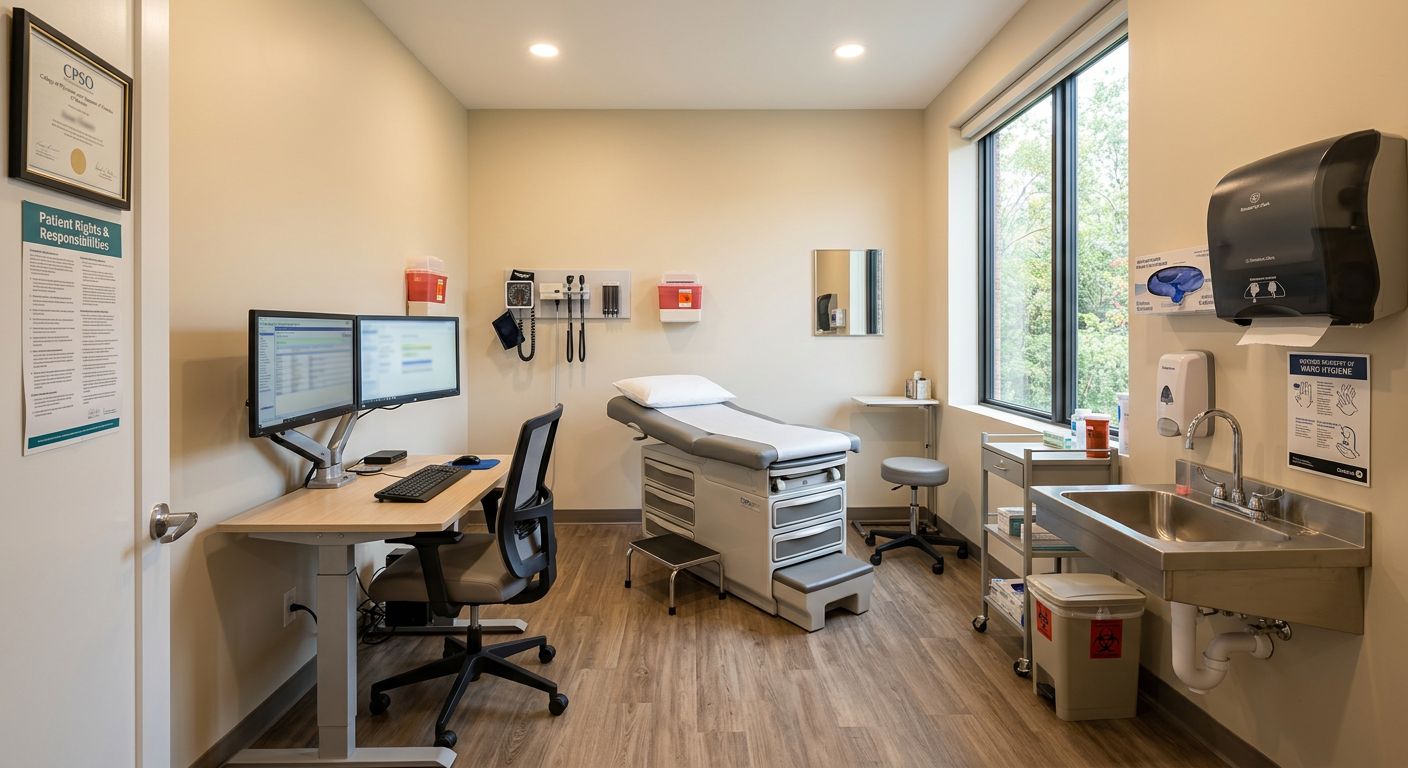
Dr. Chen had been planning his North York family practice renovation for eighteen months. The practice had grown from a solo GP to a...
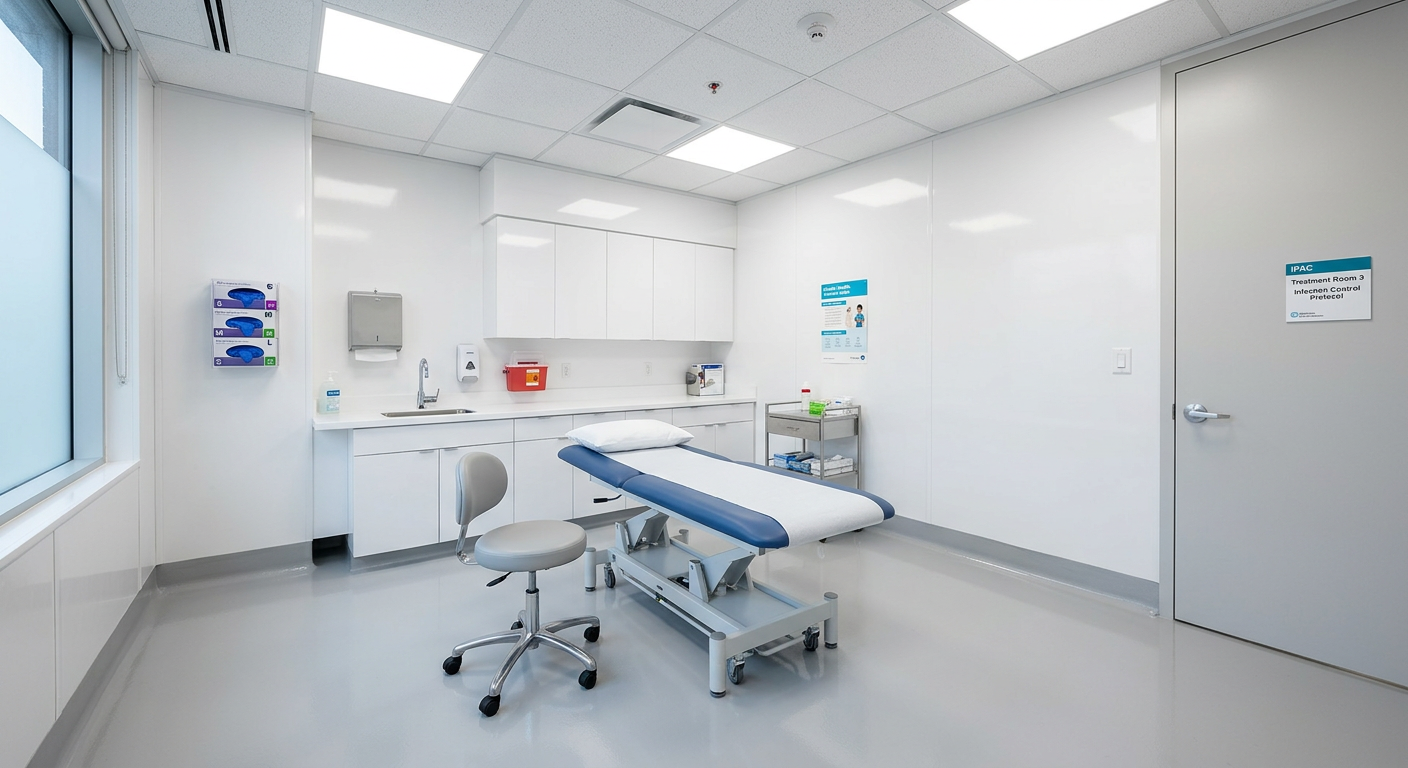
Choosing the right construction materials is critical for infection control in Ontario clinics. Learn what Toronto Public Health and IPAC inspectors look for in...
