

March 13, 2026

The Newmarket physiotherapy clinic had a problem that its owner did not discover until the first patient used the exercise gym. The clinic had...
The Mississauga walk-in clinic opened 40 minutes late on its first Monday morning.
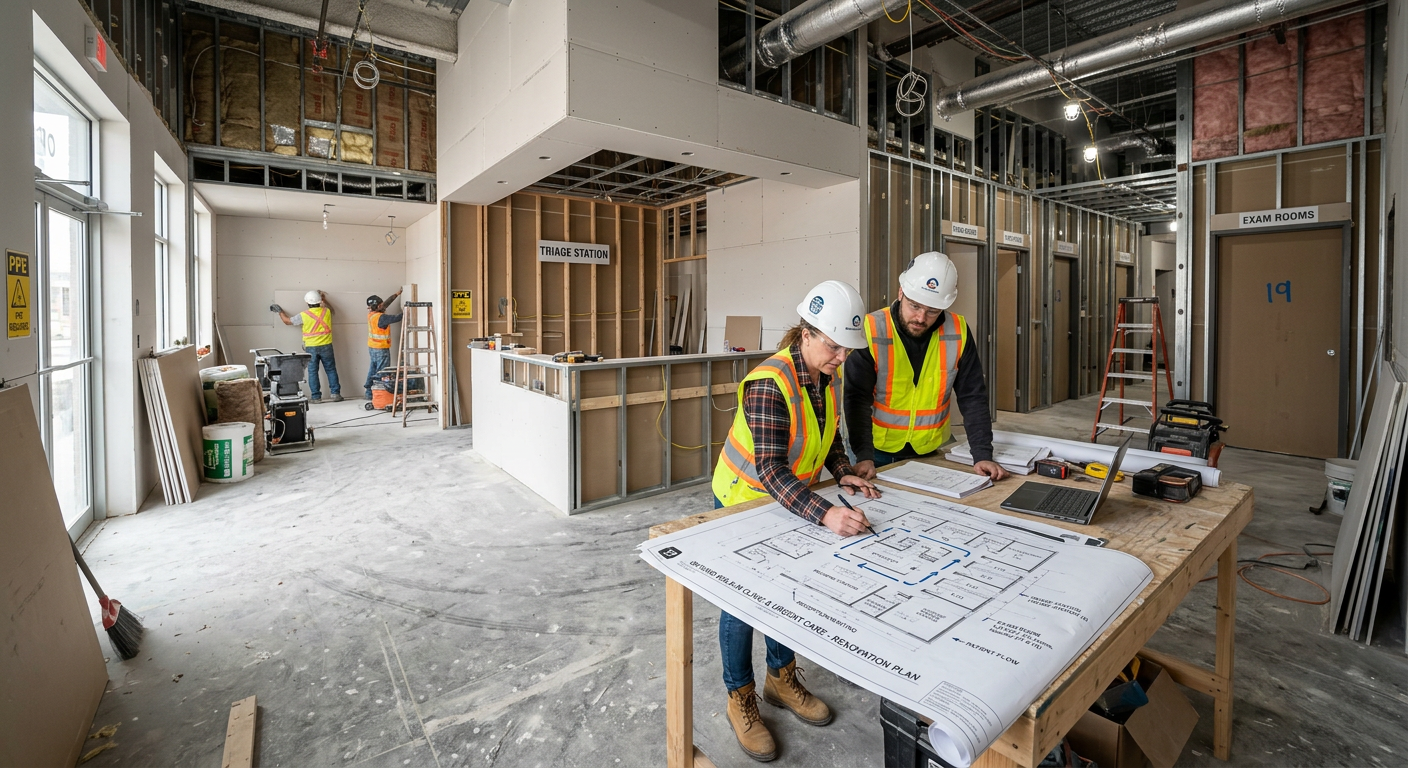
Twenty-three patients were waiting outside when the staff arrived — a line that had formed because the clinic’s Google Business Profile showed it opening at 8:00 AM but the front door lock had been installed by the renovation contractor in a location that required a key that was still with the landlord. A locksmith was called. The first patient was seen at 8:52 AM. By 9:30, the waiting room — designed for 24 patients — held 38. The triage area, which the clinic’s designer had positioned adjacent to the main entrance “to keep it close to reception,” had no acoustic privacy: every patient who arrived and described symptoms to the triage nurse was audible to everyone seated within 6 metres. By noon, the clinic had generated three patient complaints, one PHO IPAC inquiry about the overcrowded waiting room, and a social media post about the noise levels that had 14 shares by evening.
None of these problems were caused by poor clinical care. All of them were caused by design and construction decisions that were made without understanding how walk-in clinic operations actually work. The clinic’s designer had experience with family medicine offices and specialist clinics — but not with the specific operational pressures of a high-volume, no-appointment urgent care environment where patient flow, infection control, and staff security create design requirements that differ fundamentally from every other clinic type in primary care.
This guide covers every construction and renovation dimension of walk-in clinic design in Ontario — patient flow and triage design, infection control for high-turnover environments, OHIP billing and wayfinding requirements, isolation room specification, after-hours security design, and GTA cost benchmarks for 2026.
Walk-in clinics serve a fundamentally different operational reality from family medicine practices and most specialist clinics. Three characteristics make walk-in clinic design distinct and require specific construction provisions that other clinic types do not need.
A walk-in clinic with 3 physicians sees 120–200 patients per day — 3–5 times the patient volume of a GP practice with the same physician count. This volume creates: a waiting room demand that must accommodate 25–45 simultaneous patients at peak (9:00–11:30 AM and 5:00–7:30 PM), a check-in and registration process that handles 15–25 new patients per hour, exam room turnover rates of 12–20 patients per room per day (versus 6–10 in a GP practice), and a cleaning and disinfection workload that must happen between every patient — not just at end of day. Every design element in a walk-in clinic must be evaluated for its performance at this volume and turnover frequency, not at the lower volumes of appointment-based practices.
Walk-in clinic patients arrive without an appointment and without the pre-screening that occurs when a patient books with their GP. The clinic’s triage function — assessing the acuity of each patient at arrival and directing them to the appropriate level of care — is a clinical function that requires spatial support from the facility design. A triage station that cannot visually monitor the waiting room, that lacks acoustic privacy from the waiting area, or that cannot physically separate a high-acuity patient from the general waiting population creates both clinical risk (inability to detect a deteriorating patient) and IPAC risk (a potentially infectious patient in the general waiting area). The case study above is a direct consequence of a triage design that failed on the acoustic privacy requirement.
Most Ontario walk-in clinics operate 7 days per week, often until 8:00–10:00 PM or later. This operating reality creates security and access control requirements that appointment-based clinics do not face: a single physician and nurse may be the only staff in the clinic at 9:30 PM with a patient whose presenting complaint and mental state are unknown. A walk-in clinic design that does not address staff security in an after-hours scenario is incomplete. Specific design provisions for after-hours security include: a secure staff exit path from exam rooms to the rear of the building (not through the waiting room), a private staff washroom accessible without entering patient areas, a door lock and intercom system that allows staff to screen patients before granting entry after hours, and clear sightlines from the nursing station to both the waiting room entrance and the exam room corridor without requiring staff to leave their workstation.
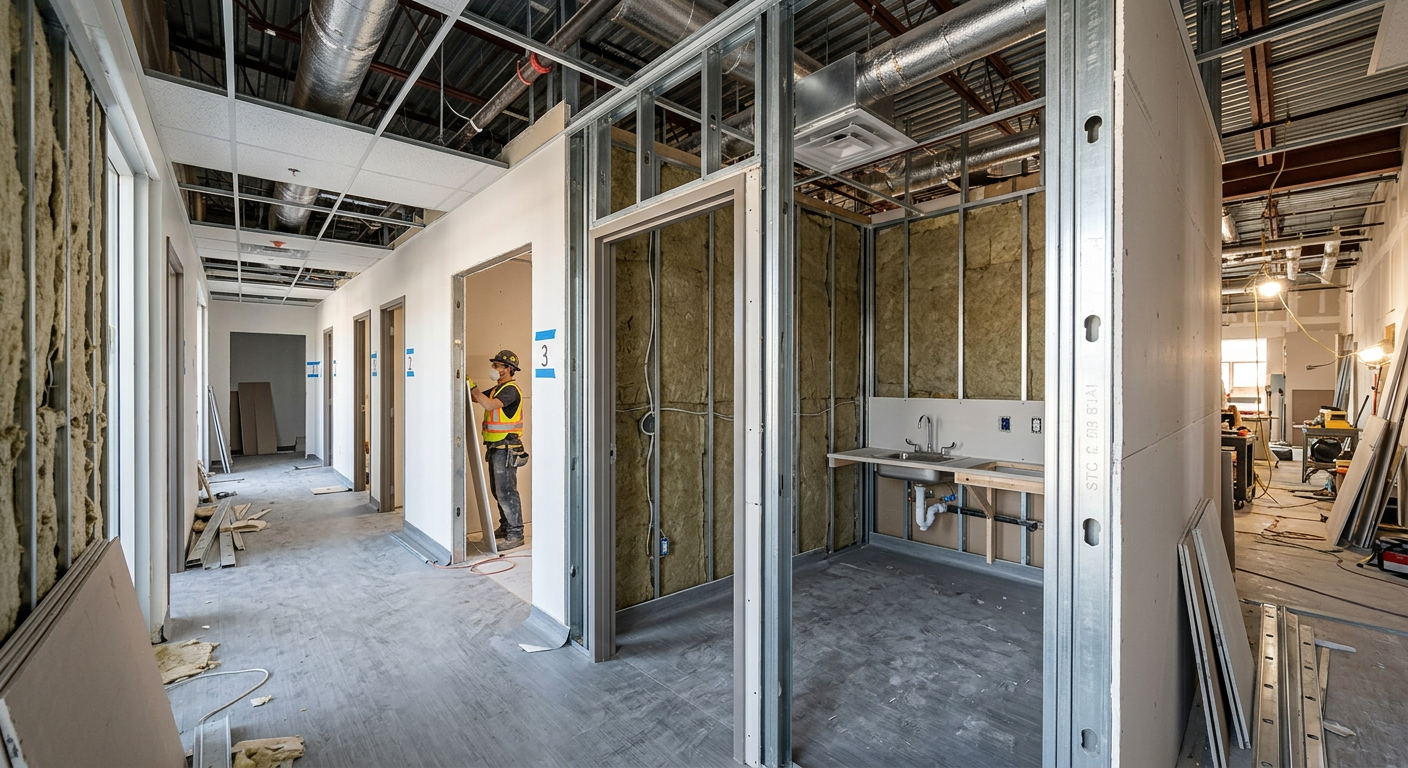
Patient flow in a walk-in clinic follows a sequence — entry/check-in, waiting, triage assessment, exam room, discharge/prescription — that the physical layout must support efficiently. Layouts that create patient flow bottlenecks at any stage of this sequence reduce clinical throughput and generate patient satisfaction problems that are disproportionately visible in online reviews.
The entry and check-in area of a walk-in clinic must accommodate three simultaneous patient states: patients entering who have not yet registered, patients standing at the registration counter, and patients who have registered and are looking for seating. A single-lane reception desk that creates a queue extending into the waiting area — common in under-designed walk-in clinics — blocks patient circulation and creates social pressure that exacerbates waiting room crowding perception. Optimal walk-in clinic entry design: a two-position reception counter with a clear queue guide (floor markers or a divider rail), a self-check-in kiosk for returning patients (reduces counter wait time by 30–40% during peak hours), a clear directional flow from entry to waiting area that does not cross the registration queue, and a separate entrance for patients returning from prescription pickup who need to re-enter the exam stream.
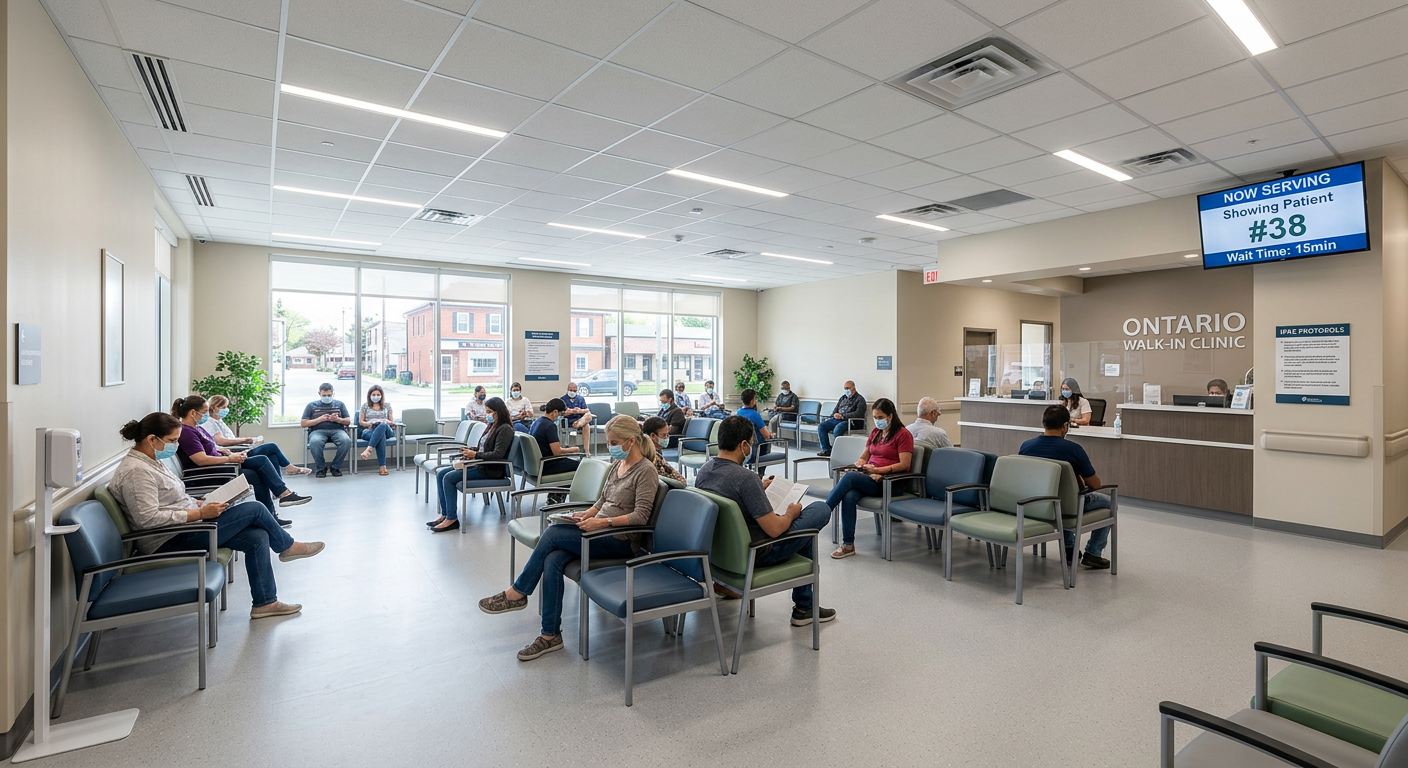
Walk-in clinic waiting rooms must accommodate peak loads of 30–50 patients simultaneously in a 600–1,000 square foot space — a density that creates infection control challenges, acoustical challenges, and patient comfort challenges simultaneously. Design provisions that address all three: fixed seating with wipeable upholstery and integral armrests in 60% of positions (fast cleaning, elderly patient comfort), removable chairs without fabric in 40% of positions (rearrangeable for surge capacity, no fabric to harbour pathogens), individual HVAC supply outlets directing fresh air downward in each seating zone (reducing cross-patient airflow), hand hygiene stations at two locations in the waiting area (not just at the entry), and visual displays showing current wait times (reduces patient anxiety and perceived waiting time by 25–35% in research on urgent care facilities). IPAC-compliant waiting room flooring: welded sheet vinyl with coved base (no grout lines, no carpet) in the full waiting area including the corridor approach.
The triage station is the most clinically critical design element in a walk-in clinic — and the most commonly under-specified. Requirements: full acoustic privacy from the waiting room (STC-45 minimum partition or an enclosed assessment room), direct visual sightlines to both the entry point (so the nurse can observe patient arrival and presentation) and the waiting area (to monitor patient condition during waiting), physical separation capability (an ability to direct a high-acuity patient from the triage area directly to an exam room without transiting the general waiting area), and proximity to the handwashing sink (triage involves physical contact assessment that requires pre-and-post hand hygiene). A triage station that satisfies all four requirements is either an enclosed room with a window to the waiting area and an adjacent corridor to the exam rooms, or a semi-enclosed station with STC-45 partitions, a one-way window to the waiting area, and a direct corridor exit. The open-plan triage station adjacent to reception — common in cost-reduced walk-in clinic designs — satisfies none of these requirements.
Walk-in clinic IPAC requirements are more demanding than those for appointment-based clinics because the combination of high patient volume, unknown acuity, and no pre-screening creates a higher infection transmission risk in the physical environment. PHO IPAC guidelines apply fully to walk-in clinics, with additional considerations for high-volume urgent care environments.
Walk-in clinic exam rooms must be cleaned and disinfected between every patient — not just at the end of each session. This cleaning frequency requires: non-porous surfaces on every surface the patient contacts or that the healthcare provider contacts on the patient’s behalf (exam table, armrests, countertop, door handle, light switch, sink faucet), seamless or welded flooring that can be wiped without seam contamination, and a cleaning supply storage location inside each exam room (to prevent staff from transiting the corridor with cleaning supplies between rooms — an IPAC risk in a high-volume environment). The exam room design standard for a walk-in clinic is identical to the standard for a GP office procedure room — the higher IPAC standard is justified by the frequency of cleaning and the unknown IPAC status of walk-in patients.
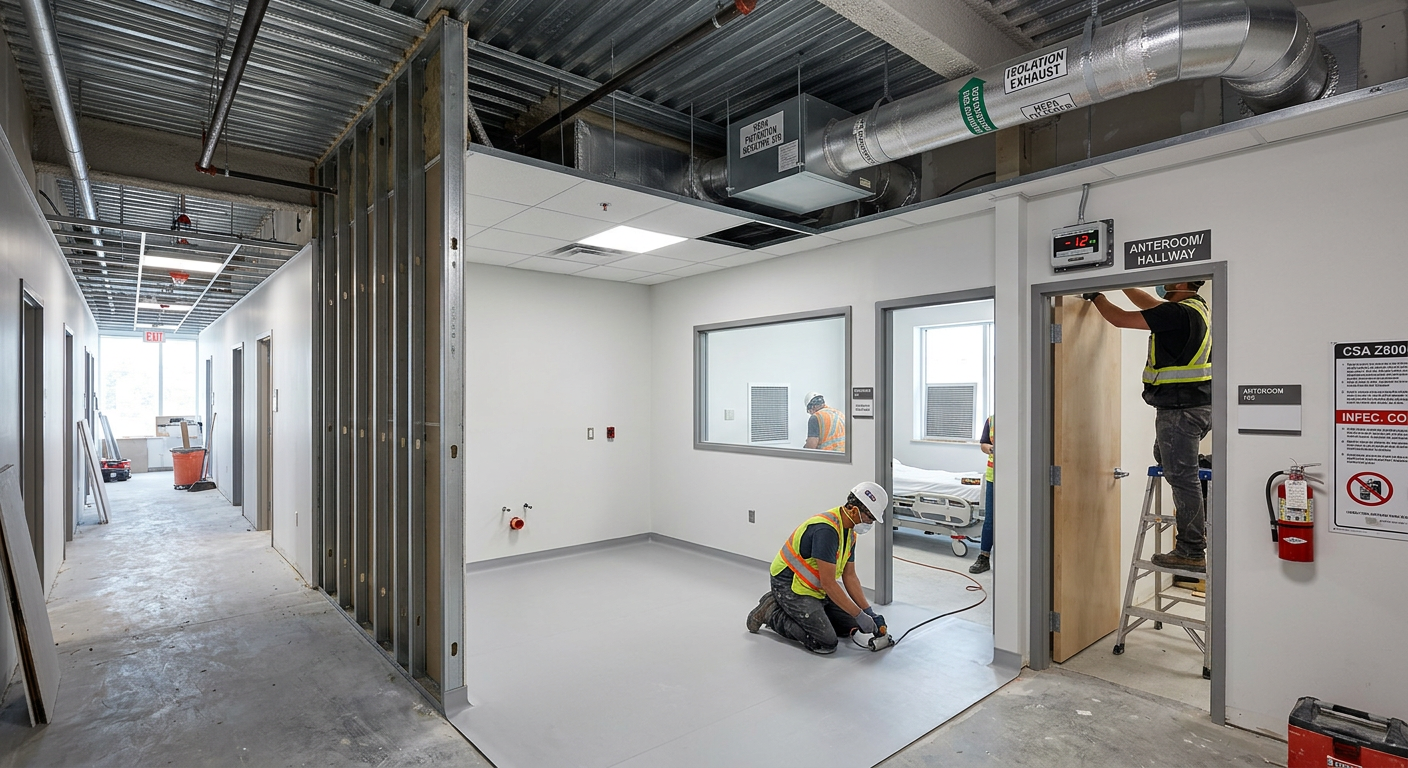
An isolation room — a single-patient room with negative pressure capability, a private anteroom for donning and doffing PPE, and direct access to a handwashing sink — is a required element of walk-in clinic design in Ontario for any clinic that accepts patients with respiratory illness presentations. PHO IPAC guidance for primary care settings specifies isolation precautions for patients with suspected or confirmed respiratory infections, and the physical capacity to implement those precautions requires a designated isolation room. The isolation room specification: minimum 10’×12′ clear floor area with the ability to establish negative pressure (a portable HEPA negative air machine connection point is the minimum; a dedicated negative pressure HVAC system is the full standard), a private anteroom of at least 40 square feet for PPE donning and doffing, a handwashing sink in the anteroom, and a dedicated patient washroom accessible from the isolation room without transiting the corridor. Isolation room construction cost: $45,000–$90,000 depending on negative pressure specification and anteroom size.
Walk-in clinic patients touch more surfaces per visit than appointment-based clinic patients — they handle pens at check-in, door handles, magazine racks (remove these — they cannot be disinfected), armrests, exam room surfaces, and bathroom fixtures. Every high-touch surface in a walk-in clinic should be specified at healthcare grade: antimicrobial copper alloy or stainless steel door hardware, wipeable armrest surfaces (no fabric, no porous padding), dispensed hand hygiene at every high-touch zone entry, no soft furnishings in the waiting room, and no paper or textile materials in patient zones that cannot be single-use or disinfected between patients. The cost premium for antimicrobial hardware specification over standard commercial hardware: $180–$400 per door set. A 20-door walk-in clinic with antimicrobial hardware on all high-touch access points: $3,600–$8,000 additional cost versus standard hardware — a trivially small investment relative to the IPAC risk reduction it provides.
Walk-in clinics billing OHIP for primary care services have specific administrative infrastructure requirements that must be reflected in the physical design. Three design elements support OHIP billing and patient administrative workflows in a walk-in clinic environment.
Ontario walk-in clinics are required to verify OHIP eligibility at each patient visit — a process that requires either a health card reader terminal at the registration desk or a workstation with OHIP online verification access. The registration desk must accommodate: a health card reader (counter-mounted or handheld, requiring a power outlet and ethernet connection at the desk), a computer workstation for EMR registration and OHIP eligibility verification, a patient-facing signature pad for OHIP consent and registration forms, and physical storage for cash, debit terminal, and administrative supplies. A registration desk that lacks proper power and data infrastructure for these functions forces improvised solutions — extension cords, wireless devices with connectivity issues, and slow patient check-in processes that exacerbate waiting room crowding. Specifying 4 duplex outlets and 2 ethernet ports at the registration desk during rough-in costs $400–$800; retrofitting these connections post-construction costs $1,800–$4,500.
Walk-in clinics must comply with AODA DOPS wayfinding requirements for signage — high contrast characters, Braille on room identification signs, and accessible height placement. Beyond AODA, walk-in clinic wayfinding must address a specific challenge: patients arrive without an established relationship with the clinic and must navigate to registration, waiting, triage, washrooms, and discharge without staff escort. Clear, unambiguous wayfinding signage throughout the clinic eliminates the patient navigation confusion that generates unnecessary staff time (answering “where is the washroom?” repeatedly is a measurable administrative burden) and patient frustration. Wayfinding signage package for a standard walk-in clinic: $3,500–$8,000 for fabrication and installation of a complete wayfinding set including entrance direction, registration, waiting room, triage, exam rooms, washrooms, and exit signs compliant with AODA requirements.
Modern Ontario walk-in clinics increasingly use point-of-care (POC) testing — rapid strep tests, influenza tests, urine dipstick analysis, glucose monitoring — that requires a dedicated sample processing area outside the exam rooms. POC testing requires: a small workspace (4–6 linear feet) with a non-porous cleanable countertop, a biohazardous waste container, a handwashing sink adjacent to the workspace, adequate lighting (500 lux minimum), and an electrical outlet for POC analyzer equipment. If this space is not designated in the clinic design, POC testing happens on exam room countertops — creating IPAC contamination risks and slowing exam room turnaround when the nurse must return to the exam room to process samples. A designated POC testing station costs $8,000–$18,000 to build correctly and reduces exam room occupancy time by 5–8 minutes per test — a meaningful throughput improvement at high volume.
Walk-in clinic staff security — particularly in after-hours operations — is a design consideration that is frequently omitted in standard medical clinic renovation specifications. Three security design provisions should be standard in every Ontario walk-in clinic renovation.
Every walk-in clinic must have a staff exit route from the clinical area that does not require passing through the patient waiting room. In single-entrance clinics where all staff must exit through the waiting room, a patient who becomes agitated or threatening creates a security situation with no safe egress for clinical staff. The secure exit path typically routes through a corridor to a rear building exit or a secondary exit accessible only with a staff access card. Building code fire egress requirements define the minimum exit provisions, but staff security requires an exit that is accessible under non-emergency conditions without passing through the waiting room. This provision is typically $3,500–$12,000 in construction cost depending on the degree of corridor modification required — and is unquantifiably valuable in the rare but real situation where a staff member needs to leave the clinical area without confrontation.
After-hours entry control — the ability to screen patients before granting access to the clinic — is achieved through a video intercom system at the entry door that allows staff at the nursing station to see and speak with a patient before remotely unlocking the door. This system requires: a video intercom panel at the exterior entry, a monitor and remote lock-release at the nursing station, and a heavy-duty electric strike or magnetic lock on the entry door. Installation cost: $3,500–$8,000 for a standard walk-in clinic entry control system. The alternative — an unlocked door that any person can enter at any time — is not a security solution for a healthcare facility operating until 10 PM in an urban environment.
The nursing station in a walk-in clinic must provide the staff member at the station with direct sightlines to: the entry door (to observe patient arrival), the registration desk (to assist with intake when a second person is not at reception), the waiting room (to monitor patient condition during waiting), and the exam room corridor (to direct patients to rooms). This visibility requirement drives the placement of the nursing station in the clinic layout — it cannot be in a back-of-clinic position or behind a closed office. The nursing station that satisfies all four sightline requirements is typically centrally located relative to all clinical zones, with a counter that provides 270 degrees of visibility when the staff member is standing. Achieving this visibility in an existing space renovation sometimes requires removing partition walls that block sightlines — a modest construction cost with significant operational impact.
| Component | Low Estimate | High Estimate | Notes |
|---|---|---|---|
| Per exam room (complete fit-out) | $28,000 | $55,000 | Seamless flooring, sink, between-patient cleaning infrastructure |
| Triage station (enclosed) | $22,000 | $45,000 | STC-45 partitions, window, acoustic door, sink |
| Isolation room with anteroom | $45,000 | $90,000 | Negative pressure provision, PPE station, dedicated washroom |
| Reception and check-in (2-position) | $35,000 | $70,000 | AODA counter, kiosk rough-in, data/power infrastructure |
| Waiting room (30-person capacity) | $28,000 | $55,000 | IPAC-grade seating, flooring, HVAC, ABHR dispensers |
| POC testing station | $8,000 | $18,000 | Dedicated sample processing area with sink and waste |
| Entry security system | $3,500 | $8,000 | Video intercom, electric strike, remote unlock at nursing station |
| Full walk-in clinic fit-out (1,800 sq ft, 3 physicians) | $320,000 | $580,000 | 6 exam rooms, triage, isolation, reception, waiting area |
| Full walk-in clinic fit-out (2,500 sq ft, 4–5 physicians) | $480,000 | $850,000 | 8 exam rooms, triage, isolation room, full reception suite |
Walk-in clinic renovation permit requirements vary across the GTA, with differences in processing times, inspection protocols, and fee structures that affect project scheduling. Understanding municipal variation before tendering allows realistic timeline planning and prevents schedule surprises that delay opening day.
Toronto Building requires a Building Permit for any interior medical renovation that changes occupancy classification or involves plumbing or HVAC modification. Walk-in clinic renovations almost always trigger occupancy review (converting retail or general office to Group B Division 2 medical occupancy under OBC Part 3). Processing time for a commercial healthcare renovation permit: 15–25 business days for an initial permit. Where mechanical or plumbing scope is significant, the Toronto Fire Prevention Office conducts a separate review that adds 5–10 business days. Toronto Public Health may conduct a pre-opening inspection for clinic types (walk-in, urgent care) that see acute patients. Toronto clinics should budget 8–14 weeks from permit submission to permit issuance on a typical 2,200–3,500 sq ft walk-in renovation — and should not begin construction until the permit is issued.
York Region municipalities process commercial healthcare permits in 10–18 business days for standard walk-in clinic renovations. Vaughan Building Standards and Richmond Hill Building and Regulatory Services both use electronic permit submission (EPR) that reduces administrative delays. Markham Building Standards requires a pre-application consultation for clinics with isolation room scope — a meeting that adds 5–7 business days but often surfaces plan issues early enough to avoid a resubmission. York Region Public Health may require a pre-opening visit for walk-in clinics that will see patients with suspected communicable disease. Budget 6–10 weeks from permit submission to issuance for a York Region walk-in clinic renovation.
Peel Region municipalities integrate Peel Public Health into the walk-in clinic permit review for facilities that include isolation rooms, procedure scope, or communicable disease protocols. Mississauga Building typically takes 12–20 business days for permit review; Peel Public Health adds a parallel 5–10 business day review that does not necessarily extend the critical path if both processes run concurrently. Brampton Building requires a structural engineer’s review letter for any partition wall modification in a Class A or B occupancy building. Budget 7–12 weeks for a Peel Region walk-in clinic renovation permit process.
| Municipality | Permit Timeline | Special Walk-In Requirements | Fee Range (2,500 sq ft) |
|---|---|---|---|
| City of Toronto | 15–25 business days | Fire prevention office review; Public Health pre-opening | $8,500–$16,000 |
| Vaughan | 10–16 business days | Electronic submission required | $5,500–$10,000 |
| Richmond Hill | 10–18 business days | EPR submission; public health notification | $5,500–$10,500 |
| Markham | 12–18 business days | Pre-application consultation for isolation scope | $6,000–$11,000 |
| Mississauga | 12–20 business days | Peel Public Health parallel review | $6,500–$12,000 |
| Brampton | 14–22 business days | Structural engineer letter for partitions; PPH review | $7,000–$13,000 |
Walk-in clinic technology infrastructure — EMR integration, patient registration systems, point-of-care testing, and communication systems — must be designed into the renovation from the start. Technology retrofitted after construction consistently costs 2–3x more than technology roughed-in during construction, and technology that conflicts with the architectural layout generates permanent workflow inefficiencies that cannot be corrected without another renovation.
Walk-in clinics in Ontario use EMR systems (typically OSCAR, PS Suite, or a cloud-based urgent care EMR) that require specific infrastructure. At the registration counter: minimum 2 dedicated Cat6a data outlets per workstation, a privacy screen mount position that prevents the registration screen from being visible to the waiting room, and a health card reader mount position at the counter height accessible for standing patients (ODB readers require specific ergonomic placement). In exam rooms: 1 data outlet at the provider workstation position, 1 additional outlet for a wall-mounted monitor, and conduit continuity to a central patch panel. Rough-in conduit during renovation for all data runs — the cost difference between roughing-in conduit during construction ($1,200–$2,800) versus fishing wire through finished walls post-construction ($4,500–$12,000 per run) is substantial across a multi-room walk-in clinic.
Walk-in clinics with multiple exam rooms benefit from a patient call or communication system that allows providers to signal room readiness to reception without walking the corridor. Basic systems: wireless call buttons in each exam room ($280–$650 per room, no rough-in required). Wired nurse call systems: $3,500–$8,500 for a 6-room walk-in clinic, requiring conduit rough-in during construction. Queue management displays (numeric queue systems common in high-volume walk-in clinics): $4,500–$9,000 including display monitor, counter kiosk, and integration with registration software. Rough-in conduit for nurse call wiring during construction costs $800–$2,200 — far less than retrofitting through finished ceilings and walls. If a queue management display will be mounted in the waiting area, specify the wall location and provide conduit and power rough-in during construction.
Walk-in clinics see a higher proportion of distressed, agitated, or intoxicated patients than scheduled-appointment practices. Security infrastructure — camera coverage, access control between public and clinical areas, and a panic alarm system — is a legitimate clinical safety requirement, not an optional add-on. Camera rough-in: specify camera locations during design, provide conduit to each camera position and to the central NVR location. A 2,500 sq ft walk-in clinic typically requires 6–10 cameras (exterior entrance, waiting room, registration, corridor, each exam room corridor). Conduit rough-in during construction: $2,500–$4,500. Cameras and NVR added post-construction using rough-in: $6,000–$14,000. Access control rough-in between public waiting area and clinical corridor: $800–$1,800 for conduit and door position power — far less than retrofitting through a finished door frame.
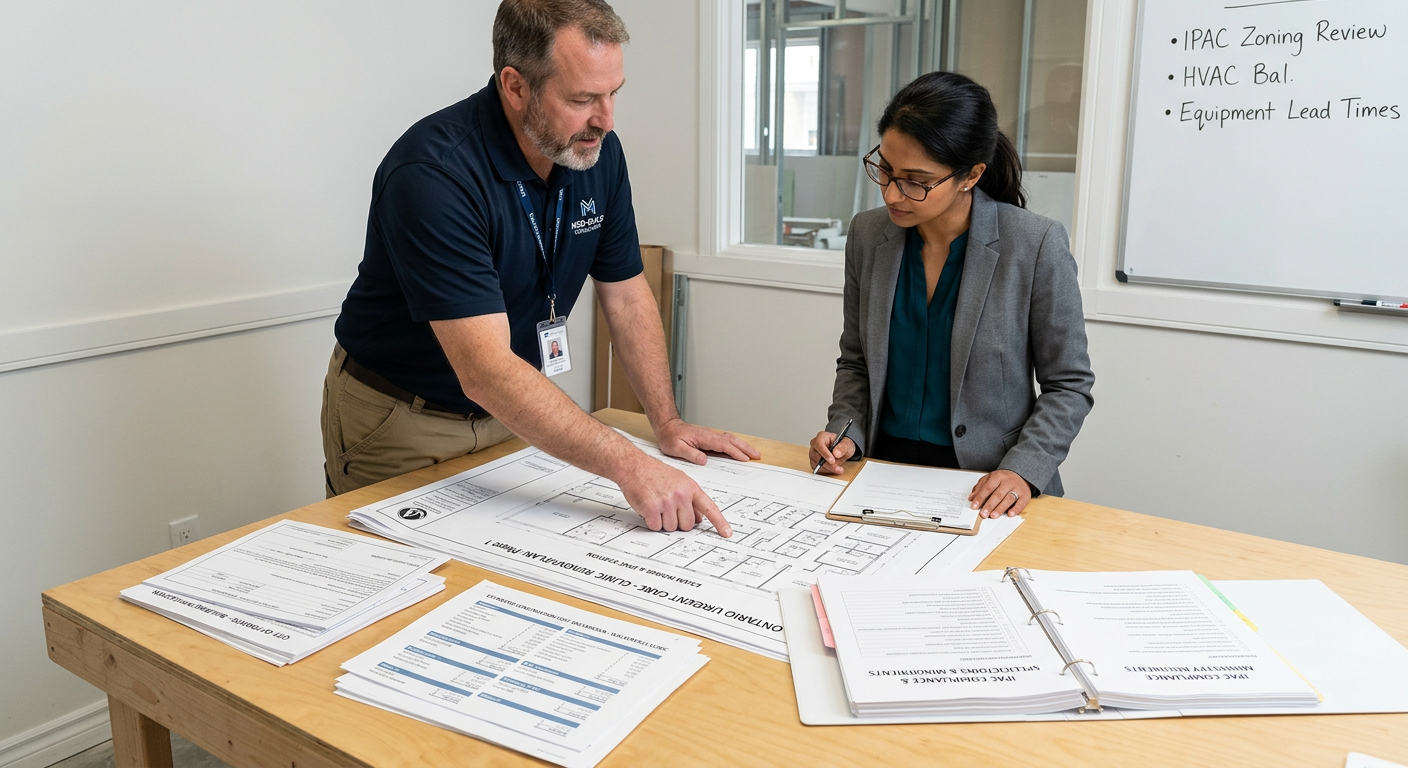
Walk-in clinic renovation requires a contractor who understands both the commercial construction baseline and the clinical overlay — IPAC material specifications, isolation room negative pressure, after-hours security rough-in, and the permit complexity of Group B medical occupancy. Contractors who have renovated general commercial offices or residential spaces consistently underestimate the clinical compliance scope, generating the change orders and delays documented in the case studies throughout this guide. Five questions separate qualified healthcare contractors from general contractors who claim healthcare experience.
A qualified contractor should be able to name specific walk-in or urgent care clinic projects in Ontario — with locations, approximate sizes, and contact references. Contractors who have completed walk-in clinic renovations specifically understand triage flow design, isolation room construction requirements, and the permit process for Group B medical occupancy in GTA municipalities. A contractor whose “medical experience” consists of a single dental office renovation or a GP office refresh has relevant background but lacks walk-in-specific knowledge. Ask for references from the healthcare property managers or clinic owners of completed walk-in clinic projects — and call them. Ask references whether the contractor understood IPAC requirements without being prompted, whether the isolation room was built to spec on the first inspection, and whether the project was delivered on schedule.
HVAC scope in a walk-in clinic renovation — isolation room negative pressure, exam room individual zone control, waiting room ventilation for high-density occupancy, and ASHRAE 170 compliance — requires a mechanical subcontractor with healthcare HVAC experience. Ask the general contractor who their mechanical sub is for medical projects specifically, and ask for that mechanical sub’s healthcare project list. A mechanical subcontractor who has installed isolation room pressure control and HVAC zone systems in medical facilities understands the commissioning requirements and the building inspector’s expectations. A mechanical sub whose healthcare experience is limited to replacing split-system units in a medical office building is not the right choice for an isolation room build. The GC’s mechanical sub selection directly predicts whether the HVAC scope will be built correctly on the first inspection or will require costly modification.
Walk-in clinics that remain partially operational during renovation require contractors who have implemented IPAC construction protocols: hard barrier separation (floor-to-deck partition, not just temporary wall), HEPA-filtered negative air machine in the construction zone, separate construction worker entrance, and daily cleaning at the barrier transition. Ask the contractor to describe their IPAC construction protocol specifically. A contractor who responds with a generic answer about “keeping things clean” has not implemented clinical IPAC protocols before. A contractor who immediately describes the HEPA filtration requirement, the hard barrier specification, and the construction traffic route separation has managed clinical IPAC before. This question also filters out contractors who will agree to IPAC requirements at tender and then implement them loosely on-site — a pattern that generates PHO inspections and costly remediation.
Before any design work begins, validate that the selected space can accommodate walk-in clinic operations. Specific validation items: Is the entry accessible from street-level parking with a direct, weather-protected approach? Does the floor plan support the race-track patient flow required for triage-to-exam-room efficiency? Is the space’s HVAC capacity sufficient for the occupant density of a 35-patient waiting room at peak? Is the landlord’s base building HVAC isolatable to allow the isolation room to achieve negative pressure? Walk-in clinic operations require specific spatial characteristics that not all commercial spaces can provide — confirming these before signing a lease prevents a renovation that produces a layout that does not work clinically.
Architect produces drawings with triage station, isolation room, and security design fully detailed. IPAC consultant reviews triage adjacencies and isolation room specification. Mechanical engineer designs isolation room negative pressure provisions, waiting room HVAC, and exam room individual zone control. Electrical engineer designs reception data/power infrastructure, security intercom system, and EMR workstation rough-in in each exam room. Building permit submission: City of Toronto walk-in clinic permits — 8–12 weeks; suburban GTA — 4–8 weeks. HSO (Health Standards Organization) notification if pursuing accreditation. OHIP billing registration concurrently with design phase.
Plumbing rough-in priority: isolation room washroom (critical path item requiring concrete slab penetration), exam room sinks, triage sink, and POC testing station sink. Electrical rough-in: entry security system conduit and device rough-in, isolation room negative air machine connection point, reception 4-outlet and 2-ethernet positions, exam room workstation positions. HVAC rough-in: individual zone dampers for exam rooms, isolation room HVAC isolation with NAM connection, waiting room supply distribution for 35+ occupant ventilation rate.
Flooring installation: isolation room first (highest specification), exam rooms, waiting room, triage, corridors. Triage station millwork and acoustic partition completion. Entry security system installation and testing: video intercom, electric strike, remote unlock. Reception millwork and health card reader mounting. Seating installation: IPAC-compliant wipeable chairs in waiting room. HVAC commissioning: verify waiting room air change rates for peak occupancy, verify isolation room negative pressure differential. Signage installation: complete AODA-compliant wayfinding set.
IPAC operational walk-through: designate cleaning supply storage in each exam room, document between-patient cleaning protocol for each room, confirm PPE donning and doffing procedure in isolation room anteroom. Staff security training: entry security operation, secure exit path walkthrough, after-hours protocol. OHIP billing system integration: health card reader testing, EMR connectivity verification, OHIP eligibility verification. Soft opening with limited patient volume to test patient flow — identify any bottlenecks at registration, triage, or exam room transitions before full volume opening. Community marketing announcement: 2 weeks before opening, post on Google Business Profile, Healthmatch, and clinic website with hours, address, and walk-in welcome messaging.
PHO IPAC guidance requires that primary care facilities accepting patients with respiratory illness presentations have a mechanism for implementing isolation precautions — which, in a physical design context, means a designated isolation room or the ability to designate a room for isolation purposes. Walk-in clinics are the primary setting in Ontario for patients with respiratory illness presentations seeking care before they are ill enough to require emergency services. A walk-in clinic that does not have a designated isolation room cannot implement the PHO IPAC isolation precautions that protect other patients and staff — creating a compliance exposure and a patient safety gap that increases during respiratory illness seasons. An isolation room is not mandated by building code for walk-in clinics specifically, but it is required for IPAC compliance and is expected by PHO and health unit inspectors who assess walk-in clinic infection control practices.
A walk-in clinic waiting room should be sized for peak occupancy, not average occupancy. Peak occupancy for a 3-physician walk-in clinic operating from 8 AM to 8 PM is approximately 30–45 patients simultaneously during the morning and late-afternoon rush periods. Planning for 15–18 square feet of clear floor area per waiting patient (including circulation paths between seats), the waiting room should be 450–810 square feet for a 30–45 patient peak load. This is significantly larger than the waiting areas of most appointment-based clinics — under-sized waiting rooms produce the overcrowding, patient frustration, and infection control risks that generate complaints and regulatory inquiries. Walk-in clinic owners who are selecting a space should confirm that the available waiting room square footage can accommodate their anticipated peak occupancy before signing a lease.
OHIP billing requirements for walk-in clinics are administrative rather than physical — they govern billing practices, fee codes, and eligibility verification, not the physical design of the facility. However, the physical infrastructure that supports OHIP billing (health card reader positions, EMR workstations, patient registration positions) must be designed into the clinic layout. OHIP billing also creates patient flow requirements: a patient who has not had their health card verified cannot be seen — creating a registration bottleneck if the registration infrastructure cannot handle peak arrival rates. The registration desk design (two-position counter, self-check-in kiosk, adequate data and power infrastructure) is the physical clinic design element most directly driven by OHIP billing workflow requirements.
Shared space between a walk-in clinic and another practice — operating at different hours in the same physical space — is feasible but requires specific design provisions: a universal registration system that works for both practice types (usually an EMR that supports multiple billing profiles), IPAC cleaning between sessions that returns the shared space to the standard required by both practice types, and physical design that accommodates both practices’ patient flow requirements without the shared space becoming a compromise for both. The most common shared walk-in arrangement is a GP practice that opens a walk-in session in evenings and weekends using the same physical space — a model that works when the GP office design includes adequate waiting room capacity and exam room count for walk-in volume. A GP office designed for 2.5 rooms per physician can serve as a walk-in space in evenings when all physicians are present — but it will reach capacity constraint earlier than a dedicated walk-in design.
A walk-in clinic renovation in the GTA — from initial design engagement to patient-ready opening — takes 5–8 months for a standard project (existing commercial space, no structural changes). Design and permit: 8–12 weeks including GTA permit review timelines. Construction: 8–12 weeks for a typical 1,800–2,500 square foot walk-in clinic renovation scope. Pre-opening commissioning and staff training: 2–3 weeks. Regulatory registrations (OHIP billing, health unit notification, HSO accreditation if applicable): 4–8 weeks running concurrently with construction. Walk-in clinic owners who begin planning with a “we want to open in 4 months” timeline regularly find that permit review alone — which cannot be accelerated in most GTA municipalities — consumes 2–3 months of that window. The realistic minimum timeline from first design meeting to first patient is 5 months in the most efficient suburban GTA municipality; 7–8 months in the City of Toronto where permit review takes longer.
The Newmarket physiotherapy clinic had a problem that its owner did not discover until the first patient used the exercise gym. The clinic had...
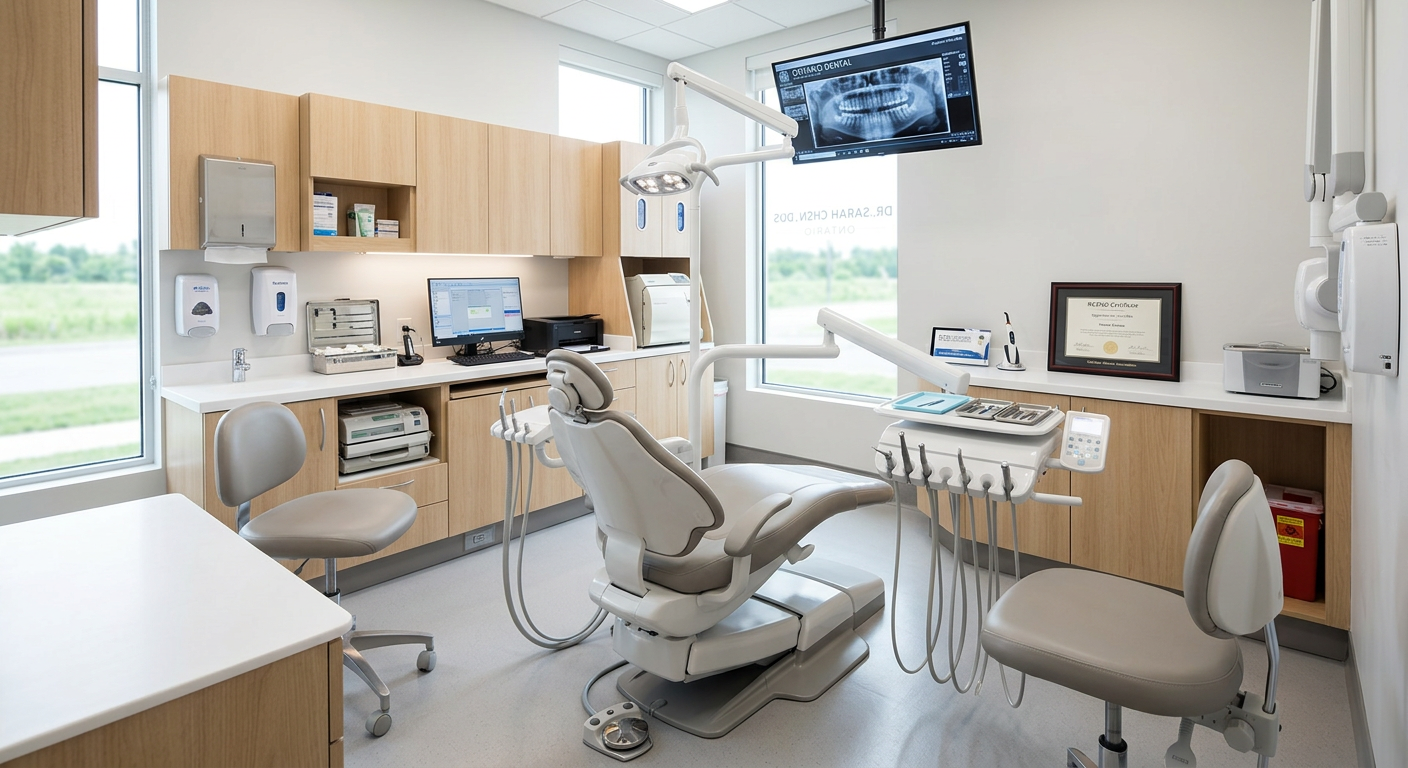
Dr. Ahmed Siddiqui had been practising in North York for nine years when the Royal College of Dental Surgeons of Ontario sent an inspector...
A step-by-step guide to planning a medical office renovation in Ontario—covering permits, IPAC requirements, contractor selection, and timelines for healthcare professionals.
