
April 21, 2026

A full GTA bathroom renovation costs $20,000 to $45,000 in 2026. See detailed breakdowns, component pricing, and Toronto-specific factors from RenoEthics.
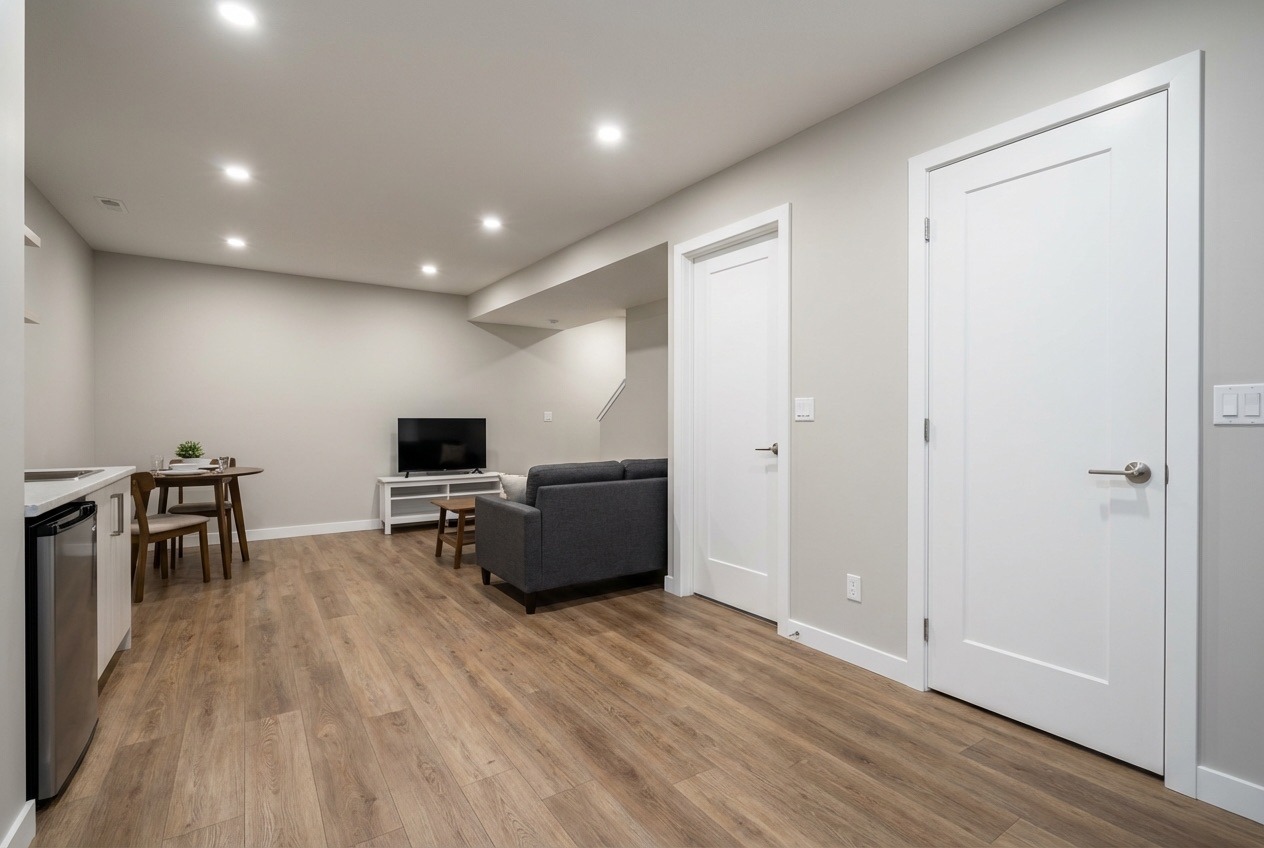
Short answer: A legal secondary suite conversion in a GTA basement costs $95,000 to $175,000 in 2026 and takes 12 to 18 weeks to build plus 6–10 weeks for permit review. Typical rental income: $1,600–$2,400/month for a 1-bedroom in York Region or North Toronto. Payback period on the build-out: 5–8 years. Property value uplift: 1.5x to 2.5x the construction cost in most GTA markets.
Legal secondary suites (also called basement apartments, accessory dwelling units, or in-law suites) are one of the strongest ROI residential renovations available to GTA homeowners in 2026 — not just for rental income, but for property value, mortgage qualifying income, and family flexibility. This guide covers exactly what’s required to build one legally under the Ontario Building Code.
Most GTA basement apartments built before 2015 are not technically legal. They may be habitable and even rented, but they don’t meet the current Ontario Building Code for secondary suites. This matters because:
If you are considering building a basement apartment, build it legally from day one. Retrofitting an illegal suite to legal status post-construction typically costs 30–50% more than doing it right the first time.
The full requirements are in the Ontario Building Code, Division B, Part 9, and Toronto Zoning Bylaw 569-2013. The practical summary:
Confirm your specific property via Toronto’s zoning lookup tool or consult a designer before committing to the project.
Based on a 900 sq ft basement converting to a 1-bedroom legal suite (bedroom, full bath, kitchen, living area) in a Toronto-area semi-detached home:
| Scope item | Cost |
|---|---|
| Demolition + waste disposal | $3,500 |
| Waterproofing + sump pump upgrade | $7,500 |
| Separate entrance excavation + concrete steps | $18,000 |
| Egress window retrofit (if no separate entrance) | $4,500 |
| Framing + insulation (fire-rated assemblies) | $12,500 |
| Electrical (subpanel + circuits + AFCI + ESA permit) | $9,500 |
| Plumbing (bathroom + kitchen rough-in + ejector if needed) | $10,500 |
| HVAC (dedicated zone / mini-split or zone dampers) | $4,500 |
| Drywall + mud + paint (Type X where required) | $10,500 |
| Kitchen cabinetry + countertops + appliances | $11,500 |
| Bathroom fixtures + tile + vanity + shower | $8,500 |
| Flooring (vinyl plank throughout except bath) | $7,200 |
| Doors + trim + hardware | $3,500 |
| Smoke / CO alarms (hard-wired + interconnected) | $1,200 |
| Building + ESA + plumbing permits | $3,800 |
| Designer fees / drawings | $3,500 |
| Labour + project management | $14,800 |
| Total | $125,000 |
Numbers vary widely based on existing conditions. Older homes with knob-and-tube wiring, galvanized plumbing, or significant moisture issues add $8,000–$25,000 to the total. Underpinning to gain ceiling height adds another $40,000–$80,000.
2026 rent comparables in York Region and North Toronto for legal 1-bedroom basement suites:
Gross annual rent: $18,000–$31,000. Operating costs (utilities you absorb, maintenance, vacancy allowance): typically 20–30%. Net annual income: $13,000–$24,000.
On a $125,000 build-out generating $18,000 net/year: 6.9-year simple payback. On a $150,000 build-out generating $22,000 net/year: 6.8-year payback. Faster with higher-end finishes targeting higher rent.
Legal secondary suites typically add 1.5–2.5x construction cost to property value in the GTA. A $125,000 build-out adds $185,000–$310,000 to resale price in most York Region and North Toronto markets. This is because:
Major Canadian lenders credit 50–70% of documented rental income toward qualifying income. A $2,000/month suite adds $12,000–$16,800 of qualifying income — often the difference between qualifying for your next home and not.
Total: roughly 7–9 months from first designer meeting to first month’s rent deposit.
The kitchen is usually the most regulated room in a legal secondary suite — it’s where fire hazard, ventilation, water safety, and egress all converge. If any single element of the suite fails inspection, it’s usually the kitchen. Here’s what OBC Part 9 actually requires for a basement kitchen in a secondary suite:
Ontario Building Code requires a minimum dwelling-unit kitchen area of 4.2 m² (45 sq ft) when the kitchen is separate from the dining area. In open-plan secondary suites where the kitchen, dining, and living spaces share a room, the combined space must be at least 13.5 m² (145 sq ft). Ceiling height in habitable basement rooms must be at least 1.95 m (6’5″) under beams, 2.03 m (6’8″) at the lowest point of the room — a common disqualifier in older Richmond Hill and North York bungalows with 6’0″ basements that cannot be economically excavated.
The basement kitchen range hood must move at least 120 cfm with a minimum 3.5 m/s discharge velocity, and it must vent directly to the exterior — no recirculating-only hoods permitted in secondary suites. The vent run must be as short and straight as practical; every 90-degree elbow reduces effective airflow by roughly 10%. In a 4-metre duct run, that means the rated hood must be sized up by one tier to maintain compliance airflow. RenoEthics installs OBC-compliant exterior venting with weatherproof hood caps and backdraft dampers.
Walls and ceilings between the main dwelling and secondary suite require a 45-minute fire-resistance rating (FRR), typically achieved with 5/8″ Type X fire-rated drywall on both sides with insulation in the cavity. The kitchen is an especially critical junction because cooking is the #1 residential ignition source. All penetrations through the fire separation (electrical boxes, plumbing, ductwork) must be sealed with firestop caulking or intumescent collars. Missing or non-compliant firestops are among the most common reasons a suite fails inspection.
A legal secondary-suite kitchen requires cold and hot supply to the sink, and hot water temperature at the fixture cannot exceed 49°C per OBC 7.6.5. This typically requires a thermostatic mixing (tempering) valve on the kitchen supply line — which many DIY renovators overlook. Drainage must connect to the building’s main waste stack without reducing flow to the upper unit’s drainage. In condo or semi-detached situations, strata approval is required for any new drain connection.
Secondary-suite kitchens require at minimum a dedicated 20-amp small-appliance circuit for countertop outlets plus GFCI protection on all outlets within 1.5 m of a sink. A typical basement kitchen needs 2-3 new circuits pulled from the main panel, not tapped off existing household circuits. In older homes with 60-amp panels (common in pre-1980 Toronto, Vaughan, and North York housing stock), a 100-amp upgrade is almost always required to support the secondary-suite load — adding $2,500-$5,500 and ESA inspection coordination. All electrical work must be certified by an ESA-licensed contractor and pass ESA inspection before the suite receives occupancy approval.
Ontario’s 2020 Additional Residential Unit (ARU) legislation made second units a province-wide as-of-right use — but municipalities still set their own zoning-specific rules, setbacks, parking minimums, and registration processes. Here’s how the GTA-north cities we serve handle it:
Richmond Hill permits second units in all single-detached, semi-detached, and townhouse zones as of right. Requirements: minimum lot frontage 12m, one additional parking spot (can be tandem), and compliance with OBC Part 9. Second-unit registration is mandatory — unregistered suites face $500-$50,000 fines and an Order to Comply. Richmond Hill requires inspections for fire separation, ventilation, and egress before issuing the occupancy permit.
Vaughan’s 2022 ARU bylaw permits two ARUs (basement + detached) on most single-family lots, with streamlined approval for units meeting pre-approved design standards. Noteworthy: Vaughan’s Major Residential Development Charges apply to ARUs over 500 sq ft — adding $8,000-$20,000 to the project cost depending on suite size. Parking requirement is one additional space per ARU, can be in a driveway.
Markham permits second units in all residential zones with as-of-right approval. Distinctive features: the city actively registers ARUs as part of its rental-housing inventory, and provides a downloadable “ARU Construction Guide” that aligns with OBC Part 9. Markham also offers financial incentive programs for homeowners adding energy-efficient ARUs — worth checking at application time.
Aurora’s ARU bylaw permits one basement or detached ARU per single-family lot, with a 150 m² maximum ARU size and 40% maximum coverage for detached ARUs (garden suites). Aurora requires pre-application consultation for basement ARUs in older neighbourhoods where ceiling height or egress may be constrained.
Newmarket permits second units in single-detached, semi-detached, and row dwellings. Registration is required and the town issues a unique ARU identifier used for tax assessment and rental-licensing purposes. East Gwillimbury follows similar rules but with additional restrictions in agricultural-zone properties.
North York falls under City of Toronto Zoning Bylaw 569-2013, which permits second units in all single-detached, semi-detached, and townhouse zones within the 416 area code. Toronto additionally permits laneway suites in much of the former City of Toronto and a growing portion of North York. Registration is mandatory via the City’s ARU Registry. Toronto-specific note: areas under Heritage Conservation District designation may have additional exterior-modification restrictions.
Three OBC and OESC updates effective January 2026 tighten secondary-suite requirements:
These are in addition to the ongoing requirements: egress windows in every bedroom (minimum 760mm × 600mm clear opening, per OBC 9.9.10.1), smoke alarms interconnected between units, and separate HVAC zoning where the secondary suite is on its own thermostat.
Some homeowners explore doing their secondary suite as an owner-builder project. Here’s the practical comparison — and where the math stops working in your favour:
| Factor | DIY / Owner-Builder | Licensed Contractor (RenoEthics) |
|---|---|---|
| Permit drawings | You pay architect/designer $1,800-$5,000 | Included in project |
| ESA electrical cert | Must hire ESA contractor ($3,500-$7,500) | Included in project |
| Inspector coordination | You schedule + wait (often delays project 4-8 weeks) | We coordinate all trades, inspections, sign-offs |
| Warranty | None (your work, your liability) | 1-year workmanship + manufacturer product warranties |
| Home insurance | At risk of voidance if unpermitted or work non-compliant | Fully covered; contractor carries $2M liability |
| Mortgage & refinancing | Lenders often require ESA cert + occupancy permit before approving secondary-suite income | Full documentation provided at project walkthrough |
| Total time investment | 500-1,000 hours of homeowner labour + coordination | Homeowner time limited to selection meetings + walkthrough |
| Typical timeline | 12-24 months (with job/weekend schedule) | 3-5 months start to occupancy |
For most homeowners, the math favours professional installation once you factor in the real cost of ESA contracting, permit drawings, architect fees, the 4-8 week inspector-scheduling delays most DIYs encounter, and the insurance-voidance risk. The “savings” from DIY often evaporate when an inspection fails and you’re forced to tear open walls, or when your insurer discovers unpermitted work after a claim.
RenoEthics is one of the only GTA contractors that works across medical and clinical spaces — audiology, dental, GP, walk-in, veterinary, pharmacy — AND residential secondary suites. The same non-porous, easy-clean, moisture-resistant finishes we install in exam rooms translate directly to legal basement kitchens and bathrooms, where tenant turnover demands durability and IPAC-grade cleanability.
In medical projects, cabinets and countertops must meet Ontario IPAC (Infection Prevention and Control) standards: non-porous surfaces that prevent bacterial harbouring, sealed joints that resist moisture infiltration, and finishes that tolerate aggressive cleaning chemicals. These same properties matter in rental secondary-suite kitchens, where tenant cooking patterns, move-in/move-out cleaning cycles, and often-imperfect ventilation create cumulative moisture and grease stress. Our healthcare-grade installs routinely last 15-20 years without replacement — protecting your rental income and your property value.
Learn more about our medical office renovation work and the finish standards we bring to every secondary-suite project.
Adding a legal secondary suite is one of the biggest renovation investments a GTA homeowner makes — typically $125,000-$250,000 for a full basement conversion. You want a contractor that handles the paperwork, manages the trades, coordinates inspections, and delivers a suite that both passes inspection and lasts 20+ years.
Yes — a building permit is always required for a legal secondary suite. This is non-negotiable. Ontario’s 2020 ARU legislation made second units a province-wide as-of-right use, but every secondary suite requires a building permit plus ESA electrical permit and often a plumbing permit. Unpermitted suites face Orders to Comply (with fines up to $50,000), insurance voidance, inability to claim rental income on your taxes, and forced tear-out at your expense. RenoEthics handles all permit submissions, inspector coordination, and final ARU registration as part of every project.
Ontario Building Code requires a minimum ceiling height of 1.95 m (6’5″) under beams and 2.03 m (6’8″) in the main area of habitable basement rooms. This is a common disqualifier in older Richmond Hill, North York, and central Toronto bungalows where basement ceilings are naturally 6’0″ to 6’3″. Excavation (underpinning) can add 300-500mm of additional height but costs $40,000-$100,000+ — often making the ARU uneconomic. During our consultation we measure ceiling height at 4-6 points to confirm whether your basement qualifies before you commit to the project.
Yes — a basement kitchenette without a separate entrance, not functioning as an independent dwelling unit, is not a “secondary suite” and doesn’t require ARU registration. However, if it includes a cooking appliance (stove or cooktop), it still must meet OBC 9.32 ventilation requirements (120 cfm hood vented to exterior) and OBC electrical requirements (20-amp small-appliance circuit, GFCI outlets). Many GTA homeowners add a basement “wet bar” or prep kitchen for entertainment purposes, which has simpler code requirements than a full legal suite. We’ll clarify the path during your consultation based on how you plan to use the space.
Fines for unregistered or non-compliant secondary suites range from $500 to $50,000 depending on the municipality and severity. Most GTA cities issue an Order to Comply with a 30-60 day remedy window, after which fines escalate. More significant risk: your home insurance is typically voided for any claim related to unpermitted renovation work, and mortgage lenders may call the loan if they discover unregistered rental units. A Compliance Officer can also force tear-out at your expense. The “savings” from skipping permits almost always get erased by these risks within the first 1-3 years.
A full legal basement secondary suite in the GTA typically costs $125,000 to $250,000, with median around $180,000. The kitchen alone (cabinets, appliances, counters, ventilation) runs $25,000-$55,000. Bathroom $15,000-$30,000. Separate entrance, fire separation, egress windows, HVAC separation, and electrical upgrades add $35,000-$80,000. Permit fees, architect drawings, ESA certification, and municipal registration add $8,000-$15,000. ROI: a $180,000 investment typically generates $1,800-$2,400/month rental income in the GTA, delivering payback in 7-10 years and $150,000-$250,000 of added property value.
Almost always — yes. Homes built before 1990 commonly have 60-amp panels, which cannot safely support the additional 30-50 amps a secondary suite requires. A typical basement ARU adds 2-3 new circuits (kitchen small-appliance, bathroom GFCI, HVAC if separate) plus ESA-mandated dedicated circuits. A 100-amp panel upgrade runs $2,500-$5,500 including the ESA inspection. Some homes in older Toronto neighbourhoods may need a 200-amp service upgrade, adding another $3,000-$6,000 and coordination with your local utility. We assess panel adequacy during the free consultation and quote the upgrade as part of the fixed-price package.
Yes — a legal secondary suite must have its own exterior entrance that does not pass through the primary dwelling. In Toronto and most GTA municipalities, the entrance can be a rear walk-out stairwell, side-yard stairwell with window well, or dedicated door off a shared vestibule — provided the secondary-suite side has lockable separation. Entrance construction adds $8,000-$25,000 to the project depending on excavation needs. During consultation we identify the most economical entrance location based on your home’s layout and lot configuration.
From initial design to occupancy permit, typical timeline is 4 to 7 months. Breakdown: 4-6 weeks for architect/designer permit drawings and submission, 6-10 weeks for municipal permit approval (Toronto runs slower than 905 municipalities), 10-16 weeks of construction, and 2-4 weeks for final inspections and occupancy sign-off. Projects in Richmond Hill, Vaughan, and Markham tend to run faster than City of Toronto. We provide a realistic timeline during the initial consultation based on your specific municipality and project scope.
Yes — this is the most common secondary-suite arrangement in the GTA. You maintain owner-occupancy of the primary dwelling and rent the legal secondary suite to a tenant. This generally has the most favourable tax treatment (principal-residence exemption maintained on the primary dwelling, rental income on the secondary suite) and often qualifies for owner-occupied mortgage rates. Work with a Canadian tax professional to structure the rental and maximize deductions; major deductions include depreciation (CCA), pro-rated utilities, maintenance, and mortgage interest allocated to the secondary-suite square footage.
Yes — we handle ARU registration as part of every secondary-suite project. This includes completing the application form, providing copies of the building permit and occupancy certificate, delivering the ESA electrical certificate, and submitting to your municipal ARU registry (City of Toronto, Richmond Hill, Vaughan, Markham, Aurora, Newmarket, or East Gwillimbury). Registration fees vary by municipality ($150-$600) and are passed through at cost. Once registered, your suite is legally rentable, insurable, and income-declarable — and the registration is transferable to the next homeowner at resale.
Inspection failure is not final — you’re given an itemized list of remediations and a re-inspection window (typically 14-30 days). Common failure points we see on other contractors’ work: non-compliant firestops at utility penetrations, incorrect egress window size, missing GFCI protection, interconnected smoke/CO detectors not wired correctly, and ventilation not meeting OBC 9.32 cfm requirements. Because RenoEthics works extensively on medical fit-outs where inspection is non-negotiable, our projects pass inspection on the first attempt more than 95% of the time. When there’s a minor flag, we remediate at no additional cost to you before re-inspection.
We’ve built legal secondary suites across Richmond Hill, Vaughan, Markham, Aurora, and North York. We handle drawings, permits, construction, inspections, and final occupancy approval — start to finish. Every suite is built to full Code compliance so it can be insured, financed, and rented legally from day one. See our basement renovation service page for related scope.
Book a free secondary suite consultation or call 647-725-9754. We provide fixed-price suite conversion quotes within 72 hours.
A full GTA bathroom renovation costs $20,000 to $45,000 in 2026. See detailed breakdowns, component pricing, and Toronto-specific factors from RenoEthics.
GTA kitchen renovations run $35,000 to $75,000 in 2026. See complete cost breakdowns, cabinetry tiers, and Toronto-specific permit factors from RenoEthics.
A finished basement in Toronto and the GTA costs $45,000 to $85,000 in 2026. See rec rooms, secondary suites, underpinning, and ROI math from...