Toronto Building Permit Guide: When You Need One for a Renovation

RenoEthics Bathroom PermitsDocuments BenefitCard v1

Toronto Building Permit Guide: When You Need One for a Renovation

Short answer: You need a building permit in Toronto for any renovation that involves structural changes, plumbing relocations, new electrical circuits, adding or removing walls, basement finishing, decks over 24” high, additions, and new kitchens. You do not need a permit for paint, flooring, cabinet replacement, fixture swaps, countertops, or cosmetic work. Permit fees run $200 to $3,500 for typical residential projects. Review windows run 4 to 10 weeks in the City of Toronto in 2026.

The Toronto permit process is the single biggest source of schedule delay on residential renovations. Contractors who understand the system and submit clean drawings get permits in 4 weeks. Homeowners who try to DIY often wait 10–14 weeks. This guide covers what requires a permit, what doesn’t, and how to move through the system without getting stuck.

When you need a permit in Toronto

Under the Ontario Building Code and Toronto Municipal Code, you need a permit for any of the following:

  • New construction, additions, or reconstructions
  • Structural changes (removing or adding walls, beams, columns)
  • Renovations that alter the use of a space (e.g., unfinished basement to livable space, garage to living area)
  • Creating new plumbing fixtures or relocating existing ones
  • New electrical circuits or panel upgrades (also requires separate Electrical Safety Authority / ESA permit)
  • Adding, removing, or altering exterior doors and windows
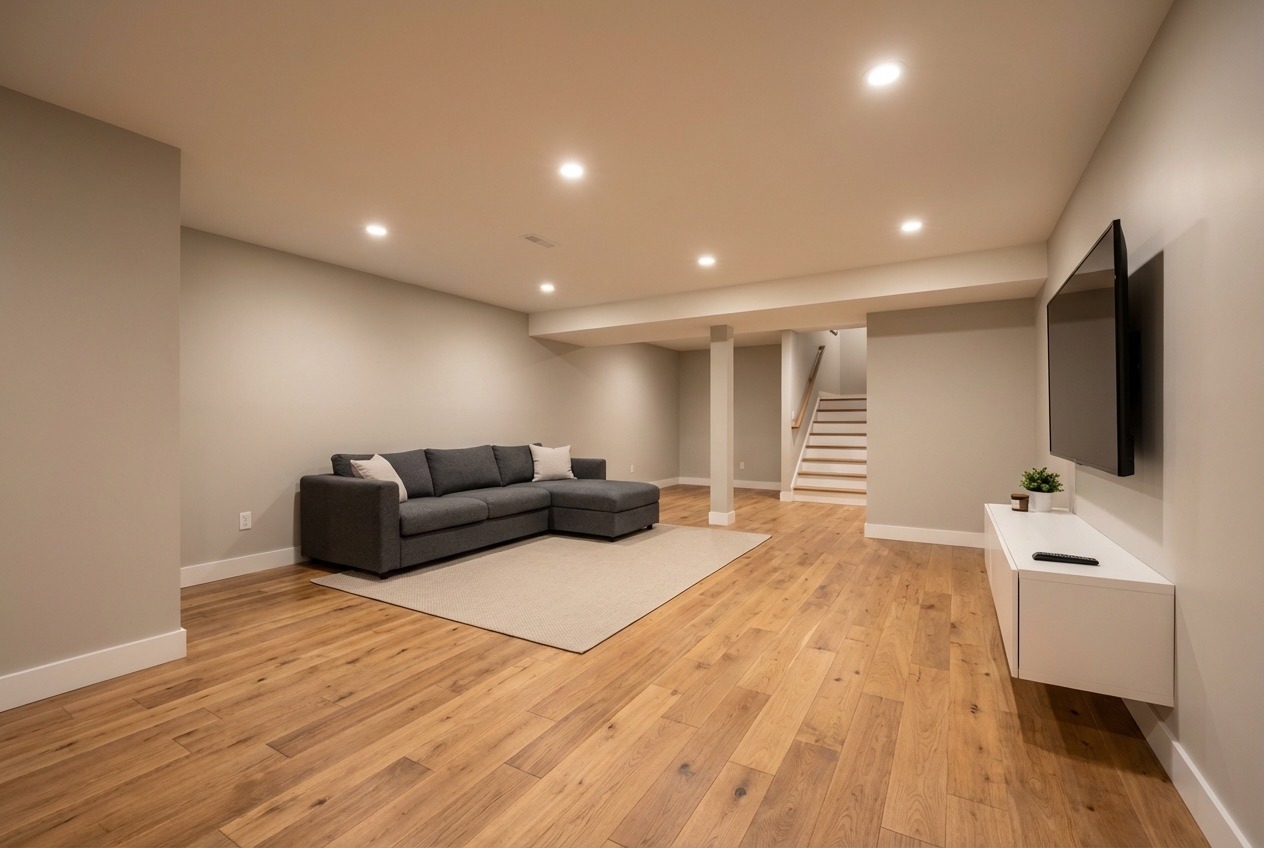
  • Basement finishing (all new framing, plumbing, electrical)
  • Adding a second suite / basement apartment
  • Decks higher than 24” above grade or attached to the house
  • Sheds larger than 10 sq m (108 sq ft)
  • Fences higher than 2m (6.5 ft)
  • Swimming pools and hot tubs (also fence requirements)
  • HVAC changes (new ductwork, new system)
  • Demolition (partial or full)
  • Change of use (commercial to residential, single to multi-unit)

See the City of Toronto’s official list for current comprehensive requirements.

When you don’t need a permit

The following are typically exempt in the City of Toronto:

  • Paint, wallpaper, trim replacement
  • Flooring replacement (like-for-like, no subfloor changes)
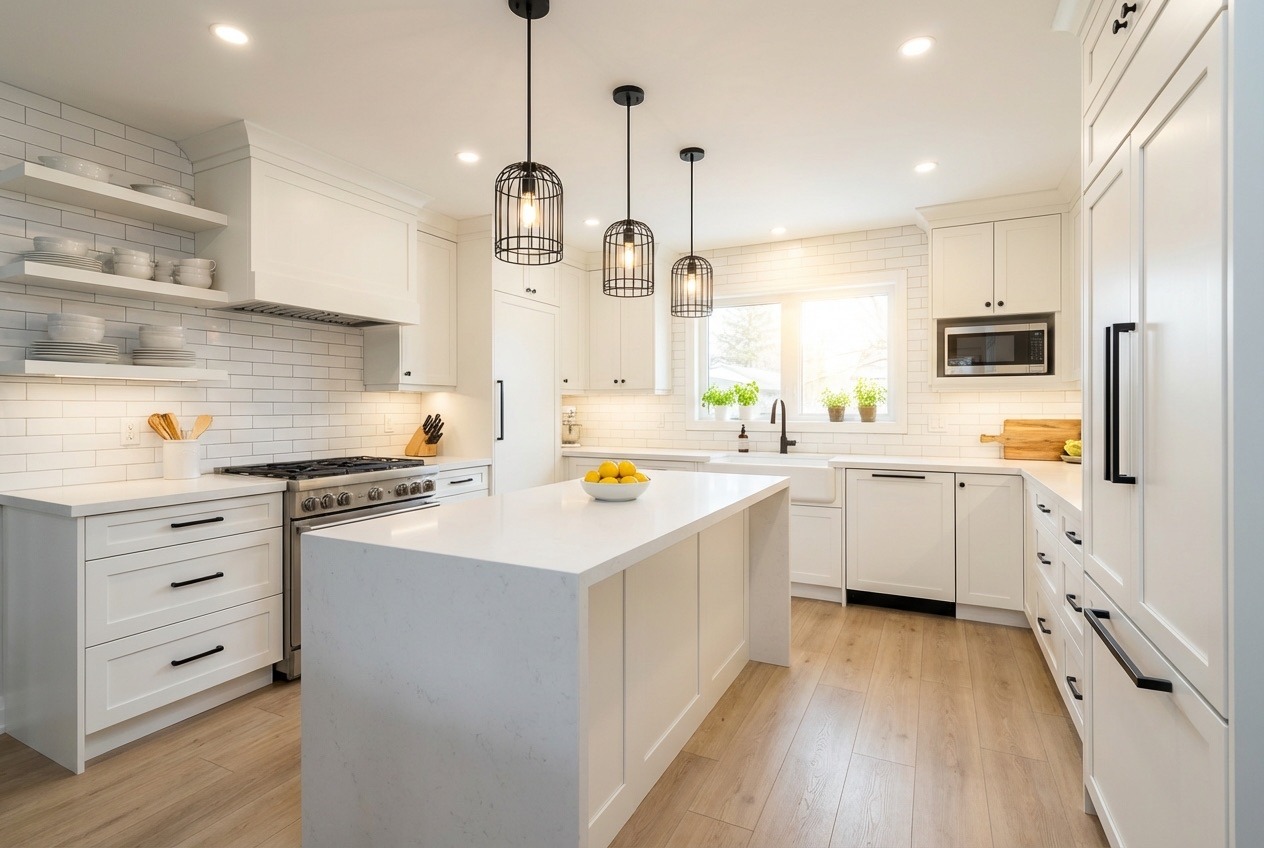
  • Kitchen cabinet replacement (if plumbing and electrical aren’t relocated)
  • Countertop replacement
  • Plumbing fixture replacement (faucet, toilet, sink, dishwasher) like-for-like in the same location
  • Light fixture replacement (same location, same circuit)
  • Interior door replacement
  • Roof shingle replacement (same material, same slope)
  • Repair to existing structure (replacing damaged wood in same location, same dimensions)
  • Sheds under 10 sq m
  • Decks under 24” high that are not attached to the house
  • Fences under 2m

One important nuance: “Like-for-like replacement” means same size, same location, same material class. Replacing a toilet with a similar toilet in the same spot is fine. Replacing a toilet with a wall-hung model that requires changing the drain rough-in is not exempt.

Toronto permit fees (residential, 2026)

Project type Typical fee
Bathroom renovation (plumbing / electrical) $200–$500
Kitchen renovation (plumbing / electrical) $350–$700
Basement finishing (non-secondary-suite) $1,200–$2,500
Secondary suite / basement apartment $2,500–$4,500
Interior load-bearing wall removal $800–$1,500
Home addition (small — bump-out, mudroom) $3,500–$6,500
Second-storey addition $6,500–$14,000
Deck (with attachment to house) $350–$900
Detached garage $800–$1,800

Fees are scaled by construction value in most municipalities. Add a separate ESA (Electrical Safety Authority) permit for electrical work: $95–$225 for typical residential. Plumbing work is folded into the building permit in Toronto.

Permit review timelines in 2026

The City of Toronto’s current review targets (first review, not full approval):

  • Small residential (bathroom/kitchen reno): 10 business days target, 3–4 weeks typical actual
  • Medium residential (basement, wall removal): 15 business days target, 4–6 weeks typical
  • Addition or secondary suite: 20 business days target, 6–10 weeks typical
  • Major addition / second storey: 30+ business days, 10–16 weeks typical

“Typical actual” differs from the published target because most applications require at least one round of revisions. Clean, complete applications move faster. Missing details or code-noncompliant drawings get a request-for-revision that adds 2–4 weeks per round.

Why permits get delayed

  1. Incomplete drawings. Missing floor plans, missing structural details, missing fire-separation details for secondary suites. This is the #1 delay cause.
  2. Zoning issues. Additions that exceed height/setback limits require a Committee of Adjustment hearing (adds 2–4 months).
  3. Heritage or conservation district. Homes in heritage areas need an additional heritage permit (adds 4–12 weeks). Check your property via the Toronto Heritage Register.
  4. Tree protection. Any construction within 6m of a city-owned or private protected tree requires arborist-signed tree protection plans.
  5. Site plan control. Secondary suites and infill projects in some neighbourhoods trigger site plan review.

The permit process, step by step

  1. Pre-application research. Confirm zoning, heritage status, tree protection requirements, setback compliance. Free via Toronto’s online zoning tool.
  2. Design and drawings. Engage a designer, architect, or contractor with drafting capability. For basements and small renos, a BCIN-qualified designer is sufficient. Structural changes may require a Professional Engineer’s stamp.
  3. Drawing package submission. Floor plans, elevations, structural details, fire-separation details (for secondary suites), electrical plan (for new circuits), plumbing fixture schedule, mechanical HVAC plan.
  4. Plan review. City reviewers check code compliance, zoning, and structural adequacy. Expect at least one request for revision.
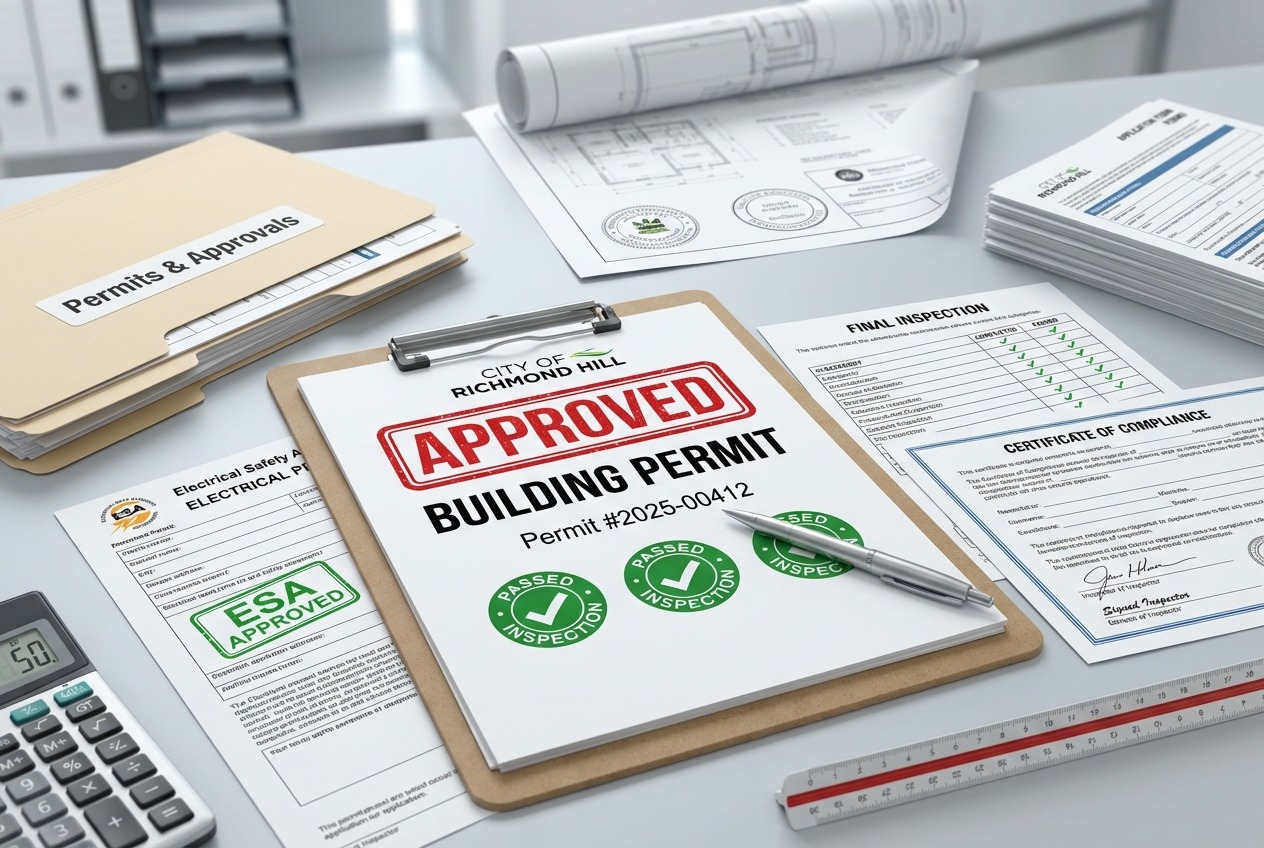
  5. Permit issued. Fees due at issuance. Post permit placard on site before work begins.
  6. Inspections during construction. Framing/structural, plumbing rough-in, electrical rough-in, insulation/vapour barrier, final. Miss an inspection and subsequent inspections get delayed.
  7. Final inspection and closure. Once all final inspections pass, the permit is closed. Keep the closure document — it’s disclosed on resale.

What happens if you skip the permit

Short-term: nothing, usually. Long-term: several expensive problems.

  • Insurance denial. If unpermitted work causes damage (plumbing leak, electrical fire), your home insurer may deny the claim. Bathroom and kitchen renovations are the most common source of water damage claims.
  • Buyer discovery. Pre-listing inspections and buyer home inspections commonly flag unpermitted work. Buyers walk or drop their offer by 2–5% to cover the risk.
  • Forced removal. Cities can issue Orders to Comply or Orders to Remove for unpermitted structural work. A $40,000 basement renovation can become a $60,000 renovation + $15,000 remediation if the city gets involved.
  • Secondary suite illegality. An unpermitted basement apartment is not a legal dwelling. The city can order it vacated. Rental income can be clawed back. Your mortgage lender may no longer credit the rent for qualifying income.
  • Resale disclosure. Ontario real estate law requires disclosure of known defects. Unpermitted renovations are disclosed. Failure to disclose opens you to post-sale lawsuits.

“It’s just a bathroom, no one will know” is a common rationalization. Inspectors pulling a new permit for the next owner’s renovation frequently find old unpermitted work and flag it.

Condo and co-op renovation permits

Condo units in Toronto follow the same building permit rules as freehold homes for interior renovations, but:

  • The condominium corporation has its own approval process — separate from, and in addition to, the city permit
  • Board review typically requires architectural drawings, contractor insurance certificates, and a completion schedule
  • Board approval adds 3–8 weeks to the project timeline
  • Work is typically restricted to weekday daytime hours
  • Elevator booking fees and deposits are common

York Region: how it differs from Toronto

Richmond Hill, Vaughan, Markham, Aurora, and Newmarket follow the same Ontario Building Code, but each municipality has its own permit desk and fee schedule:

  • Richmond Hill: typically 3–5 weeks for residential renovation permits. Online application portal.
  • Vaughan: 3–6 weeks. Larger permit volumes, variable processing speed.
  • Markham: 3–5 weeks. Strict on complete applications — incomplete ones bounce immediately.
  • Aurora: 2–4 weeks. Smaller municipality, faster turnarounds.
  • Newmarket: 2–4 weeks. Similar speed to Aurora.

For specific requirements by city, see our service areas page with links to each municipality’s build-out guide.

Hiring a permit-ready contractor

The fastest way to move a permit through is to hire a contractor who handles it start-to-finish. Look for:

  • Has pulled permits in your specific municipality before
  • Has an in-house drafter or long-term relationship with a BCIN designer
  • Can provide samples of successfully-permitted projects in the last 12 months
  • Willing to list “permit included” as a line item in the quote (not vague “as required”)
  • Will not begin work before the permit is issued

If a contractor suggests skipping the permit on work that legally requires one, that’s the end of the conversation. See our GTA contractor vetting checklist for full criteria.

Frequently asked questions

Do I need a permit to renovate a bathroom in Toronto?

Yes, if the renovation involves moving plumbing (drain, vent, supply), altering electrical (new circuits, relocated fixtures), or structural work. No, if it’s a like-for-like fixture replacement, new vanity in the same position, new paint, new flooring, or a cosmetic update without changes to rough-ins.

How long does a building permit take in Toronto?

Small residential renovations: 3–4 weeks typical. Basement finishing: 4–6 weeks. Secondary suites: 6–10 weeks. Major additions: 10–16 weeks. Clean applications with complete drawings move faster. Most applications need at least one revision round, which adds 2–4 weeks per round.

Can I pull my own permit as a homeowner in Toronto?

Yes. Ontario allows homeowners to be the applicant and builder on their own principal residence. But the drawings must still meet Building Code requirements, and you take on full liability for construction defects. Most homeowners have their contractor pull the permit — they are the experts in passing inspections.

Can I start work before the permit is issued?

Demolition within the scope of a pending permit is a grey area. Starting framing or any rough-in before the permit is issued is a clear violation and can trigger fines ($500–$50,000 depending on severity) and Orders to Comply. Wait for the permit.

What’s the difference between a building permit and a zoning approval?

A building permit confirms that construction meets Building Code (safety, structure, fire separation). A zoning approval confirms that the land use is permitted (height, setback, coverage, use type). Building permits include a zoning check, so most projects don’t need separate zoning approval — but additions that exceed zoning limits need a Committee of Adjustment variance first, which is a separate multi-month process.

Do I need a permit for a kitchen cabinet replacement?

No, if you’re replacing cabinets in the same footprint, not moving plumbing, not changing electrical. Adding a new circuit for an appliance, moving the sink, or adding an island with power/water triggers a permit.

Planning a permitted renovation in the GTA?

RenoEthics handles permit submissions for every renovation we build. Our in-house drafters produce code-compliant drawings, we submit to the city, we coordinate inspections, and we close out the permit at final. Permit fees are line-itemed in the quote — no surprises.

Request a free renovation consultation or call 647-725-9754.

Related Posts