
May 18, 2023

Quis lorem suspendisse urna. Donec sed dui mollis, elementum enim quis.
Dr. James Okafor had a clear plan for his Brampton medical clinic expansion. He had a budget of $140,000, a trusted contractor who had renovated his home, and a 12-week timeline that would have the two new exam rooms open before his new associate physician started in September.
Eleven months later, the project was still incomplete. The budget had reached $287,000. The associate physician had deferred her start date twice, then taken a position elsewhere. The City of Brampton had issued a stop-work order after the contractor began framing without a building permit. The HVAC installed in the new exam rooms failed a CVO inspection because the contractor — a skilled residential renovator who had done excellent work on the physician’s home — had never heard of the Ontario College of Physicians and Surgeons’ facility standards, much less designed to them.
The $140,000 renovation became a $287,000 catastrophe. Not because the scope was wrong. Not because the budget was unrealistic. But because Dr. Okafor made five specific, preventable mistakes — the same five mistakes that account for the majority of Ontario healthcare renovation failures. This guide covers each one in detail, with specific dollar amounts and the prevention strategies that cost a fraction of what the mistakes do.
Healthcare facilities renovation is a specialized discipline, not a variation of standard commercial construction. The reasons for its elevated failure rate are structural, not random:
Each of the five mistakes below is a direct manifestation of one or more of these structural challenges. Understanding them in advance — before you sign a contract — is the most valuable thing this guide can do for you.

The most common and most expensive mistake in Ontario healthcare renovations: engaging a contractor who is competent at commercial or residential construction but has no specific experience with medical facility standards. This mistake is easy to make because qualified general contractors present professionally, quote confidently, and often have strong references from non-healthcare projects. The gap in their knowledge isn’t visible until construction begins — or worse, until the CVO or CPSO inspector arrives.
Case A — Markham Family Practice: A family medicine practice hired a commercial contractor with 15 years of office renovation experience to add two exam rooms and reconfigure a nurse station. The contractor specified standard 5/8″ drywall with semi-gloss latex paint for the exam room walls. CVO Essential Standards require non-porous, disinfectable surfaces in clinical areas — latex paint applied over drywall does not satisfy this requirement. Result: both exam rooms required re-specification, removal of the new drywall, installation of FRP (fibre-reinforced plastic) panels, and repainting with the appropriate alkyd-based medical-grade finish. Additional cost: $22,000 above the original contract. Timeline extension: 6 weeks.
Case B — North York Specialist Clinic: A dermatology clinic engaged a well-regarded commercial contractor who had completed multiple office renovations in the same building. The contractor installed a standard commercial HVAC system in the clinic’s procedure room — appropriate for general office use, delivering 4 air changes per hour. CPSO facility standards for minor procedure rooms require a minimum of 6 ACH with appropriate filtration. The Health Facility Standards inspector failed the room; the HVAC system had to be replaced with a dedicated unit delivering 6+ ACH with MERV-13 filtration. Additional cost: $34,000. Procedure room closure: 11 weeks during HVAC replacement.
Healthcare contractor vetting requires specific questions that go beyond standard commercial contractor screening. The five qualification questions to ask every contractor before hiring:
Cost of prevention: The premium for a qualified healthcare renovation contractor over a general commercial contractor is typically 10–20% of contract value in the GTA market. On a $200,000 renovation project, that’s $20,000–$40,000. The remediation costs for Mistake #1 in documented Ontario cases range from $22,000 to $150,000+. The premium is worth paying every time.
AODA compliance is treated as an afterthought by many clinic owners because it feels like a regulatory obligation rather than a business priority. The typical pattern: a clinic owner approves a design that optimizes for clinical functionality and aesthetic preferences, then — when the designer or contractor raises AODA requirements — discovers that achieving compliance requires significant re-design. Changes that are cheap at the design stage (moving a door, adjusting a counter height, relocating a sink) become expensive when construction has already begun.
A Richmond Hill multi-specialty clinic completed detailed architectural drawings for a 3,800 sq ft renovation before an AODA consultant reviewed the design. The consultant identified seven non-conformances with the Integrated Accessibility Standards Regulation (IASR) Design of Public Spaces standards: insufficient turning radius in two exam rooms (minimum 1,500 mm × 1,500 mm), reception counter without lowered accessible section, entrance door with insufficient force resistance for manual operation, inaccessible washroom, parking area with insufficient van-accessible space, and an accessible route obstructed by planned millwork placement. Re-drawing the affected areas added $9,500 in architectural fees and required the contractor to resubmit drawings that had already been submitted for permit — adding 5 weeks to the permit timeline. The AODA-required changes added $31,000 to construction cost when implemented late in the design process.
The same AODA scope, had it been integrated from the beginning of the design process, would have cost approximately $14,000 in construction — because accessible turning radius is a room layout decision that has no cost premium when the room is being designed from scratch, versus a very high cost when it requires moving already-planned walls. Total extra cost of the late AODA integration: $26,500 in avoidable expense on a project that ultimately cost $415,000.
Beyond construction cost, AODA non-compliance carries direct legal exposure. The Ontario Human Rights Tribunal has awarded damages of $15,000–$50,000 in healthcare accessibility complaints, with the clinic or physician owner bearing the cost regardless of whether the non-compliance was intentional. Legal fees for HRTO representation run $15,000–$40,000 per matter independently of any award. A single HRTO complaint can cost $30,000–$90,000 in combined damages and legal fees — far exceeding the cost of proactive compliance.
Commission an AODA compliance review as the first step in the design process — before any drawings are created, not as a review of completed drawings. A 2–3 hour audit of your existing facility by an AODA-experienced consultant costs $500–$1,500 and produces a complete gap analysis. Bring these findings to the design briefing; your architect or designer incorporates them from the start, at zero additional construction cost. Require your architect to confirm in writing that the final design complies with O. Reg. 413/12 DOPS standards before submitting for permit. This single procedural change eliminates the most expensive form of this mistake entirely.
HVAC is the invisible infrastructure of healthcare renovation — and the most technically demanding. Standard commercial HVAC delivers 2–4 air changes per hour with standard MERV-8 filtration, which is appropriate for offices but inadequate for medical procedure rooms, surgical suites, or isolation wards. The gap between what a standard commercial HVAC contractor knows and what a healthcare HVAC system requires is significant. Unfortunately, most building permit applications for medical clinic renovations do not specifically require a healthcare-trained mechanical engineer — so a general commercial HVAC contractor can pull a permit for work they are not qualified to design correctly.
Medical clinic HVAC requirements vary by room type and are defined in ASHRAE Standard 170 (Ventilation of Health Care Facilities) and reinforced by CPSO and CVO facility standards:
| Room Type | Minimum ACH | Pressure Relationship | Filtration Grade |
|---|---|---|---|
| Exam room (general) | 6 ACH | Neutral or positive | MERV-8 minimum |
| Minor procedure room | 6 ACH (15 ACH per ASHRAE preferred) | Positive | MERV-13 minimum |
| Surgical suite (veterinary or medical) | 10–15 ACH | Positive (+2.5 Pa) | MERV-14 / HEPA preferred |
| Isolation ward | 12+ ACH | Negative (−2.5 Pa) | HEPA on exhaust |
| Sterilization room | 10 ACH | Negative | MERV-8 minimum |
| Waiting area / reception | 4–6 ACH | Neutral | MERV-8 |
The pressure relationships are as critical as the ACH values. Surgical suites must be positive pressure to prevent contamination from adjacent areas entering the sterile field. Isolation rooms must be negative pressure to prevent pathogens from escaping into the main clinic. Standard commercial HVAC design does not manage pressure differentials between individual rooms — it designs for building-wide pressure balance, which does not satisfy healthcare requirements.
A Vaughan family medicine clinic expanded its facility to include two minor procedure rooms. The HVAC contractor — experienced with office and retail construction — installed a standard variable-air-volume (VAV) system serving the new rooms. CPSO’s Health Facility Standards inspector measured 5 ACH in one room and 4.5 ACH in the other; 6 ACH minimum was required for minor procedure room use. Both rooms failed inspection. The VAV system had to be replaced with dedicated air handling units (AHUs) serving each procedure room independently, with independent controls, MERV-13 filtration, and pressure monitoring capability. The HVAC remediation cost: $67,000. Both procedure rooms were out of service for 9 weeks during replacement.
Prevention cost: Specifying a dedicated AHU per procedure room from the start, with appropriate filtration and pressure controls, would have added approximately $18,000 to the original HVAC contract — versus $67,000 in replacement costs. The properly specified system also provided the commissioning documentation required for CPSO inspection — documentation the original system could not produce because it had never been designed to healthcare specifications.
Require a P.Eng.-stamped mechanical design from a licensed Ontario professional engineer with documented healthcare HVAC experience — not just an HVAC contractor’s equipment selection. The mechanical design package must include: room-by-room ACH calculations, pressure differential specifications and management strategy, filtration specifications by room type, and commissioning protocol (how ACH and pressure will be measured and documented upon completion). This engineering package costs $3,000–$8,000 depending on project scope and is the single most valuable technical investment in any medical clinic renovation with new or modified HVAC.
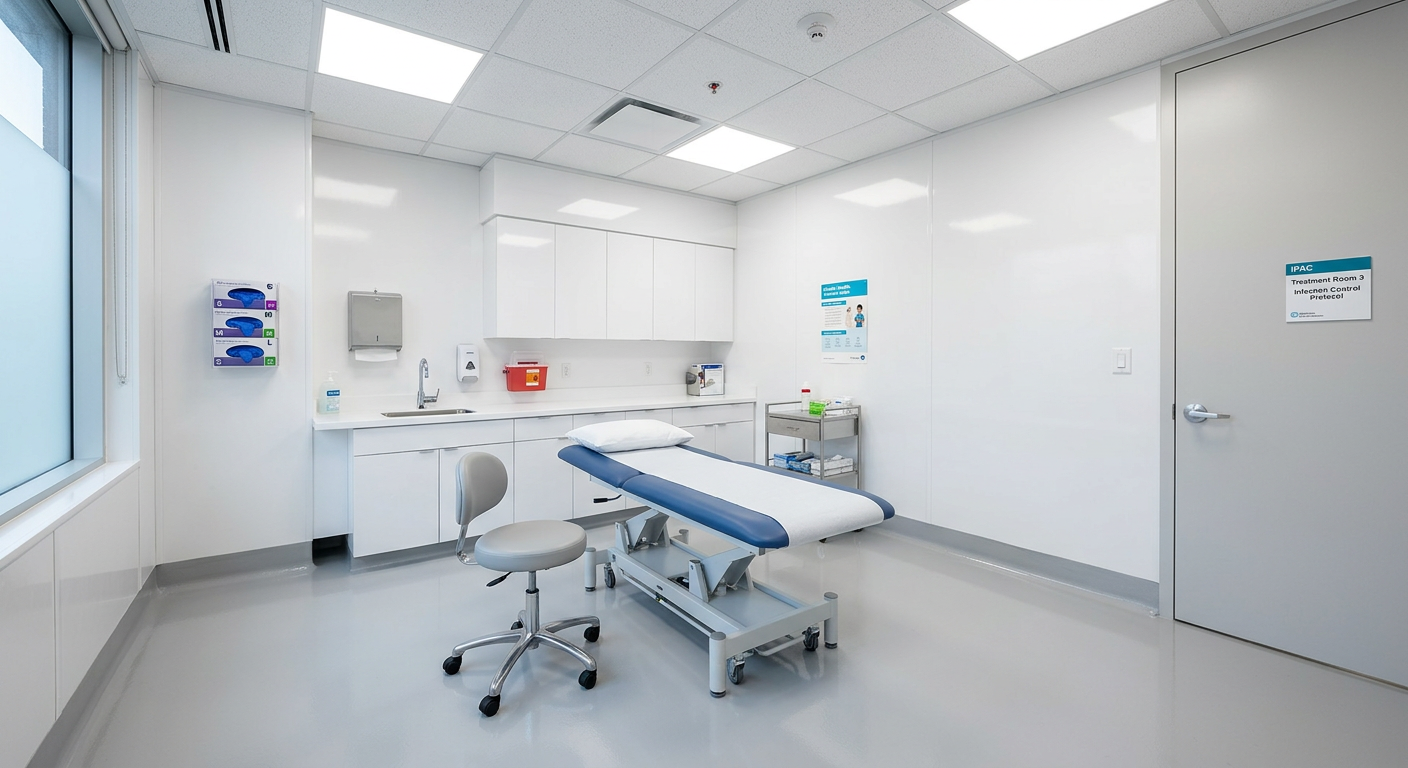
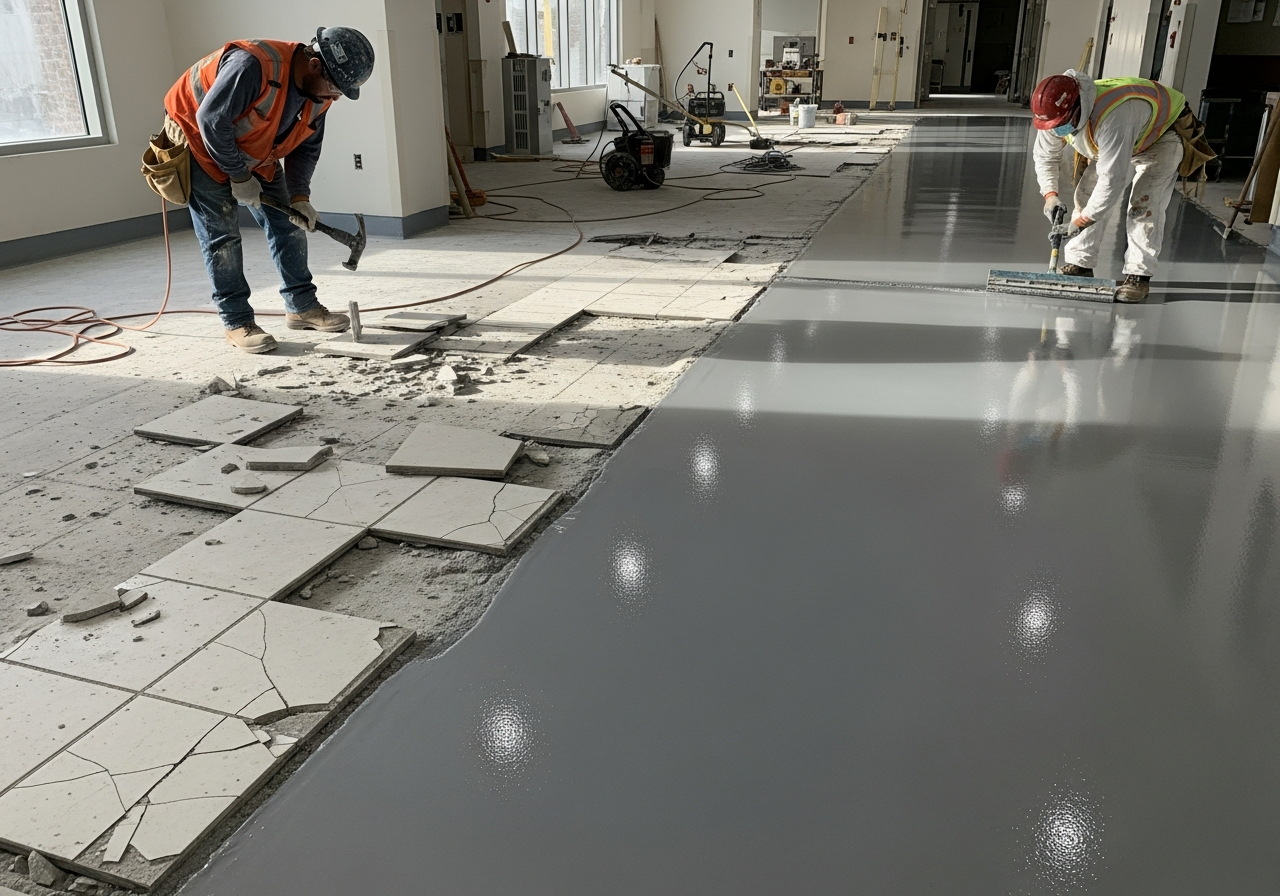
This is the most common and most underestimated compliance mistake. Standard commercial finishes — ceramic tile, painted drywall, standard luxury vinyl tile, polyurethane-sealed hardwood — are appropriate for offices, retail, and general commercial spaces. They are not appropriate for medical clinical areas because they harbour pathogens in joints, absorb disinfectants unevenly, and cannot be cleaned to the standards required by Public Health Ontario’s IPAC guidelines and CVO or CPSO facility standards.
Healthcare renovation materials specifications differ from commercial specifications in three key ways: they must be seamless (no joints where pathogens accumulate), non-porous (impermeable to disinfectants and contaminants), and disinfectant-compatible (resistant to the concentrations of bleach, quaternary ammonium, and accelerated hydrogen peroxide used in healthcare disinfection protocols). Standard commercial materials meet none of these three criteria reliably.
| Material | Failure Mode in Clinical Area | Compliant Alternative | Cost Difference |
|---|---|---|---|
| Ceramic tile (with grout) | Grout joints harbour pathogens; cannot achieve clinical clean | Seamless poured epoxy or welded vinyl | $2–$8/sq ft more |
| Standard painted drywall | Latex paint not disinfectant-resistant; wall joint not cleanable | FRP panels or semi-gloss alkyd over sealed substrate | $3–$9/sq ft more |
| Click-lock LVT | Joints between tiles harbour contaminants | Welded-seam sheet vinyl or seamless epoxy | $2–$6/sq ft more |
| Standard ceiling tiles (T-bar) | Porous tile harbours pathogens; accessible gap above tiles | Sealed gypsum ceiling with epoxy paint | $6–$12/sq ft more |
| Standard plastic laminate countertop | Exposed particleboard substrate absorbs moisture and pathogens at sink cutout | Solid surface (Corian) or stainless steel | $400–$1,200 per linear foot more |
A Newmarket veterinary clinic, as documented in our vet clinic renovation guide, had ceramic tile installed throughout its surgical suite by a general contractor. The CVO inspector flagged both the tile grout lines and the 90° floor-to-wall junction. Remediation required demolition of the tile installation, moisture barrier preparation, and installation of seamless epoxy with coved base. Demolition and reinstallation cost $34,000 — nearly twice the $19,000 cost of the original tile installation. The properly specified seamless epoxy would have cost $22,000 at the time of original installation — $3,000 more than the tile — avoiding $15,000 in additional remediation cost and 3 weeks of surgical suite closure.
Require a room-by-room materials specification sheet from your contractor or designer before any materials are purchased. For each clinical area (exam rooms, procedure rooms, surgical suite, isolation area), the specification should explicitly list: flooring system type and installation method with seamless/joint-free confirmation; wall finish type and disinfectant compatibility rating; ceiling system type; and counter/casework substrate and surface material. Review this specification against the relevant regulatory standard (CVO Essential Standards, CPSO Health Facility Standards, Public Health Ontario IPAC guidelines) before approving it. If the specification includes ceramic tile, click-lock LVT, standard painted drywall, T-bar ceiling tiles, or plastic laminate countertops in any clinical area, it is non-compliant and must be revised before construction begins.
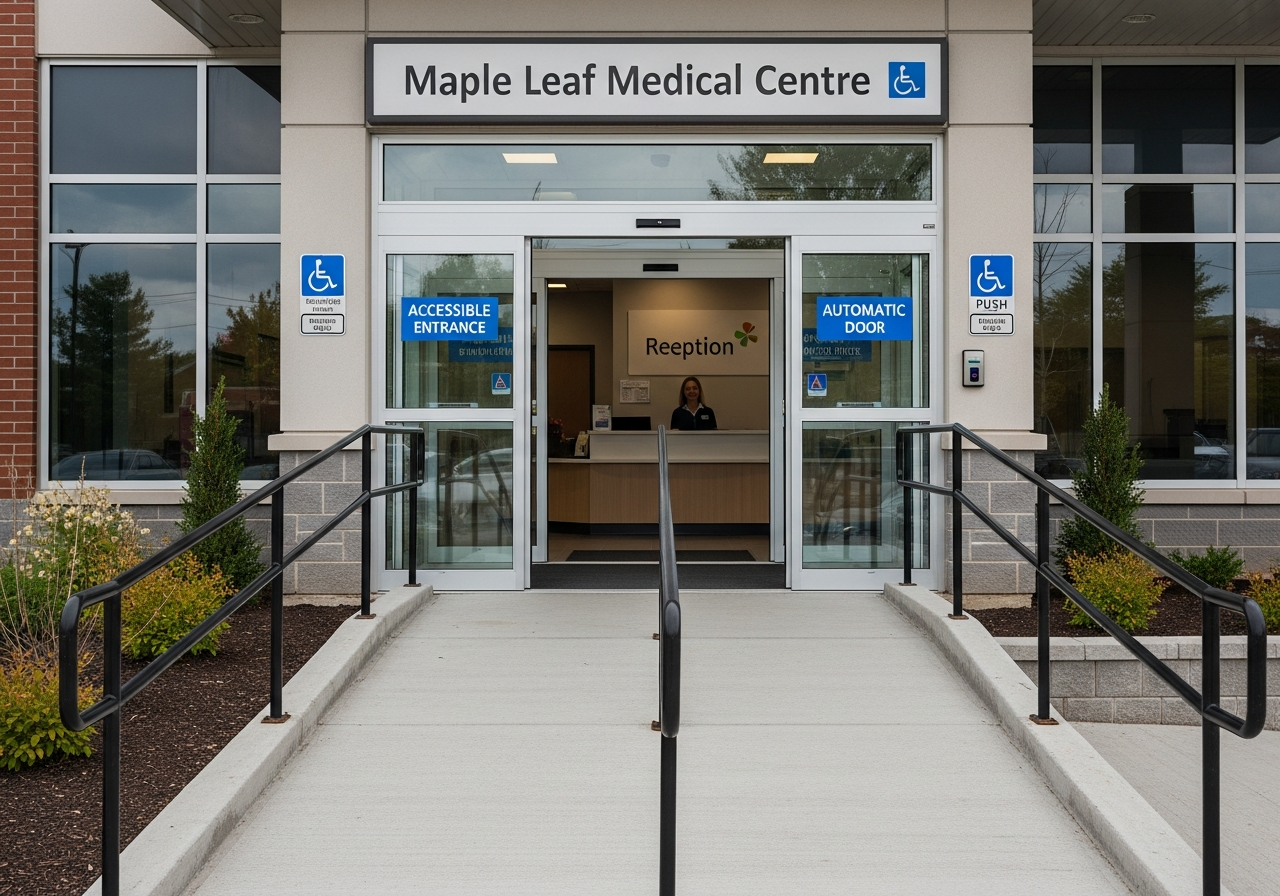
Permit timelines in GTA municipalities for healthcare clinic renovations run 4–16 weeks depending on project scope and municipality. When a clinic owner is paying rent on an empty new space, has announced an opening date to patients and staff, and has a contractor ready to begin, waiting 8–12 weeks for permit approval is genuinely painful. The pressure to begin “preliminary” work — demolition, framing, rough-in — before permits are issued is understandable. It is also illegal, and the consequences in the GTA construction environment are severe.
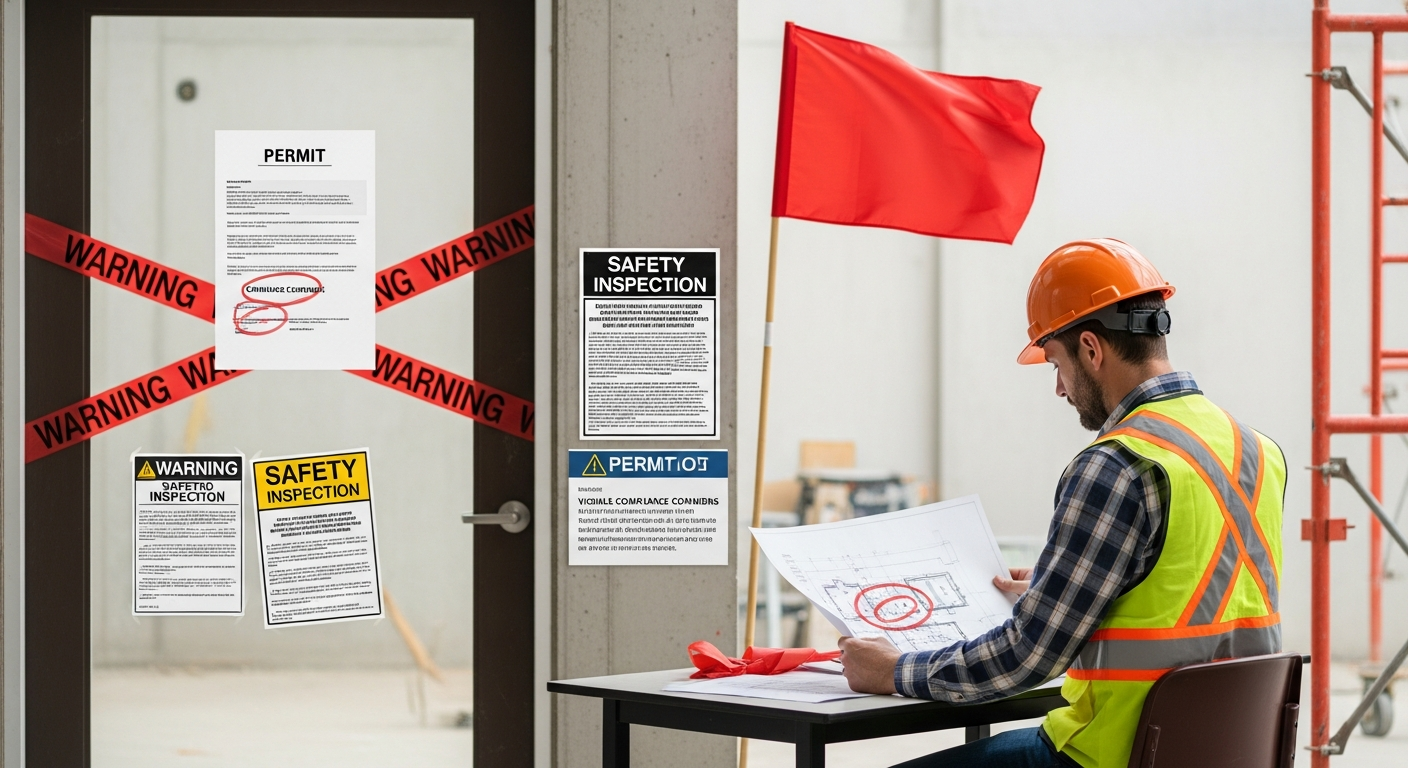
Stop-work orders: Municipal building inspectors conduct routine site visits in commercial zones. An active construction site with no permit posted will receive a stop-work order. The stop-work order requires all work to cease immediately — not at a convenient stopping point, but immediately. Work that has already been done in the unpermitted area cannot be inspected retroactively in most cases and may need to be opened up (walls cut open, slabs removed) for the building inspector to verify code compliance. The cost of a stop-work order on a medical clinic renovation in the GTA ranges from $15,000–$80,000 depending on how much work had been completed when the order was issued — because the demolition to expose completed work for retroactive inspection is often as expensive as the original rough-in.
Case study — Brampton medical clinic: The clinic owner described in the introduction to this guide (Dr. Okafor) began framing for two new exam rooms before the building permit was issued. The Brampton building department issued a stop-work order after 3 weeks of unpermitted framing. The framing was not pre-inspected before being enclosed; the building inspector required the contractor to open a portion of the new walls to verify fire blocking, structural connections, and electrical rough-in before the permit could be issued retroactively. The cost of the stop-work order — demolition, re-inspection, rework, and schedule delay — was $43,000 above the original construction budget, not including the 11-week timeline extension that caused Dr. Okafor to lose his incoming associate physician.
Double permit fees: Most Ontario municipalities double the permit fee for applications filed after construction has begun. On a $300,000 renovation with a $6,000 permit fee, beginning construction before permit issuance adds $6,000 in additional fees — before any remediation costs.
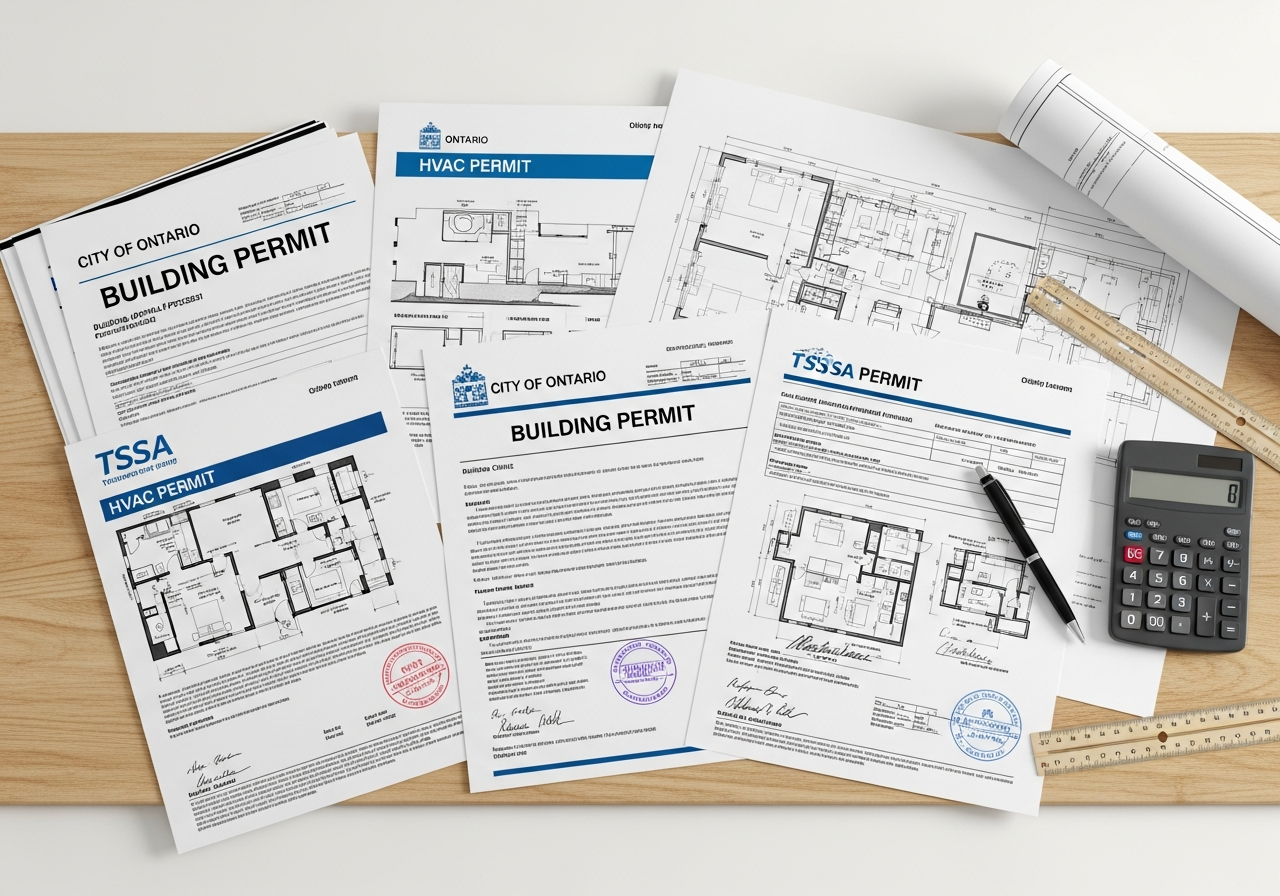
The permit delay problem has two solutions, not one: first, begin the permit application process earlier than you think necessary; second, use the permit waiting period productively. For GTA medical clinic renovations, submit permit applications before finalizing contractor selection. The permit submission requires finalized drawings — which means your design work is complete by the time you’re collecting contractor quotes — but the actual permit waiting period (4–16 weeks) is contractor-quote and contract-negotiation time. By the time you’ve selected a contractor and negotiated a contract, permits are issued or nearly issued. If your project requires TSSA permits in addition to building permits, submit them simultaneously with the building permit application. A qualified healthcare renovation contractor knows how to manage concurrent permit submissions and will factor permit timelines into their project schedule from day one — not as an afterthought discovered when they’re ready to break ground.
Every Ontario healthcare clinic renovation that avoids the five mistakes above follows a consistent pre-construction discipline. Before any contractor breaks ground, these six verifications must be complete — not in progress, not promised for next week, but complete and documented.
These six verifications add approximately 3–6 weeks to the pre-construction timeline versus starting without them. The documented return on that time investment: dramatically lower incidence of the five mistakes above, higher probability of first-inspection compliance approval, and a project that finishes closer to its original budget and timeline. For Ontario healthcare clinic owners who have been through a renovation that failed one or more of these verifications, the pre-construction discipline described here is the single change they would make if they could do it again.
Use this checklist when evaluating any contractor for a medical clinic renovation in Ontario. A qualified healthcare renovation contractor should be able to answer every question on this list confidently and with documentation where noted.
To illustrate how these five mistakes compound when they occur together — as they did for Dr. Okafor in Brampton — here is a complete cost accounting of a scenario that is more common than most clinic owners realize. This scenario is representative of documented Ontario cases where multiple mistakes intersected in a single project.
| Mistake | Original Contract Impact | Remediation Cost | Operational Impact |
|---|---|---|---|
| Wrong contractor (Mistake #1) | $0 (quoted lower than specialist) | $45,000–$75,000 (rework across all rooms) | 6–10 week delay |
| AODA late integration (Mistake #2) | $0 (not in scope) | $18,000–$40,000 (redesign + rebuild) | Permit resubmission delay |
| Wrong HVAC (Mistake #3) | Saved $18,000–$35,000 vs. proper spec | $45,000–$120,000 (full HVAC replacement) | 8–14 weeks closure |
| Wrong materials (Mistake #4) | Saved $8,000–$22,000 vs. proper spec | $20,000–$55,000 (demolish and replace) | 3–6 week delay |
| Pre-permit construction (Mistake #5) | $0 (no permit wait) | $15,000–$80,000 (stop-work + rework) | 8–14 weeks halt |
| Total | Saved $26,000–$57,000 | $143,000–$370,000 | 25–44 weeks total |
The Brampton case at the beginning of this guide followed this pattern precisely. The clinic owner saved approximately $30,000 by choosing the lower-priced general contractor over a healthcare-specialist firm. The total project cost overrun was $147,000. Net cost of the five mistakes: $117,000. Timeline extended by 11 months. The associated physician who would have generated $280,000 in annual OHIP billings was lost to another practice. Dr. Okafor estimates the fully loaded cost of the five mistakes — including the lost physician revenue for the first year — at over $400,000.
Before you call a single contractor, prepare this 10-question qualification script. These questions can be asked in a single 10-minute phone call and will immediately separate qualified healthcare renovation contractors from general commercial contractors who have not worked in medical environments.
Question 1: “Can you describe what CVO Essential Standards require for surgical suite ventilation?” — A qualified contractor answers: 10–15 ACH, positive pressure, supply from ceiling. A non-specialist answers vaguely or says “we follow building code.”
Question 2: “What permits does a medical clinic renovation require if we’re modifying HVAC?” — The correct answer includes building permit, mechanical permit, plumbing permit, electrical permit, and TSSA permit for specialty HVAC. Incomplete answers indicate limited permit experience.
Question 3: “What flooring do you specify for exam rooms?” — The correct answer is seamless: poured epoxy, MMA resin, or welded-seam sheet vinyl with coved base. Ceramic tile or standard LVT is the wrong answer.
Question 4: “Do you have IPAC construction protocols for working in occupied healthcare facilities?” — A qualified contractor says yes and offers to send the protocol document. A general contractor offers to “keep things clean.”
Question 5: “Can you provide the name and phone number of three clinic owners whose projects passed CVO or CPSO first inspection?” — A qualified contractor has this list ready. A general contractor may not know what CVO or CPSO is.
Question 6: “Who is your mechanical engineer for HVAC design, and have they done healthcare HVAC work?” — A qualified contractor has a named P.Eng. with documented healthcare experience. A general contractor uses an HVAC contractor with no engineering oversight.
Question 7: “Have you ever had a stop-work order issued on a healthcare project?” — A straightforward answer with context is acceptable. Evasion or confusion about what a stop-work order is raises serious concerns.
Question 8: “What is your process for HVAC commissioning and documentation?” — A qualified contractor describes ACH measurement by a commissioning agent, pressure differential verification, and a commissioning report that can be presented to the health authority inspector.
Question 9: “What is your current WSIB clearance status?” — The answer should be “current and I’ll send you the certificate.” A contractor who doesn’t know what a WSIB clearance certificate is should not be on your short list.
Question 10: “What is your insurance limit for commercial general liability?” — Minimum $5M for any medical clinic renovation project. A contractor carrying $2M or less is inadequately insured for the liability exposure of a healthcare environment.
A contractor who answers all ten questions correctly, specifically, and with documentation available is qualified to proceed to a site visit and detailed proposal. A contractor who fails any of the first five questions should be removed from consideration, regardless of their quoted price or the quality of their non-healthcare references.
If any portion of your renovation touches clinical spaces — exam rooms, procedure rooms, surgical suites, isolation areas, sterilization rooms, or any area where patient care is delivered — you need a healthcare-experienced contractor. The specific trigger: if the renovation requires HVAC modifications, flooring replacement in clinical areas, or wall/ceiling work in clinical spaces, a general commercial contractor is not qualified. The distinction matters because the materials specifications, HVAC parameters, and infection control requirements for clinical spaces are fundamentally different from general commercial construction — and getting them wrong triggers the compliance failures and remediation costs described throughout this guide. Waiting area renovations, reception desk updates, and exterior work are lower-risk and may be manageable by a well-supervised general contractor, but even these benefit from a healthcare-familiar contractor because the regulatory context shapes decisions that appear to be aesthetic.
By total dollar impact, non-compliant HVAC in surgical suites and procedure rooms is consistently the most expensive single mistake — remediation typically runs $45,000–$180,000 depending on how extensively the non-compliant system must be replaced. However, the stop-work-order/permit mistake (Mistake #5) is sometimes more expensive in total when project delay costs are included — a 10-week construction halt on a project where the clinic owner is paying $8,000/month in rent on an unoccupied new space adds $20,000 in carrying costs on top of the remediation. The combined “wrong contractor + wrong HVAC” failure mode — where a non-specialist contractor installs inadequate HVAC — is the most common pathway to $100,000+ remediation costs. This is why contractor qualification is the first and most important prevention investment: a qualified healthcare contractor simply does not make the HVAC, materials, or permit mistakes described in this guide, because they’ve built their practice around knowing what these standards require.
Yes, and well-designed phasing specifically reduces compliance risk, not just cost. The most risk-aware phasing approach: complete the most compliance-intensive rooms first (surgical suite, procedure rooms, isolation ward) when the contractor’s focus and the project’s resources are concentrated, then proceed to lower-complexity spaces. This ensures that the highest-risk work — the rooms where HVAC, flooring, and materials specification must meet the strictest standards — is completed while the project team is fresh, the permit is current, and the inspector relationship is being established. Doing compliance-intensive rooms at the end of a phased project, when budget is often under pressure, produces the highest rate of specification shortcuts. The risk-reduction logic of “hardest first” applies regardless of operational disruption considerations — but when operational continuity is also a factor, the phasing must be designed so that compliance-intensive rooms can be completed without operational interference. This typically means full closure of compliance-critical areas regardless of the operational status of other areas.
A failed CVO or CPSO facility inspection produces a formal deficiency report listing each non-conformance with the specific standard violated. For minor deficiencies, you typically receive 30–90 days to remediate with a re-inspection at the end of the period. For major deficiencies — particularly non-compliant surgical suite HVAC, inadequate isolation ward pressure management, or infection control material failures — the college may place conditions on your facility certificate restricting the scope of procedures you can perform until remediation is verified. Suspension of facility certificate (the most severe outcome) requires the practice to cease specific regulated activities at that location until compliance is achieved and re-inspected. The practice owner bears full responsibility for bringing the facility to compliance — the contractor’s liability, while potentially recoverable in civil litigation, is a separate matter that does not accelerate the regulatory remediation timeline. This is why contractor qualification is a risk management decision, not just a quality preference: the regulatory consequences of contractor non-performance fall on the clinic owner, not the contractor.
Commission an independent AODA compliance review from a certified accessibility consultant or AODA-experienced architect after construction is complete and before you request any government inspection. This pre-inspection audit costs $500–$2,000 and typically identifies any remaining non-conformances while there is still time and contractor mobilization to address them cheaply. Common late-stage AODA failures found in pre-inspection audits: door closing force exceeding 38 N (the DOPS standard), accessible parking space not meeting van-accessible dimensions, lowered reception counter with insufficient knee clearance depth, and missing tactile walking surface indicators at entrance level changes. All of these are inexpensive fixes when identified before final completion — and potentially expensive when identified by an inspector whose report creates a formal remediation obligation with a deadline.
A well-planned healthcare renovation with a qualified contractor and complete permit package should be budgeted at 10–15% contingency — comparable to other complex commercial construction. However, projects with any of the five risk factors discussed in this guide — non-specialist contractor, late AODA integration, inadequate HVAC engineering, non-healthcare materials specification, or pre-permit construction — should budget 25–40% contingency, because these factors have documented remediation cost ranges that can reach or exceed the original contract value. The contingency buffer for a well-managed project protects against legitimate unknowns (hidden conditions in existing structure, municipal inspection interpretation variations, material lead time extensions). The contingency for a poorly-planned project is not a buffer — it is an inevitability. The distinction between the two types of projects is almost entirely in contractor qualification and upfront planning investment: characteristics that are identifiable and controllable before any construction begins.
The documented pattern from Ontario healthcare renovation remediation cases is consistent: doing it right from the start costs 15–30% more than the lowest-quoted approach, while remediation costs 40–150% of the original project cost. On a $200,000 renovation, choosing the qualified healthcare contractor at a 20% premium means spending $240,000. Choosing the lowest-priced general contractor and then remediating a non-compliant HVAC system, non-compliant flooring, and AODA deficiencies means spending $200,000 plus $85,000–$160,000 in remediation — or $285,000–$360,000 total. The premium for doing it right is $40,000. The cost of doing it wrong is $85,000–$160,000 extra, plus months of operational disruption, plus potential regulatory consequences. The math is not ambiguous. The challenge is that the cost of doing it wrong is not visible at the time of contractor selection — which is exactly why this guide exists.
Written by the RenoEthics construction team — specialists in Ontario medical clinic renovation and healthcare facility compliance. Last updated March 2026. RenoEthics completes medical clinic, veterinary clinic, and pharmacy renovations across Richmond Hill, Markham, Vaughan, Newmarket, Aurora, Toronto, and the broader GTA. Request a complimentary project assessment or get a quote for your healthcare renovation.

Quis lorem suspendisse urna. Donec sed dui mollis, elementum enim quis.

Renovating a pharmacy in 2026 goes far beyond fresh paint and updated shelving—it’s a strategic investment that transforms how you deliver patient care, optimize...
If you’re a healthcare professional planning to renovate your medical office in Ontario, understanding accurate cost expectations is crucial for successful project planning. Whether...