
Designing Patient-Friendly Waiting Areas in Walk-In Clinics
The waiting room is not a neutral space. It is the first physical environment your patients experience, and research consistently shows it shapes how they perceive the quality of care they receive before they ever see a provider. In a walk-in clinic specifically, where patients often arrive stressed, symptomatic, and uncertain, the design of your waiting area can either compound that anxiety or actively reduce it.
This guide goes far beyond the standard advice on paint colours and comfortable chairs. We cover the full picture: IPAC infection control requirements that are mandatory for Ontario clinical settings, AODA accessibility standards for waiting areas, evidence-based design decisions that reduce perceived wait times, the materials that actually perform in a high-turnover healthcare environment, and the layout mistakes that experienced contractors see over and over in clinic renovations across the GTA.
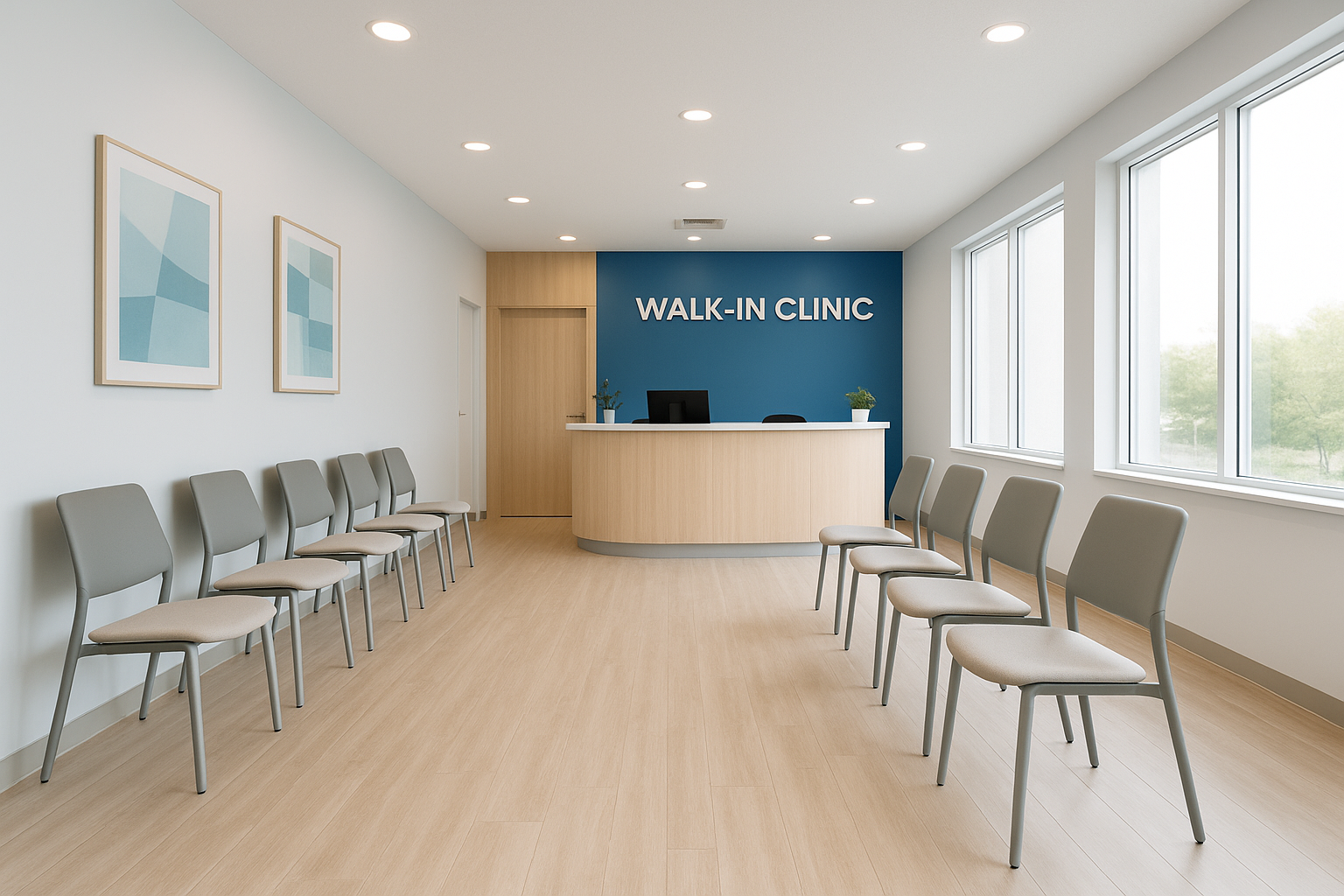
What's in This Guide
- Why Waiting Room Design Matters More Than You Think
- IPAC Requirements for Walk-In Clinic Waiting Areas in Ontario
- Layout, Flow, and Space Planning
- Seating: What Actually Works in a Healthcare Environment
- Flooring and Surface Materials
- Lighting, Acoustics, and Colour Psychology
- AODA Accessibility Requirements for Waiting Areas
- Technology Integration
- 6 Waiting Room Design Mistakes Walk-In Clinics Make
- Waiting Room Renovation Checklist
- Frequently Asked Questions
Why Waiting Room Design Matters More Than You Think
Walk-in clinics operate in one of the most competitive and time-pressured segments of primary care. Patients have choices, and they use online reviews to make them. Studies consistently show that patient satisfaction scores correlate more strongly with the physical environment and wait-time experience than with clinical outcomes for routine visits. In other words, a patient who waits 45 minutes in a calming, well-designed space often rates their visit higher than a patient who waits 20 minutes in a cramped, noisy, dated room.
The waiting area also has operational consequences. Poor layout creates bottlenecks at the reception desk. Inadequate acoustic design forces staff to repeat themselves and creates privacy violations at check-in. Lack of IPAC-compliant spatial separation increases infection transmission risk and the liability exposure that comes with it. And non-compliance with AODA accessibility standards leaves your clinic open to human rights complaints that can follow a renovation far longer than the renovation itself.
Who This Guide Is For
This guide is written for walk-in clinic operators, family health team administrators, and building owners who are planning a waiting room renovation or designing a new clinic space. It is also relevant to GP office renovations, urgent care centres, and any high-volume outpatient setting with a shared patient waiting area. For broader medical office renovation planning, see our step-by-step medical office renovation planning guide.
IPAC Requirements for Walk-In Clinic Waiting Areas in Ontario
This is the section that most waiting room design articles skip entirely, and it is the section that will get your clinic cited in an inspection if you ignore it. Public Health Ontario's Infection Prevention and Control (IPAC) for Clinical Office Practice guidelines, developed with the College of Physicians and Surgeons of Ontario, set specific design and operational requirements for clinical waiting areas. These are not suggestions.
Respiratory Triage and Patient Separation
The single most important IPAC design requirement for walk-in clinic waiting rooms is the ability to spatially separate patients with acute respiratory symptoms from the general waiting population. This became a formalized design requirement following the COVID-19 pandemic and remains in full effect as of 2026. Practically, this means your waiting area design must accommodate one of the following:
- A designated triage point at or adjacent to the entrance where incoming patients are screened before entering the main waiting area
- A secondary waiting zone—either a partitioned alcove, a separate anteroom, or sheltered outdoor seating—where symptomatic respiratory patients can wait separated from other patients
- Clear one-way flow routing so that symptomatic patients can be directed to exam rooms without passing through the general waiting area
IPAC Lapse Risk: Open Waiting Rooms Without Separation Capability
Toronto Public Health and other regional health units actively investigate and publicly post IPAC lapses in walk-in clinics under the Ontario Public Health Standards. A waiting room that lacks any mechanism to separate symptomatic respiratory patients represents a documented IPAC risk. Design your space so separation is operationally feasible, not just theoretically possible.
Hand Hygiene Stations
IPAC guidelines require that alcohol-based hand rub (ABHR) stations be accessible to patients at or immediately after entry into the waiting area. The station must be positioned so patients encounter it before touching shared surfaces (door handles, reception counters, seating). This has direct design implications: your entry vestibule or reception approach must include a built-in or mounted ABHR dispenser location. Wall-mounted units are preferred over freestanding units, which create trip hazards and are easily moved out of position.
Cleanable Surfaces Throughout
All surfaces in clinical waiting areas must be non-porous, easily cleanable, and compatible with hospital-grade disinfectants. This applies to:
- Seating upholstery: must be seamless vinyl or antimicrobial-rated fabric; no tufting, button details, or exposed foam edges that harbor pathogens
- Flooring: must support wet mopping with disinfectant; carpet is not acceptable in clinical waiting areas under current IPAC guidelines
- Reception desk surfaces: no raw wood, unsealed grout, or textured materials that cannot be wiped down thoroughly
- Shared surfaces (side tables, arms, door handles): specify solid surface or stainless steel rather than laminate with exposed edges or seams
- Children's play areas: if included, must be designed so all elements can be disinfected between patients; open bins of shared toys are not IPAC-compliant
Ventilation and Air Quality
While detailed HVAC specifications are beyond the scope of this design guide, your walk-in clinic renovation must address ventilation as part of the waiting room design. Ontario Building Code and CSA Z317.2 (Special Requirements for HVAC in Health Care Facilities) require minimum outdoor air change rates in clinical settings. For waiting areas, this typically means 4 to 6 total air changes per hour (ACH), with provision for increased ventilation when the room is at capacity. If you are renovating an existing space, verify that existing HVAC capacity meets current healthcare requirements—many older retail or office conversions fall significantly short.
Layout, Flow, and Space Planning
The functional layout of a walk-in clinic waiting room determines not just patient comfort but operational efficiency for your entire clinic. A poorly planned layout creates congestion at reception, obscures patients from staff line-of-sight, and creates privacy problems at check-in. Good layout design is invisible to patients—the space simply feels right.
The Four Zones Every Walk-In Clinic Waiting Room Needs
Entry Transition Zone
A decompression space between the exterior door and the reception desk where patients can orient themselves, access ABHR, and decide how to proceed. This zone should be 1,500–2,000mm deep and free of furniture. It reduces crowding at reception and gives patients a moment of perceived control before check-in.
IPAC: ABHR station required hereReception Interface Zone
The immediate area in front of the reception desk where patients check in, verify insurance, and ask questions. This zone requires acoustic management (partial walls, screen, or recessed counter) to prevent conversations from carrying into the general waiting area. Minimum 1,500mm clear depth in front of the desk for wheelchair users.
AODA: Accessible counter at 820mmGeneral Seating Zone
The primary waiting area, organized in seating clusters of 3–6 chairs rather than linear rows. Each cluster should have clear lines of sight to the reception desk, which assures patients they will not be missed and allows staff to observe for medical emergencies. Wheelchair spaces must be distributed throughout, not grouped at edges.
Recommended: 2.3–2.8m² per patientRespiratory Triage / Secondary Waiting Zone
A physically or visually separated area where patients with respiratory symptoms can wait apart from the general population. Can be achieved with a partial wall, planter partition, or a separate anteroom. Should have its own access to a washroom if possible, and must be accessible by design, not just an afterthought corner.
IPAC: Required for Ontario walk-in clinicsOne-Way Flow: Why It Matters
Walk-in clinics that achieve one-way patient flow—where the path from entry to check-in to seating to exam room to exit does not require patients to cross each other—see measurably lower perceived crowding and better infection control outcomes. This is not always achievable in retrofitted spaces, but it should be the design objective. At minimum, the entry and exit paths should be distinct, and the circulation route from reception to exam corridors should not pass through the middle of the seating area.
Contractor Tip: Model Peak Occupancy Before Finalizing Layout
Before fixing your layout, calculate your realistic peak occupancy—typically 1.5x your average daily patient volume compressed into a 3-hour morning rush. Walk through that occupancy scenario on paper: where do people queue at reception? Where do wheelchairs go? Where does a symptomatic patient wait if the secondary zone is full? The answers often reveal layout problems that are easy to fix in design but expensive to address after construction.
Seating: What Actually Works in a Healthcare Environment
Seating selection is where many clinic renovations make well-intentioned but impractical choices. Residential-inspired furniture looks welcoming but fails under healthcare conditions within months. The right seating balances clinical durability with genuine patient comfort.
Seating Specifications That Matter
- Upholstery: Healthcare-grade vinyl or antimicrobial fabric only. Must be seamless (no seams where pathogens accumulate), wipeable with quaternary ammonium and bleach-based disinfectants, and rated for 100,000+ double-rub abrasion. Avoid tufted designs, button details, or velvet-adjacent textures.
- Seat height: 450–480mm for general seating; 480–520mm for chairs intended for elderly patients. Higher seats reduce the effort of standing, which is particularly important in a population that may include post-procedure patients, pregnant women, and elderly individuals.
- Arms: All chairs should have arms. Arms define personal space (reducing perceived crowding between strangers) and are essential for patients standing up from seated—especially critical for older adults or those with mobility limitations.
- Weight capacity: Standard healthcare seating should be rated to 160kg minimum; include at least 15% of seats rated to bariatric capacity (250–350kg) in a walk-in clinic serving a general adult population.
- Leg configuration: Sled-base or four-leg configurations are easier to clean under and around than pedestal bases. Avoid chairs with complex base structures that trap debris.
Cluster vs. Row Configuration
Research from the Center for Health Design and clinical studies on patient experience consistently show that cluster seating of 3–6 chairs significantly outperforms row seating for patient satisfaction, perceived wait time, and sense of personal space. Rows force strangers into shoulder-to-shoulder proximity (Hall's intimate-to-personal space zone) and create a waiting room that feels institutional and crowded even when it is not at capacity.
Clusters allow patients to choose their level of social proximity, create natural personal territory around each seating pod, and are easier to reconfigure for cleaning or social distancing protocols if needed. Each cluster should include a small side table or shared surface so patients can set down bags, water bottles, or devices without placing them on adjacent chairs.
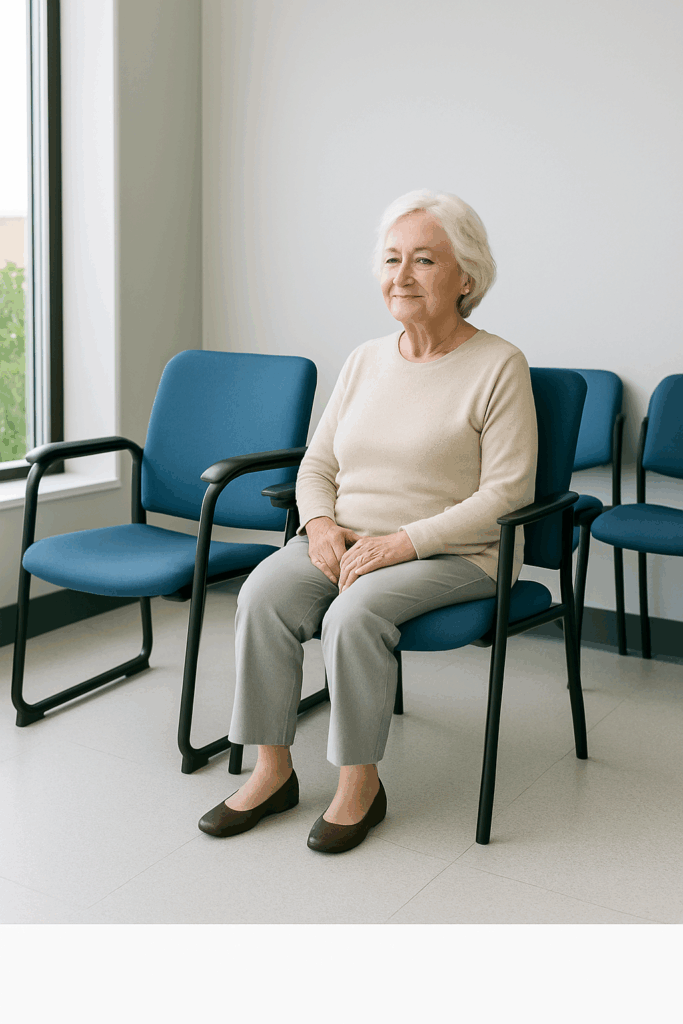
Pod seating with distributed wheelchair clearances, high-back options for elderly patients, and visible lines of sight to reception — the standard RenoEthics applies to walk-in clinic waiting area renovations.
Flooring and Surface Materials
Material selection in a walk-in clinic waiting room is a clinical decision as much as an aesthetic one. The wrong materials create infection control failures, accelerated wear, and accessibility problems. The right materials last 15–20 years, clean quickly between patient waves, and create a space that feels warm rather than institutional.
Flooring
Luxury Vinyl Tile (LVT) with a minimum R10 slip resistance rating is the preferred flooring choice for Ontario walk-in clinic waiting areas in 2026. Key reasons:
- IPAC-compliant: non-porous surface supports wet disinfection mopping; no grout lines that harbor pathogens
- AODA-compliant: firm, stable surface that does not impede wheelchair or walker mobility; transitions must not exceed 6mm vertical or 13mm beveled
- Practical for Ontario winters: resists the wet salt and snow tracked in from November through March, which destroys laminate and deteriorates unsealed hardwood rapidly
- Acoustic benefit: commercial LVT with acoustic backing reduces impact sound, which contributes to noise management without requiring additional acoustic flooring layers
- Aesthetic flexibility: available in wood, stone, and concrete patterns that create a residential warmth without the maintenance of natural materials
Why Carpet Is Not Acceptable in Clinical Waiting Areas
Despite its acoustic and comfort appeal, carpet does not meet IPAC requirements for walk-in clinic waiting areas. It cannot be effectively disinfected with healthcare-grade cleaning agents, it impedes wheelchair mobility (maximum pile height for accessibility is 13mm with firm backing, which still reduces wheelchair rolling resistance), and it retains biological material in ways that create genuine infection control risk. If noise is the concern, address it through ceiling tiles, acoustic wall panels, and LVT with acoustic backing instead.
Wall and Ceiling Surfaces
- Walls: Eggshell or semi-gloss paint minimum (wipeable); chair-rail height impact-resistant panels in high-traffic paths; avoid wallpaper in clinical areas unless specifically rated for healthcare environments and disinfection
- Ceilings: Acoustic ceiling tile (ACT) with NRC (Noise Reduction Coefficient) of 0.70 or higher is the most practical combination of acoustic performance, cleanability, and cost; select tiles with healthcare-appropriate CAC ratings in areas near confidential conversations
- Reception desk surfaces: Solid surface (Corian or equivalent) is strongly preferred over laminate—it is non-porous, easily repaired, and presents no seam failures at the high-use counter edge
Lighting, Acoustics, and Colour Psychology
Lighting
Harsh fluorescent lighting—specifically compact fluorescent (CFL) tubes with their characteristic flicker—has been associated with nervous system irritation, headaches, and increased stress responses in clinical waiting environments. Yet poor lighting alternatives create their own problems: dim spaces can feel unsettling, and inadequate task lighting at reception creates operational errors.
The 2026 approach to waiting room lighting layers multiple sources:
- Ambient base: LED panels with a colour temperature of 3,000–3,500K (warm white) in the waiting area create warmth without sacrificing lux levels. Avoid 5,000K+ daylight-temperature LEDs in patient-facing areas—they read as harsh and institutional.
- Natural light priority: Where windows exist, maximize natural light penetration. Studies show natural light reduces blood pressure and patient-reported stress. Use frosted film or angled louvers to prevent direct glare without blocking daylight.
- Task lighting at reception: Separate, higher-intensity lighting at the reception desk ensures staff can read documents and screens without eye strain, while the general waiting area remains at comfort-appropriate ambient levels.
- Avoid CFL entirely: All lighting in new installations should be LED. The cost difference is negligible over a 5-year period, and the patient experience improvement is material.
Acoustics
Noise is the most consistently cited environmental complaint in healthcare waiting room surveys. Walk-in clinics are particularly vulnerable because they combine high patient volumes, hard-surface clinical materials, and conversations that patients perceive as intrusive into their personal space.
Acoustic management in a waiting room renovation works on three layers:
- Absorption: Acoustic ceiling tiles (NRC 0.70+), upholstered seating, and fabric wall panels absorb sound that would otherwise reflect off hard surfaces. These are the most cost-effective acoustic interventions.
- Blocking: Partial walls, reception screens, and planter dividers between zones reduce sound transmission between seating clusters and between the reception counter and general waiting.
- Masking: Low-volume background music at approximately 60 beats per minute (research indicates this tempo is associated with reduced anxiety in clinical settings) or a white noise / nature sound system provides an acoustic mask that makes individual conversations less intelligible and therefore less intrusive.
Colour Psychology
Colour choice in clinical waiting areas is not merely aesthetic. Colour psychology research consistently identifies the same palette as optimal for anxiety reduction in healthcare environments: sage green, soft dusty blue, warm grey, and off-white or warm cream tones. These palettes are associated with lower cortisol response, perceived cleanliness, and calm.
Colours to avoid: pure white (reads as clinical and cold), saturated red or orange (elevates physiological arousal), and any colour that would read as soiled when scuffed or marked. Accent walls in a warmer tone can add visual interest without creating anxiety. Biophilic elements—indoor plants, nature-themed artwork, or materials with wood grain and stone texture—have demonstrated stress-reduction benefits in peer-reviewed research and integrate well into the neutral palettes described above.
AODA Accessibility Requirements for Walk-In Clinic Waiting Areas
Walk-in clinic waiting areas must comply with Ontario's AODA accessibility standards—specifically the Design of Public Spaces Standard and the Ontario Building Code's barrier-free provisions. These are not optional even for small clinics undertaking a renovation that triggers a building permit.
Here are the specific requirements that directly apply to waiting room design and layout:
- Wheelchair maneuvering clearance: Minimum 1,500mm x 1,500mm clear turning space integrated throughout the waiting area, not isolated to one corner. If wheelchair users can only access a small section of the room, that is not compliant.
- Accessible seating zones: Designated clear floor spaces for wheelchair users (minimum 900mm x 1,200mm each) must be distributed throughout the general seating area and adjacent to standard seats, not grouped separately at the edge of the room.
- Accessible reception: At least one service point on the reception desk at 820mm height with 760mm x 685mm knee clearance beneath, accessible to wheelchair users without obstruction.
- Patient call system: If the clinic uses any form of patient call or notification system (overhead speaker, number display, staff announcements), it must include a visual component—digital display, light signal, or vibrating notification device—for patients with hearing impairments.
- Signage: All directional and room signage must have minimum 70% luminance contrast. Room identification signs should be mounted at 1,500mm centreline height, beside the door latch side, with tactile characters and Braille.
- Path of travel: The path from the accessible entrance to the reception desk, waiting area, and accessible washroom must be entirely clear and compliant at all times—including when the waiting room is at or near capacity.
AODA and Your Waiting Room: A Common Misconception
Many clinic owners believe AODA accessibility compliance is only about wheelchair ramps and washrooms. In reality, the waiting room itself has specific accessibility requirements that are regularly cited in building department reviews: wheelchair clearances integrated throughout the seating layout, accessible counter height at reception, and multi-modal patient notification systems. If you are renovating your waiting area with a building permit, these will be reviewed by the municipality. For a complete breakdown of AODA requirements for medical facilities, see our full AODA compliance guide for Ontario medical clinics.
Technology Integration in the Waiting Area
Technology investments in the waiting room pay back through reduced staff interruptions, improved patient-perceived efficiency, and data that helps you manage flow. Here is what actually delivers value in 2026 Ontario walk-in clinic contexts:
Queue Display Screens
Digital screens showing estimated wait times and patient call numbers are the single highest-impact technology investment for reducing anxiety. Research shows patients who have information about their wait report significantly higher satisfaction than those who do not, even when actual wait times are identical. Screens must have visual and text-based output to meet AODA accessibility requirements.
AODA: Visual display required if call system existsDevice Charging Stations
Built-in USB-A and USB-C charging points integrated into seating or side tables, or a dedicated charging station in the waiting area, are expected by modern patients. Patients who can charge their devices are less likely to feel their time is being wasted. Specify recessed or flush-mounted units that are cleanable and do not create cord hazards.
Best Practice: Flush-mounted, wipeableFree Wi-Fi
Reliable, password-free guest Wi-Fi is now a patient expectation rather than an amenity. Display the network name prominently on a sign or on the digital queue screen. Network should be isolated from clinical systems for security compliance.
Infrastructure: Separate SSID from clinical networkDigital Check-In Kiosks
Self-serve check-in kiosks or tablet-based intake forms reduce queue pressure at the reception desk during peak hours and are increasingly common in Ontario walk-in clinic renovations. Must be mounted at an accessible height (900–1,200mm touchscreen reach range) and include audio assistance capability for AODA compliance. Plan power and data conduit to kiosk locations during construction.
AODA: Accessible height and audio output6 Waiting Room Design Mistakes Walk-In Clinics Make
After working on walk-in clinic and medical office renovations across Richmond Hill, Vaughan, Markham, and the broader GTA, we see the same design failures repeatedly. These are the ones that cost the most to fix after the fact.
Mistake 1: Designing for Average Occupancy Instead of Peak Occupancy
A waiting room designed for your average patient load will feel crowded, inadequately ventilated, and impossible to clean during morning rush hours. Design for 1.5x average to maintain functional comfort at peak. This affects seating count, wheelchair clearances, HVAC capacity, and acoustic performance.
Mistake 2: Ignoring Acoustic Privacy at Reception
In a fully open plan waiting room with no acoustic separation between the reception desk and seating, every patient conversation about symptoms, insurance, and personal health information is audible to every other patient. This is a PHIPA (personal health information) exposure risk, a patient experience failure, and in a busy room with staff raising their voices over background noise, an IPAC risk too. Address it with partial walls, reception screens, or recessed counters as part of the renovation design.
Mistake 3: Choosing Furniture That Cannot Survive Healthcare Cleaning Protocols
Residential-grade furniture or office furniture not rated for healthcare disinfectants deteriorates within months of daily cleaning with bleach-based or quaternary ammonium solutions. Upholstery seams fail, laminate edges peel, and foam exposed at seams becomes a contamination site. Specify healthcare-rated furniture from the outset. The cost premium is 20–40% at purchase and saves full replacement within 2–3 years.
Mistake 4: No Mechanism for Respiratory Patient Separation
As described in the IPAC section, this is not optional in Ontario. A walk-in clinic that cannot separate symptomatic respiratory patients from the general waiting population is not compliant with Public Health Ontario's IPAC guidelines for clinical office settings. Design a solution into your renovation—even a simple partitioned alcove serves the purpose—rather than attempting to address it operationally after the fact.
Mistake 5: Wheelchair Spaces Isolated to One Corner
Grouping all wheelchair-accessible floor clearances at the end of a row or in a single corner of the room is a common AODA compliance failure and creates an experience of segregation for patients using wheelchairs. AODA requires accessible spaces to be distributed throughout the seating area and adjacent to standard seating. This must be addressed in the furniture layout plan before installation.
Mistake 6: Installing a Patient Call System Without a Visual Component
Many clinics retrofit an overhead speaker or auditory number-calling system and consider it done. AODA requires that any patient notification system include a visual component—a screen display, light signal, or equivalent—for patients with hearing impairments. Retrofitting this after the fact is disproportionately expensive compared to designing for it from the start.
Walk-In Clinic Waiting Room Renovation Checklist
Use this checklist when planning or reviewing a waiting room renovation for an Ontario walk-in clinic. All items below reflect current 2026 IPAC, AODA, and Ontario Building Code requirements, plus evidence-based design best practices.
IPAC Compliance
- Entry zone ABHR dispenser location designated (wall-mounted, before shared surfaces)
- Respiratory triage or secondary waiting zone designed into floor plan
- All seating upholstery: seamless healthcare-grade vinyl or antimicrobial fabric
- Flooring: non-porous, disinfection-compatible surface (no carpet in clinical zones)
- Reception and shared surfaces: non-porous, seam-free, disinfectant-rated materials
- HVAC capacity verified for healthcare air change rates (4–6 ACH minimum for waiting areas)
- Children's play area (if included): entirely disinfectable, no shared soft toys in open bins
AODA Accessibility
- 1,500mm x 1,500mm wheelchair maneuvering clearances distributed throughout waiting area
- Wheelchair-accessible spaces (900mm x 1,200mm) adjacent to standard seating throughout room
- Reception counter accessible service point at 820mm height with knee clearance beneath
- Patient call/notification system includes visual component (screen, light signal, or equivalent)
- Signage: 70% minimum luminance contrast, tactile characters, mounted at 1,500mm centreline
- Accessible path of travel from entrance to reception, seating, and washrooms confirmed clear
Layout and Flow
- Entry transition zone (1,500–2,000mm deep) designed before reception desk
- One-way or minimally crossing patient flow from entry to exit
- All seating clusters with direct line of sight to reception desk
- Acoustic separation between reception counter and general waiting area
- Peak occupancy (1.5x average) modelled in layout plan before finalization
Materials and Finishes
- LVT flooring with R10+ slip resistance and 6mm maximum vertical transitions
- Acoustic ceiling tiles at NRC 0.70+ throughout waiting area
- Wall paint: eggshell minimum (wipeable); impact-resistant panel at chair-rail height in traffic zones
- All furniture rated for healthcare-grade disinfectant compatibility
- Colour palette: anxiety-reducing neutral (sage green, dusty blue, warm grey)
- LED lighting at 3,000–3,500K in patient areas; separate task lighting at reception
Technology
- Queue display screen (visual and text) included in design
- Charging stations: power/data rough-in planned during construction
- Guest Wi-Fi network: separate SSID from clinical systems
- Digital check-in kiosk (if planned): accessible mounting height and audio output
Planning a Walk-In Clinic Renovation in the GTA?
RenoEthics specializes in healthcare facility renovations built to IPAC, AODA, and Ontario Building Code standards. We serve Richmond Hill, Vaughan, Markham, Aurora, Toronto, and the Greater Toronto Area.
Get Your Free Clinic ConsultationFrequently Asked Questions
Ontario healthcare facility planning guidelines generally recommend 2.3 to 2.8 square metres of clear floor area per seated patient in walk-in clinic waiting areas, excluding circulation paths and reception clearances. AODA requires a minimum 1,500mm x 1,500mm wheelchair maneuvering space integrated into the waiting area, not isolated to one corner. For a typical busy walk-in clinic expecting 30 to 50 concurrent patients at peak, this translates to 80 to 150 square metres of dedicated waiting space minimum. Peak occupancy planning—not average—should drive your space calculations.
Luxury vinyl tile (LVT) with a slip-resistance rating of at least R10 is the most practical choice. It meets IPAC requirements for cleanability, resists the wet and salt tracked in during Ontario winters, is AODA-compliant with firm stable surface properties, and is available in wood and stone patterns that create warmth without the maintenance issues of natural materials. Carpet is not acceptable in clinical waiting areas under Public Health Ontario's IPAC guidelines for clinical office practice.
Yes. Public Health Ontario's IPAC guidelines for clinical office practice require that patients presenting with acute respiratory symptoms be separated from the general waiting population. This became a formalized design requirement post-pandemic and remains current in 2026. It is typically achieved through a designated triage screening point at or near the entry plus a secondary waiting zone—either a partitioned area, a separate anteroom, or sheltered outdoor seating. This must be a design feature, not just an operational policy, because effective separation requires physical infrastructure.
Research from the Center for Health Design consistently shows that clustered pod seating of 3 to 6 chairs performs better than row seating for patient satisfaction and perceived wait time. Pods create personal space zones that reduce crowding anxiety. A walk-in clinic should mix standard bariatric-rated chairs (rated to 250kg+ minimum for 15% of seating), high-back chairs for elderly patients (seat height 480–520mm with sturdy arms), and AODA-compliant open spaces for wheelchair users distributed throughout the room. All chairs should have arms to assist patients standing from seated position.
Under AODA's Design of Public Spaces Standard and the Ontario Building Code's barrier-free provisions, walk-in clinic waiting areas must provide: 1,500mm x 1,500mm wheelchair turning clearances distributed throughout (not isolated); accessible seating zones for wheelchair users adjacent to standard seating throughout the room (not grouped separately); a reception desk with at least one accessible service point at 820mm height; an auditory patient-call system that includes a visual component for patients with hearing impairments; signage with minimum 70% luminance contrast; and a clear, unobstructed accessible path from entrance to reception, seating, and washrooms at all times.
Several evidence-based design strategies reduce perceived wait time without changing actual wait time. Visible digital queue displays showing estimated wait times reduce anxiety by giving patients information and a sense of control. Natural light exposure reduces stress and blood pressure during waits. Clustered seating with small side tables and access to device charging creates comfort and engagement. Warm colour palettes (sage greens, warm grays, soft blues) reduce anxiety responses. Acoustic control through ceiling tiles and soft furnishings reduces the perception of noise and crowding. Research shows patients in well-designed waiting environments rate their overall visit experience significantly higher than patients with identical wait times in poorly designed spaces.
The Waiting Room Is a Clinical Environment—Design It Like One
The most successful walk-in clinic waiting rooms share a common characteristic: they were designed with the same rigour applied to examination rooms and treatment areas. Material specifications are clinically defensible. Layouts support IPAC compliance rather than working against it. Accessibility is integrated into the design rather than bolted on after the fact. And the patient experience is shaped deliberately rather than left to chance.
In the Ontario context, this means navigating a specific intersection of AODA accessibility requirements, Ontario Building Code permit requirements, Public Health Ontario IPAC guidelines, and the practical realities of high-volume healthcare operations in a Canadian climate. Getting that intersection right from the design stage—rather than discovering compliance gaps after construction—is the difference between a waiting room that serves your clinic for 15 years and one that requires costly modifications before it reaches its third year of operation.
At RenoEthics, every walk-in clinic renovation we undertake addresses waiting room design as a clinical specification problem, not just an interior design exercise. If you are planning a waiting room renovation, a full clinic build-out, or a compliance audit of an existing space, we are available for a free consultation across Richmond Hill, Vaughan, Markham, Aurora, Newmarket, North York, and the broader Greater Toronto Area.
Ready to Renovate Your Walk-In Clinic Waiting Room?
RenoEthics specializes in IPAC-compliant, AODA-accessible walk-in clinic renovations across the GTA and York Region. Healthcare-grade quality, fixed pricing, and a contractor team that understands clinical requirements.
Get Your Free Consultation