
Audiology Clinic Renovation in Ontario: Sound Testing Rooms, CASLPA Standards & Costs (2026)
The Mississauga audiology clinic had passed its initial CASLPA accreditation inspection.
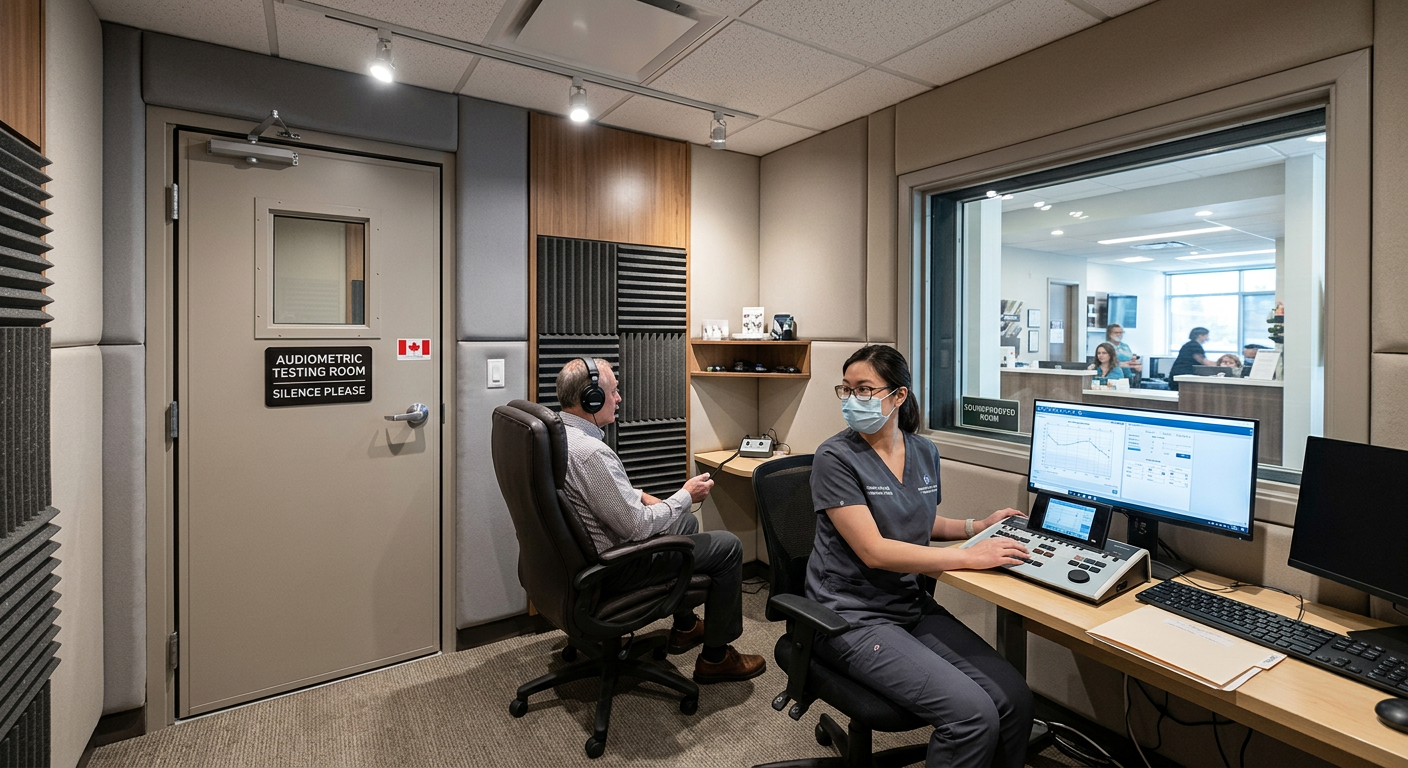
The clinic had been operating for fourteen months when CASLPA conducted its scheduled re-inspection. The audiologist who had invested $310,000 in the clinic build-out — a renovation she had trusted to a general contractor with medical clinic experience but no audiology-specific background — had no reason to expect a problem. The sound booth had passed its initial acoustics test. The clinic was busy. Staff were well-trained. But the re-inspection found what the initial test had missed: the sound booth’s STC rating had degraded from its installed value to STC-51 under actual clinic operating conditions, below the ISO 8253-1 threshold for reliable audiometric testing. The cause was vibration transmission through the building’s HVAC ductwork — ductwork that ran through the mechanical chase directly adjacent to the sound booth wall, a routing the general contractor had specified without acoustic isolation because they had not understood the vibration isolation requirements of an audiometric testing environment.
CASLPA suspended the clinic’s accreditation pending remediation. The remediation required: isolating the HVAC ductwork with flexible vibration-absorbing connectors and resilient channel decoupling, adding a second layer of mass-loaded vinyl and gypsum to the booth wall adjacent to the mechanical chase, and replacing the booth door with a double-seal acoustic door rated for STC-60. Total remediation cost: $78,000. The clinic remained closed for six months during remediation — losing an estimated $180,000 in hearing assessment and hearing aid fitting revenue. Total cost of the specification error: approximately $258,000. The cost of specifying correct HVAC isolation and STC-60 construction from the outset: $22,000 more than what was built. The audiologist estimates the specification error cost her 11 times the price of doing it correctly.
This guide covers every technical and regulatory dimension of audiology clinic renovation in Ontario — CASLPA accreditation standards, ISO 8253-1 acoustic requirements, sound testing room construction specifications, prefab booth versus built-in comparison, hearing aid dispensary design, and GTA cost benchmarks — so that Ontario audiologists can commission a renovation that passes accreditation on first inspection and remains compliant through re-inspection cycles.
What Ontario Audiologists Must Know: Regulatory and Accreditation Framework
Audiology clinic renovation in Ontario is governed by three overlapping regulatory frameworks: the provincial health profession regulation under the Regulated Health Professions Act (RHPA), the CASLPA accreditation program, and the Ontario Building Code (OBC). Understanding how these three frameworks interact determines the compliance scope of any clinic renovation.
CASLPA Accreditation Standards
The Canadian Association of Speech-Language Pathologists and Audiologists (CASLPA) operates a voluntary accreditation program for audiology clinics. While accreditation is technically voluntary, it is practically required for: referral from ENT specialists and family physicians who specify “accredited audiology clinic” in their referral language, third-party billing under most extended health insurance plans that require accreditation as a condition of direct billing authorization, and WSIB audiology services, which are mandatory for accredited clinics. CASLPA accreditation standards for audiology clinics include physical facility requirements related to acoustic performance, equipment calibration environment, patient privacy, and accessibility.
Ontario Audiologists as Regulated Health Professionals
Audiologists in Ontario are regulated by the College of Audiologists and Speech-Language Pathologists of Ontario (CASLPO) under the Audiology and Speech-Language Pathology Act, 1991. CASLPO practice standards require that audiometric testing be conducted in environments that meet ISO 8253-1 maximum permissible ambient noise (MPAN) levels — a requirement that is grounded in the science of hearing test accuracy, not administrative preference. CASLPO does not typically inspect clinic physical facilities directly, but standards of practice that reference appropriate testing environments create professional accountability that makes ISO-compliant acoustic construction a professional obligation, not just an accreditation checkbox.
Ontario Building Code Requirements
The Ontario Building Code (OBC) Part 3 applies to audiology clinics classified as Group B, Division 2 occupancies (institutional occupancies with care or detention). Audiology-specific OBC requirements relevant to renovation include: accessible washroom facilities meeting AODA Design of Public Spaces Standard dimensions (O. Reg. 413/12 DOPS), accessible service counters at reception (maximum 860mm height for accessible counter section), and an accessible route from the building entrance through all patient-accessed spaces. The OBC does not contain acoustic performance requirements specific to audiometric testing — that standard is set by ISO 8253-1 and enforced through CASLPA accreditation. The building permit for an audiology clinic renovation must reference the applicable occupancy classification and will require full AODA compliance documentation.
The Science of Audiometric Testing Environments: Why Acoustics Are Non-Negotiable
ISO 8253-1 “Acoustics — Audiometric test methods — Part 1: Pure-tone air and bone conduction audiometry” specifies the maximum permissible ambient noise (MPAN) levels for audiometric testing environments. These limits are not conservative safety margins — they are calculated based on the signal-to-noise ratios required for reliable threshold detection at each test frequency. Exceeding MPAN limits in even one frequency band compromises test validity for that frequency range.
ISO 8253-1 MPAN Requirements
ISO 8253-1 Table 1 specifies MPAN levels for one-octave and one-third-octave bands from 125 Hz to 8,000 Hz. For audiometry without insert earphones (supra-aural earphone testing), the MPAN for the 500 Hz octave band is 28 dB SPL. For testing with insert earphones, which provide additional attenuation, the MPAN limits are higher — the 500 Hz limit rises to 40 dB SPL. The key implication for construction: the acoustic performance requirement is frequency-dependent, and the specific failure mode of the Mississauga clinic — HVAC vibration transmission — was concentrated in the low-frequency range (125–500 Hz) where MPAN limits are most stringent and structural vibration is most easily transmitted. HVAC ductwork carries low-frequency vibration efficiently through building structure; without decoupling, this vibration registers as ambient noise in the test environment even when auditory noise is inaudible to the human ear without amplification.
What 1 dB of Background Noise Does to Test Accuracy
Audiometric threshold determination relies on presenting pure-tone signals at intensity levels near the patient’s hearing threshold and recording minimum detection levels. When background noise in the test environment exceeds MPAN limits, threshold measurements shift upward — patients appear to have worse hearing than they do because the ambient noise masks test tones at threshold levels. A 3–5 dB exceedance of MPAN limits can shift threshold measurements by 2–4 dB, producing clinically significant inaccuracies. For patients near the boundary of normal hearing and mild hearing loss (15–25 dB HL), a 4 dB test environment error can result in incorrect diagnosis — either missing a genuine mild hearing loss or diagnosing a loss that does not exist. The clinical and medicolegal implications of systematic threshold measurement error are substantial.
Sound Testing Room Construction Specifications
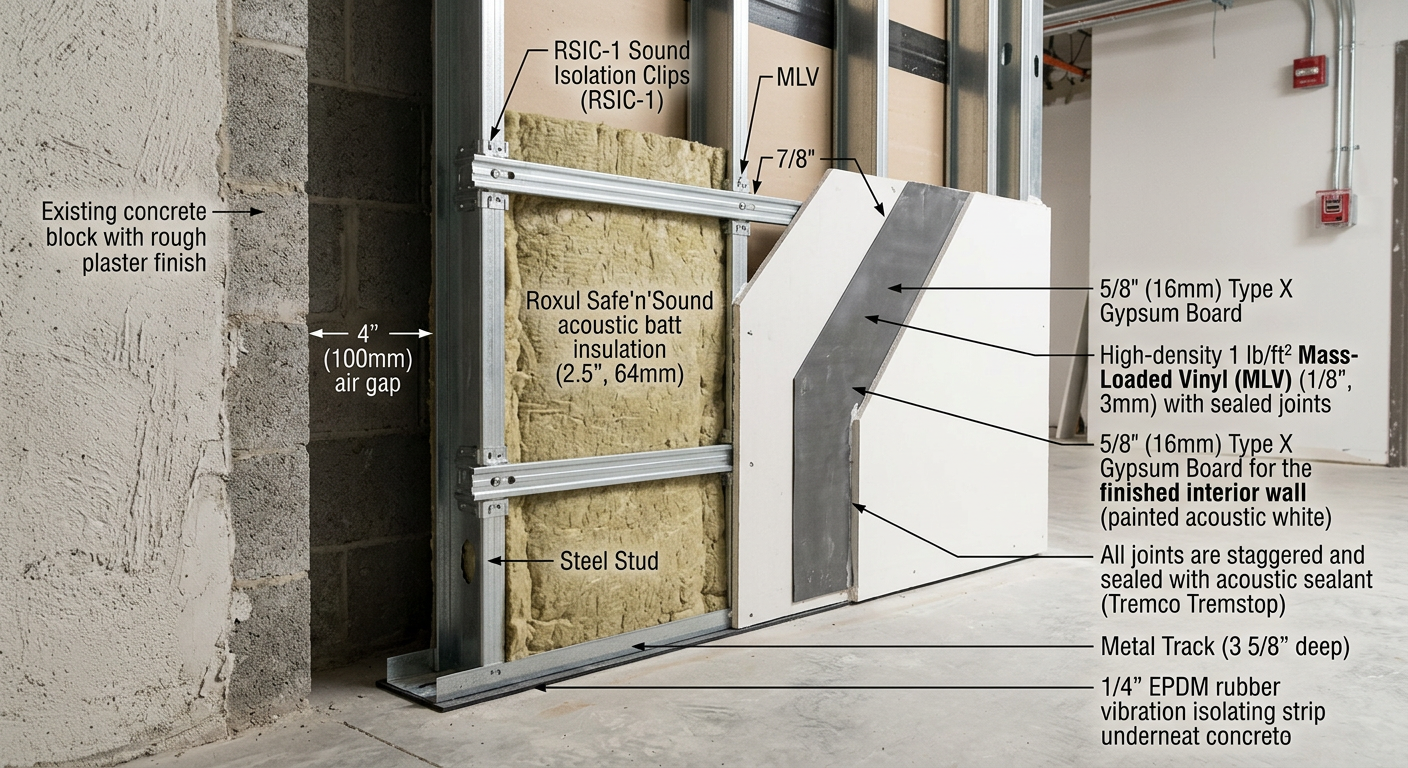
An audiometric testing room that meets ISO 8253-1 MPAN limits in a typical GTA clinical building environment requires a construction assembly that achieves STC-60 or better for wall and floor/ceiling assemblies. Achieving STC-60 requires specific construction techniques that differ fundamentally from standard commercial partition construction.
Wall Assembly: Room-Within-a-Room
Standard STC performance for a double-stud gypsum wall assembly — two rows of steel studs with offset spacing and acoustic batt insulation — is approximately STC-55 to STC-58. Achieving STC-60 reliably requires a room-within-a-room approach: the audiometric testing room is structurally decoupled from the building shell by isolating the interior room’s framing from direct contact with floor, walls, and ceiling of the surrounding structure. This is accomplished through resilient channel or specialty acoustic isolation clips (e.g., Kinetics RIM clips, Mason Industries Type 6 pads) at all wall-to-floor and wall-to-ceiling junctions. The framing must be continuous — any penetration that bridges the decoupling gap (an electrical conduit anchored to both inner and outer walls, a stud that contacts both surfaces) creates a flanking path that reduces effective STC by 5–12 points regardless of how well the walls are built. Maintaining decoupling discipline through the entire construction process requires daily contractor inspection — it is the single most common installation error in acoustic room construction.
Floating Floor Assembly
The floor assembly must prevent impact noise and vibration transmission from the building’s structural floor (concrete slab in most GTA commercial buildings) to the audiometric testing room interior. A two-layer resilient floor assembly typically consists of: a neoprene or fiberglass acoustic isolation pad (minimum 25mm, rated for the loading weight of the room contents), a 19mm plywood raft (the inner room’s floating floor subfloor), and the finished floor surface. The isolation pad must cover the entire floor area continuously — edge terminations must use perimeter isolation material to prevent flanking transmission at wall bases. The finished floor surface should be non-porous and non-resonant — rubber or vinyl sheet goods are preferred over hardwood, which can amplify footfall impact noise in adjacent spaces.
Acoustic Doors and Seals
Standard hollow metal doors achieve STC-28 to STC-32 — dramatically below the STC-60 target for the room assembly. Acoustic doors rated for audiometric testing environments are typically STC-45 to STC-55 for the door slab itself; combined with compression seals at all four perimeter edges and an automatic door bottom seal (drop seal mechanism), the door assembly achieves STC-40 to STC-48 in practice. For the room assembly to achieve STC-60, the door — as the weakest element — must be specified at the highest achievable rating for the budget. Acoustic door assembly costs for audiometric testing room quality: $4,500–$9,000 supplied and installed, compared to $400–$800 for a standard hollow metal door. The door assembly is the most common element where value-engineering substitution destroys acoustic performance; specification documents must prohibit substitution without acoustic equivalency documentation.
HVAC Silencing and Vibration Isolation
HVAC is the most technically complex element of audiometric room acoustic design. The requirements are: (1) vibration isolation — the air handling unit, ductwork, and supply/return diffusers must be mechanically decoupled from the audiometric room structure; (2) airborne noise attenuation — supply and return air paths must include sound attenuators (lined duct sections or proprietary silencers) to reduce duct-borne HVAC noise to below MPAN limits; (3) air velocity control — supply air velocities inside the testing room must be below 0.25 m/s (50 ft/min) to prevent turbulence noise from the diffuser. Flexible connections at all ductwork entry and exit points to the audiometric room prevent vibration transmission through the duct itself. The HVAC engineer responsible for the audiometric room acoustic design must be an MEP engineer with specific acoustic HVAC experience — not a standard mechanical contractor, who will typically route ducts based on structural convenience without reference to vibration transmission paths.
Electrical Noise Mitigation
Audiometers are sensitive to electrical interference. Electrical noise in the 60 Hz range (power line frequency) and its harmonics can be introduced through shared grounding, adjacent fluorescent or LED drivers, and improperly shielded electrical circuits in the audiometric room. Requirements: dedicated isolated electrical circuit for audiometer power (not shared with other clinical equipment), shielded conduit for all electrical wiring within the audiometric room, LED lighting with low-noise drivers rated for audio-sensitive environments, and a dedicated ground reference if the building’s electrical system shows measurable ground noise. An audiologist experiencing unexplained audiometer calibration drift — where the audiometer’s internal calibration reads correctly but test results are inconsistent — should suspect electrical noise before assuming audiometer fault.
Prefab Audiometric Booth vs. Built-In Sound Room: Complete Comparison
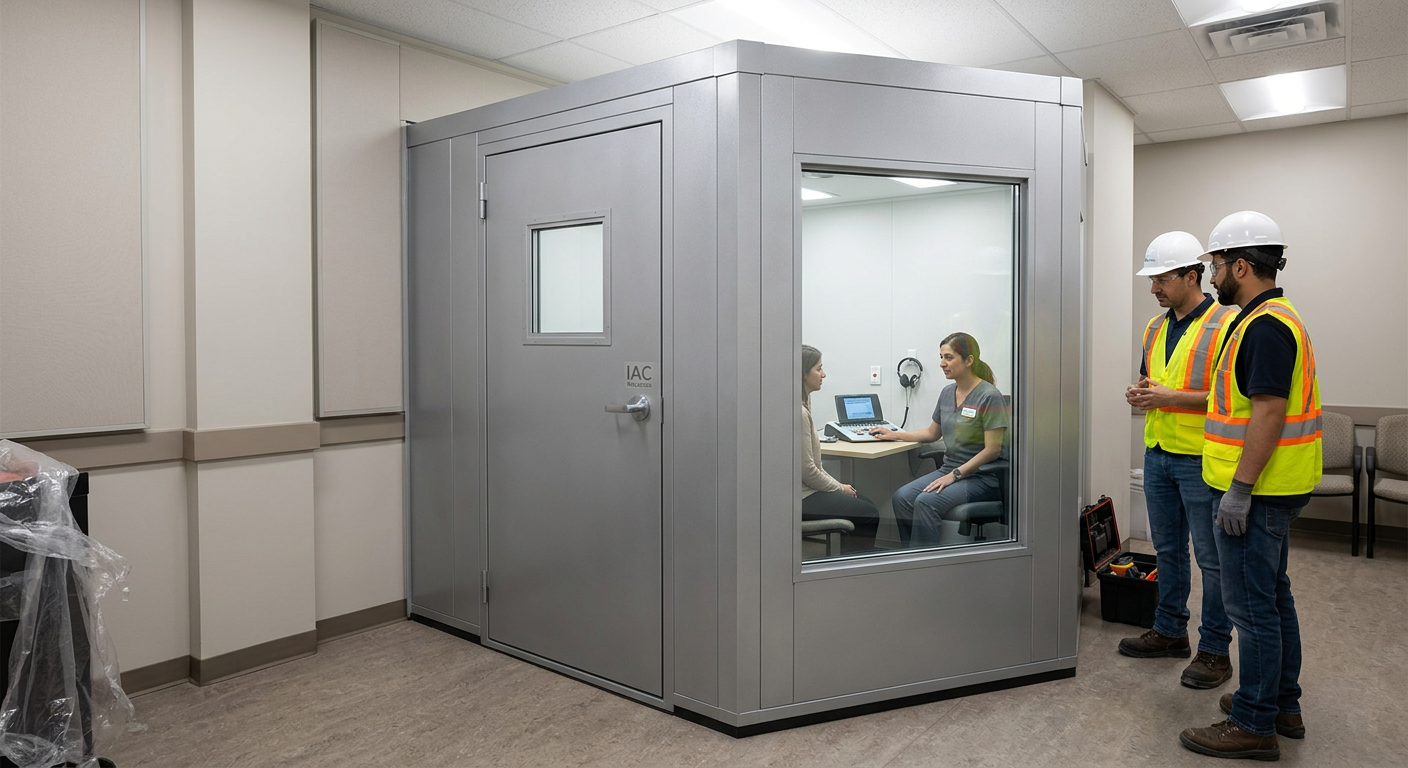
The choice between a prefabricated audiometric booth and a custom built-in sound room is the most consequential single decision in audiology clinic renovation. Both approaches can meet ISO 8253-1 requirements when correctly specified and installed; they differ significantly in cost, space efficiency, acoustic performance ceiling, flexibility, and long-term resale value.
| Factor | Prefab Audiometric Booth | Custom Built-In Room |
|---|---|---|
| Cost (single-room, Ontario installed) | $18,000–$35,000 | $45,000–$120,000 |
| Typical STC performance | STC-48 to STC-58 (manufacturer-rated) | STC-55 to STC-65+ (design-dependent) |
| Installation time | 2–4 days | 4–8 weeks |
| Space footprint | Requires minimum 12’×12′ room to house booth | Optimized to available space |
| Acoustic flexibility | Fixed panel construction — limited modification | Fully custom — any dimension or configuration |
| Relocatability | Demountable — can move to new clinic location | Permanent building component |
| Building permit requirement | Typically no structural permit (freestanding) | Full building permit required |
| Resale/liquidation value | Booth retains value — resaleable | No standalone value |
| Best for | Leased space, smaller clinics, budget constraint | Owned space, high-volume clinics, new build |
Prefab Booth Considerations
Leading prefab audiometric booth manufacturers available in Ontario include Acoustic Systems, IAC Acoustics, and Eckel Industries (Canadian manufacturer in Ottawa). Standard double-walled booths from these manufacturers are STC-48 to STC-52 at time of installation; the higher-specification models achieve STC-58 and are ASHA (American Speech-Language-Hearing Association) compliant for single-room audiometry. Key installation consideration: the booth floor must be level within 3mm across its full footprint — an uneven concrete slab requires levelling compound before booth placement, which adds $500–$2,000 to installation cost. The booth’s HVAC connection — most booths require a dedicated supply/return connection to the building HVAC system — must be specified at the design stage; field retrofitting HVAC connections to an installed booth adds $3,000–$8,000 and often creates the vibration coupling problem described in the case study above.
Built-In Room Considerations
Custom built-in rooms achieve higher acoustic performance ceilings than prefab booths and integrate more naturally into the clinic’s overall floor plan. They are the preferred solution for clinics with high audiometric volume (10+ tests per day), clinics with large patient populations requiring wheelchair-accessible test environments (most booth interiors are too small for powered wheelchair access), and clinics conducting bone conduction audiometry where MPAN standards are more stringent. The acoustic design for a built-in room must be prepared by a qualified acoustical consultant — not the architect or general contractor — and should include ISO 8253-1 compliance verification methodology before construction begins.
Hearing Aid Dispensary Design
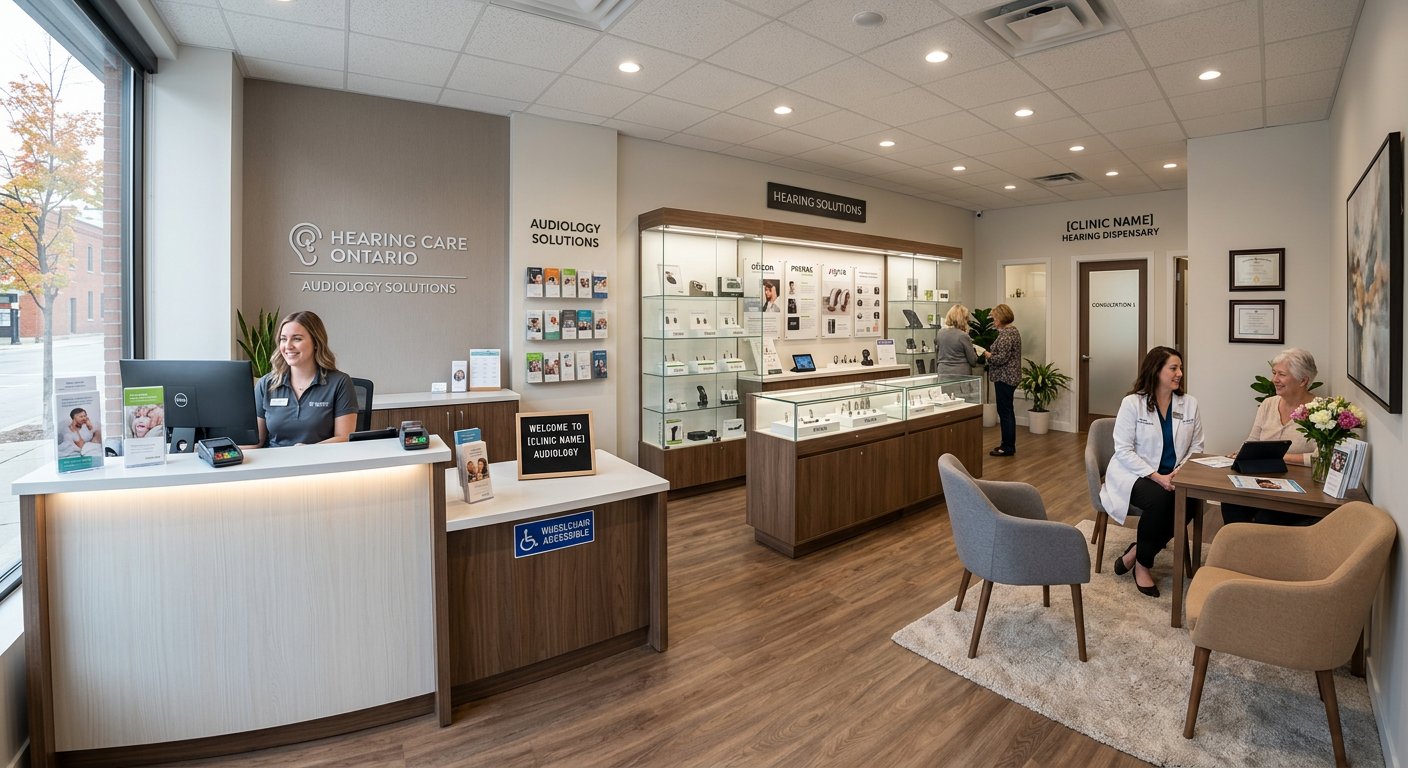
Hearing aid dispensing is a growing revenue component for Ontario audiology clinics. Dispensary design affects both the patient experience during hearing aid selection and the clinical workflow for fitting, adjustment, and follow-up. Three design elements have the greatest impact on dispensary performance.
Fitting Room Acoustics
Hearing aid fitting rooms do not require audiometric-grade acoustic construction, but they do require quieter conditions than standard office environments. A fitting room with excessive reverberation or background noise makes it difficult for the audiologist to demonstrate hearing aid benefit, because the patient cannot perceive the acoustic improvement in a noisy room. Target: RT60 (reverberation time) of 0.3–0.5 seconds in the fitting room. Achieved through: acoustic ceiling tile (NRC 0.70 or higher), acoustic wall treatment panels on at least two walls, and carpeted or resilient floor (not hard surface). HVAC noise in fitting rooms must be below NC-30 (noise criterion) — achievable with VAV diffusers set for low air velocity and acoustic flexible duct connections.
Product Display and Patient Flow
Dispensary layouts that separate the product display area from the fitting consultation area improve patient experience and increase conversion rates. A display wall with illuminated cases for hearing aid models and accessories — positioned in the waiting or reception area — allows patients to browse before the consultation without disrupting clinical workflow. Fitting consultation areas benefit from face-to-face seating at 90 degrees rather than across a desk — the 90-degree arrangement is preferred by patients with hearing loss because it allows them to read facial expressions and lip movements during conversation. The fitting area should have access to a power outlet for hearing aid programming equipment at a height accessible from a seated position.
AODA Accessibility Requirements for Dispensary
Audiology clinic patients include a high proportion of individuals with significant hearing loss and, in older demographics, mobility limitations. AODA DOPS requirements for accessible service: reception counter maximum 860mm height with a knee clearance section, waiting area seating with at least one armrest and one armless seat (for transfer from wheelchair or walker), and an accessible route to all patient-accessed spaces including fitting room and testing room. Hearing loop systems (audio induction loops) at reception counters are increasingly specified in audiology clinic renovations — they allow patients with telecoil-equipped hearing aids to receive speech directly through their hearing aids at the counter, improving communication access. Loop installation costs $800–$3,000 depending on counter size and is not currently mandated by AODA but is consistent with Universal Design principles expected in an audiology environment.
The Three Most Expensive Audiology Renovation Mistakes
Mistake 1: Underspecifying STC Rating for the Booth or Room
The most common and costly audiology renovation mistake is building an audiometric testing environment that is STC-50 or below — a performance level that fails ISO 8253-1 MPAN limits in most GTA commercial building environments. Standard-grade double-stud partitions achieve STC-50 to STC-54; these assemblies are adequate for speech privacy between offices but are not adequate for audiometric testing. The error occurs when the contractor specifies “acoustically rated construction” without understanding that audiometric testing has specific STC requirements that exceed standard acoustic partition performance. Remediation after the fact — adding mass-loaded vinyl, resilient channel, and additional gypsum layers to an existing partition — costs $35,000–$90,000 depending on scope, plus the cost of clinical closure during remediation. A Thornhill audiology clinic that opened in 2022 required $67,000 in acoustic remediation three months after opening when CASLPA inspection identified STC-51 performance in an environment that required STC-60.
Mistake 2: HVAC Vibration Transmission Through Structure
The case study that opens this guide is representative of the second most common audiology renovation mistake. HVAC vibration transmits efficiently through building structure — steel ductwork acts as a mechanical amplifier for compressor and fan vibration at frequencies that directly interfere with audiometric testing. The mistake occurs when the HVAC contractor routes ductwork through the mechanical chase closest to the audiometric room without specifying flexible connections, resilient hangers, and acoustic isolation at the room boundary. Remediation requires: vibration-absorbing flexible connectors at all ductwork entry and exit points to the acoustic zone, resilient spring mounts for any air handling unit within 10 metres of the testing room, and potentially duct re-routing if vibration paths cannot be interrupted in place. Remediation costs: $20,000–$55,000. Prevention cost: $4,000–$12,000 additional at initial construction for proper isolation specification and installation.
Mistake 3: Inadequate Electrical Grounding Affecting Audiometer Accuracy
Audiometers require clean power and clean grounding to produce accurate threshold measurements. In buildings with shared electrical infrastructure — particularly older GTA commercial buildings with shared neutral conductors — electrical noise at 60 Hz and harmonics can introduce systematic errors into audiometric threshold measurements. The failure mode is subtle: the audiometer calibrates correctly on its internal calibration check, but threshold measurements during patient testing are elevated by 3–6 dB due to electrical interference at frequencies corresponding to the audiometer’s signal range. The error is often attributed to patient cooperation or audiologist technique before the electrical root cause is identified. Remediation: dedicated isolated circuit for audiometer power, with isolated ground, typically costs $2,500–$8,000 depending on electrical panel distance. Specification at design stage: $800–$2,500 incremental over standard circuit cost. A Richmond Hill audiology clinic discovered this failure through systematic patient re-testing over six months — the audiometer’s threshold measurements were consistently elevated by 4 dB in the 2,000–4,000 Hz range, creating a pattern that was ultimately traced to electrical interference from the building’s shared neutral system.
Audiology Clinic Renovation Cost Breakdown
| Renovation Scope | Low End | High End | Notes |
|---|---|---|---|
| Prefab audiometric booth installation only | $22,000 | $42,000 | Includes HVAC connection, electrical, levelling |
| Custom built-in sound room (single) | $55,000 | $130,000 | Acoustic consultant fee included |
| Hearing aid dispensary fit-out only | $30,000 | $75,000 | Display, fitting room, reception |
| Reception and waiting area renovation | $25,000 | $60,000 | AODA-compliant counter, accessible seating |
| Full audiology clinic fit-out (shell space) | $200,000 | $450,000 | All of the above plus all finishes, mechanical, electrical |
| Acoustic remediation (after failed inspection) | $35,000 | $90,000 | Most common remediation range for STC failures |
| Acoustic consultant fee | $3,500 | $12,000 | Design + inspection + ISO compliance verification |
| HVAC vibration remediation | $20,000 | $55,000 | Isolation, re-routing, flexible connections |
Budgeting Your Audiology Clinic Renovation: What Drives Cost Variance
Audiology clinic renovation costs in Ontario vary significantly based on three primary factors: the acoustic performance requirements of the site, the scope of hearing aid dispensary build-out, and the existing condition of the leased or owned space. Understanding these cost drivers before receiving contractor quotes helps clinic owners evaluate quotes on a like-for-like basis and identify where budget allocation produces the greatest return on investment.
Site Acoustic Conditions and Their Impact on Construction Cost
The ambient noise level of the building where the clinic is located is the single greatest cost driver for the acoustic room budget. A space on the third floor of a quiet professional office building — with no mechanical rooms adjacent, no busy street fronting, and no vibrating HVAC equipment in the adjacent mechanical chase — requires the minimum acoustic construction assembly to achieve ISO 8253-1 compliance. A space on the ground floor of a building fronting a busy arterial road, with HVAC equipment rooms on the adjacent wall, requires significantly more mass and isolation — sometimes double the gypsum board layers, additional mass-loaded vinyl, and more extensive HVAC decoupling work. The acoustic consultant’s site measurement conducted before design begins determines exactly which situation applies and allows cost budgeting before any space is leased or purchased. Ontario audiologists selecting a new clinic location should commission a site acoustic measurement (cost: $800–$2,000) before signing a lease — the difference in acoustic construction cost between a favorable and an unfavorable site can be $30,000–$60,000.
Dispensary Scope vs. Diagnostic-Only Scope
Audiology clinics that include hearing aid dispensing require more square footage, more specialized fit-out (display cases, fitting room acoustic treatment, product storage), and more AODA-compliant infrastructure than diagnostic-only practices. A diagnostic-only clinic — one testing room, a waiting area, and a small reception — can be built out in 800–1,200 square feet for $180,000–$280,000 all-in. A full dispensary clinic occupying 1,500–2,200 square feet with two testing rooms, a hearing aid fitting room, a product display area, and full reception will cost $320,000–$480,000 all-in. The per-square-foot cost of the acoustic testing rooms (typically $200–$350/sq ft) is higher than the per-square-foot cost of the dispensary and reception areas (typically $150–$250/sq ft), so clinics that are heavier on diagnostic volume relative to dispensing will have a higher average renovation cost per square foot despite similar total square footage to a dispensary-heavy clinic.
Contingency Allocation for Acoustic Remediation Risk
Construction budgets for audiology clinic renovations should carry a 15–20% contingency specifically allocated to acoustic remediation risk — higher than the standard 10% construction contingency recommended for commercial renovations. This higher contingency reflects the elevated technical risk of acoustic construction: the margin between an STC-58 assembly (borderline compliant) and STC-62 assembly (clearly compliant) is often determined by installation details that are difficult to enforce and verify until the post-construction measurement is done. Clinics that budget a 10% contingency and encounter an acoustic deficiency requiring remediation frequently face financial stress because the remediation cost is not discretionary — CASLPA accreditation cannot be obtained without correction. The 15–20% acoustic contingency, if not needed, is released after the post-construction measurement confirms compliance. If needed, it covers remediation without project budget crisis.
CASLPA Compliance Checklist for Audiology Clinic Renovation
- Acoustic consultant engaged at schematic design phase with written ISO 8253-1 compliance scope
- Sound room or booth STC rating specified at STC-60 minimum (not STC-50 or “acoustically rated”)
- Room-within-a-room construction or prefab booth from CASLPA-recognized manufacturer specified
- HVAC vibration isolation specified: flexible connectors at all room penetrations, resilient AHU mounting
- HVAC supply air velocity in test room specified at ≤0.25 m/s (50 ft/min)
- HVAC background noise target: NC-25 or below in test room
- Acoustic door assembly specified at STC-45 minimum with perimeter compression seals and drop bottom seal
- Floating floor assembly specified with minimum 25mm neoprene isolation pads, continuous
- Electrical circuit for audiometer: dedicated isolated circuit, shielded conduit, isolated ground
- LED lighting drivers in test room rated for audio-sensitive environments (low electrical noise)
- No flanking paths in wall assembly: electrical boxes on opposite walls, no continuous stud contact
- AODA-compliant reception counter with accessible section (≤860mm height, knee clearance)
- Accessible route from building entrance to test room (minimum 920mm doorway clearance)
- Accessible washroom meeting AODA DOPS grab bar and turning radius requirements
- Post-construction acoustic measurement by acoustical consultant before CASLPA inspection
- Audiometer calibration certificate current (within 12 months) at time of accreditation inspection
- Instrument storage meeting CASLPA standards for audiometer and immittance equipment
- Hearing aid fitting room RT60 ≤0.5 seconds (acoustic ceiling and wall treatment installed)
5-Phase Implementation Roadmap for Audiology Clinic Renovation
Phase 1: Acoustic Design and Regulatory Pre-Planning (Weeks 1–4)
Engage acoustical consultant before any other design professional. Commission a site survey to measure existing ambient noise levels at the proposed sound room location (at different times of day, including peak HVAC load periods). The acoustic consultant’s report determines whether the site is suitable for ISO 8253-1 compliance without extraordinary measures, and establishes the minimum STC target for wall, floor, and ceiling assemblies. Simultaneously: confirm AODA requirements with the local building department, engage the audiometer supplier (Otometrics, Interacoustics, Grason-Stadler) to obtain rough-in specifications for audiometer and immittance meter installations, and confirm CASLPA accreditation documentation requirements for new or renovating clinics.
Phase 2: Design and Permit Documentation (Weeks 4–10)
Architect produces construction drawings incorporating acoustic consultant’s specifications. Mechanical engineer designs HVAC system with explicit acoustic performance criteria: vibration isolation specifications, supply air velocity targets, NC rating targets for each room type. Electrical engineer designs audiometer circuit isolation and equipment grounding. Building permit submission — typical GTA municipality review times: Toronto 6–10 weeks, Mississauga 5–8 weeks, Vaughan/Markham/Richmond Hill 4–7 weeks. Submit building permit concurrent with contractor tender process to minimize total timeline. Request pre-submission CASLPA accreditation consultation to confirm planned facility will meet accreditation standards before construction begins.
Phase 3: Acoustic Shell Construction (Weeks 10–18)
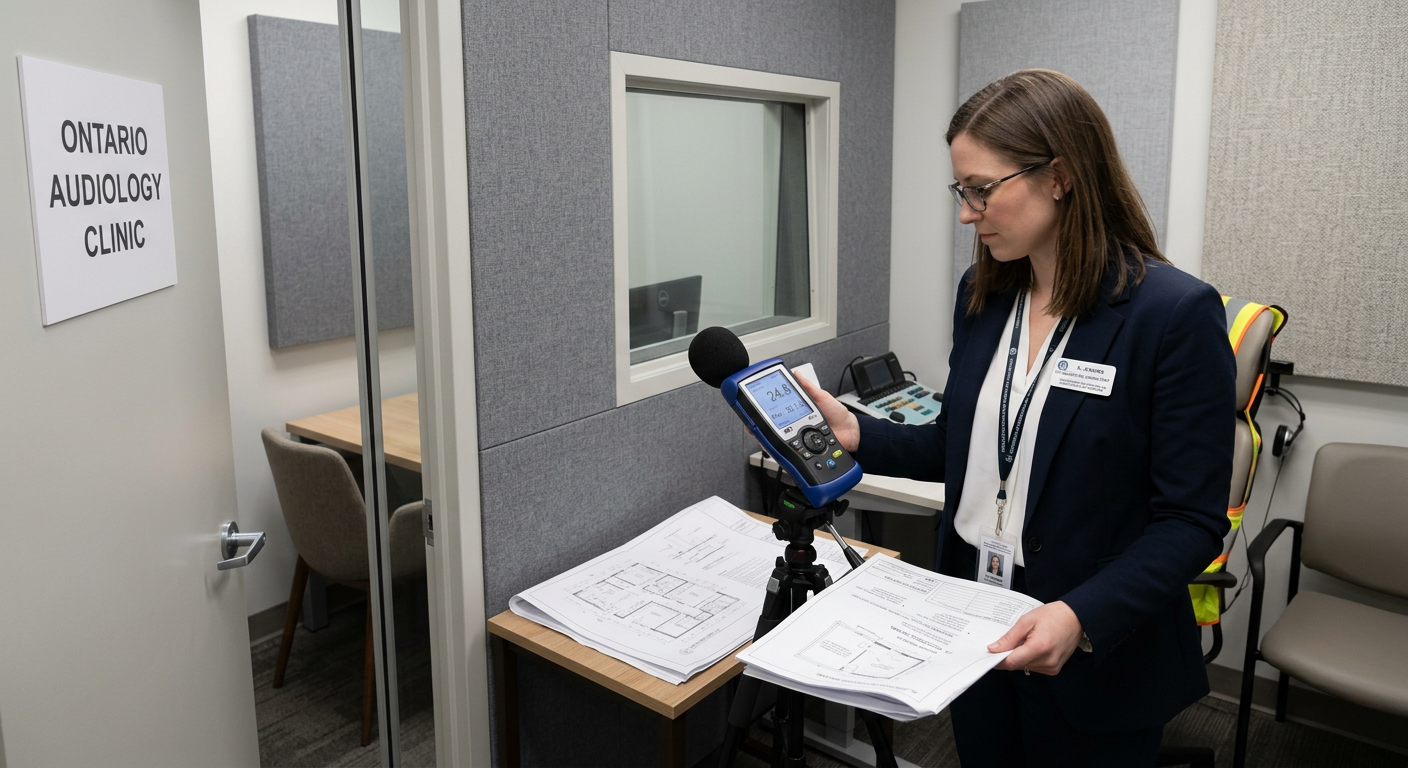
Acoustic room construction requires inspection at each critical stage: floating floor assembly before plywood raft is installed, wall framing before gypsum board is applied (to verify isolation clips and absence of flanking paths), and HVAC flexible connections before ceiling is closed. These inspections must involve the acoustical consultant — a contractor self-reporting compliance at these stages does not provide adequate verification. Wall gypsum board must be installed with staggered joints and acoustically-rated sealant at all penetrations. After room shell is complete: acoustical consultant measures preliminary STC performance before door and HVAC connections are finalized, allowing correction of deficiencies before permanent closure.
Phase 4: Fit-Out and Equipment Installation (Weeks 18–24)
Audiometer installation by certified audiometer technician. Pre-installation electrical measurement to verify audiometer circuit isolation and ground noise levels. Booth or room acoustic treatment (if required) installed and measured. Hearing aid dispensary display and fitting area fit-out completed. Reception, waiting area, and accessible washroom completed. HVAC commissioning: supply air velocity measurements, NC measurements in all room types, vibration level measurements at audiometer location. All measurements documented for CASLPA accreditation package.
Phase 5: CASLPA Inspection and Opening (Weeks 24–28)
Final ISO 8253-1 ambient noise measurement by acoustical consultant — formal measurement with calibrated equipment producing a report that confirms MPAN compliance at each required frequency band. Audiometer calibration certified by authorized technician. CASLPA accreditation application submitted with acoustic measurement report, equipment calibration certificates, and facility photographs. CASLPA accreditation review typically completes within 4–6 weeks of application. Clinic opens pending accreditation confirmation — operating before accreditation is issued is permissible but removes third-party billing authorization until accreditation is granted. Staff orientation to acoustic room protocols: door seal operation, no simultaneous HVAC changes during testing, patient briefing on test room procedures.
Hearing Loop Systems and Assistive Listening Technology in Audiology Clinics
Audiology clinics serve a patient population that includes a high proportion of individuals with significant hearing loss — the very group most likely to benefit from assistive listening infrastructure in the clinical space. Hearing loop systems (also called audio induction loops or telecoil loops) transmit audio signals directly to hearing aids and cochlear implants equipped with telecoils, enabling patients to receive speech clearly from staff at reception counters, in waiting areas, and in consultation rooms without background noise interference. Installation of hearing loop systems in audiology clinics is not currently mandated by AODA, but is increasingly expected by patients and is consistent with the Universal Design principles embedded in the AODA Design of Public Spaces Standard. Counter loop systems for reception desks cost $800–$2,500 installed, depending on counter length. Room-wide perimeter loops for waiting areas or consultation rooms cost $2,500–$6,000 depending on room size. The clinical benefit for an audiology practice is significant: patients who experience clear communication with staff at reception without asking for repetition or leaning over the counter have a measurably better clinic experience — an operational advantage in a competitive hearing care market.
Captioned telephone (CapTel) units at reception, visible alerting systems (visual fire alarms, doorbell indicators), and large-print patient intake forms are additional accessibility provisions that align with the patient population of an Ontario audiology clinic. These provisions are inexpensive to specify at renovation time — typically $1,500–$4,000 total — and significantly more expensive to add after construction is complete.
GTA Municipal Variation: Permit Timelines and Considerations
| Municipality | Building Permit Timeline | Acoustical Consultant Requirement | Notes |
|---|---|---|---|
| Toronto | 6–10 weeks | Not explicitly required by permit | TPH may inspect for IPAC compliance on clinic notification |
| Mississauga | 5–8 weeks | Not required by permit | Peel Public Health inspection on new clinic registration |
| Vaughan | 4–7 weeks | Not required by permit | York Region Building permit process; YRPH inspection on registration |
| Markham | 4–7 weeks | Not required by permit | York Region Public Health; faster permit process than Vaughan |
| Richmond Hill | 4–6 weeks | Not required by permit | Good pre-application consultation service available |
| Newmarket | 3–5 weeks | Not required by permit | Fastest permit review in York Region for small clinic renovations |
Frequently Asked Questions: Audiology Clinic Renovation in Ontario
Is CASLPA accreditation required to operate an audiology clinic in Ontario?
CASLPA accreditation is technically voluntary for Ontario audiology clinics. However, it is practically required for third-party insurance billing under most extended health benefit plans, WSIB audiology services contracts, and referral pathways from ENT and family physician practices that specify accredited clinics. An unaccredited audiology clinic can operate legally but will have significantly restricted revenue pathways. Most Ontario audiology clinics building or renovating a facility pursue CASLPA accreditation as a condition of the business case for the investment.
What is the difference between STC, NRC, and NIC ratings for acoustic rooms?
STC (Sound Transmission Class) measures how much a partition reduces airborne sound transmission — the relevant metric for audiometric testing rooms, where external noise must be blocked from entering the test environment. NRC (Noise Reduction Coefficient) measures how much sound a surface absorbs — relevant for hearing aid fitting room acoustics and reverberation control. NIC (Noise Isolation Class) measures the actual in-field acoustic performance of a room or partition assembly — as opposed to STC, which is a laboratory measurement. CASLPA accreditation and ISO 8253-1 compliance are verified through field measurements (NIC equivalent measurements) rather than specification ratings, because construction quality determines actual performance. A wall assembly specified to achieve STC-60 may achieve NIC-52 in the field due to flanking paths, installation errors, or structural transmission.
Is a prefab audiometric booth CASLPA-compliant?
Yes, prefab audiometric booths from major manufacturers (Acoustic Systems, IAC Acoustics, Eckel Industries) can meet CASLPA accreditation standards for audiology clinics when installed correctly and connected to appropriate HVAC and electrical systems. The critical factors are: the booth’s rated STC performance must be sufficient for the ambient noise conditions at the installation site, the HVAC connection must include vibration isolation, and the booth’s floor level must be within manufacturer specification. For sites with high ambient noise levels (busy urban street fronting, adjacent mechanical rooms), a prefab booth’s acoustic ceiling may be insufficient — an acoustical consultant’s site assessment determines suitability before purchase.
Can an audiology clinic remain open during renovation?
Partial operation during renovation is possible if the audiometric testing room is isolated from the construction zone. IPAC protocols (PHO guidelines) require construction dust barriers and negative pressure containment in any zone adjacent to active clinical operations. In practice, most audiology clinic renovations that include testing room work require complete clinic closure for 4–8 weeks for the acoustic shell construction phase, then allow reopening for the fit-out phase (which is less disruptive). Clinics that operate in leased spaces should negotiate with their building’s other tenants if acoustic room construction will generate construction noise that affects adjacent occupants — acoustic room construction is ironically among the noisiest construction processes, due to heavy gypsum board handling and acoustic sealant application.
How long does a CASLPA accreditation review take after the facility is complete?
CASLPA accreditation review for audiology clinics typically takes 4–8 weeks from application submission to accreditation grant, assuming the application is complete and the site inspection (if conducted) is satisfactory. Applications require: facility photographs, acoustic measurement report, equipment calibration certificates, staff credentials, quality assurance documentation, and the completed CASLPA self-assessment tool. Incomplete applications extend the timeline significantly. CASLPA conducts physical site inspections for new clinic accreditation in most cases — the inspector will verify that the facility as built matches the documentation submitted. Ontario audiologists applying for initial accreditation should budget 6–10 weeks from application to active accreditation status.
What does an acoustical consultant cost for an audiology clinic renovation?
Acoustical consultant fees for an audiology clinic renovation in Ontario range from $3,500 to $12,000 depending on scope. A basic scope includes: site ambient noise measurement, STC specification development for the test room assembly, design review of contractor drawings for acoustic compliance, and post-construction ISO 8253-1 compliance measurement. A more comprehensive scope adds: attendance at critical construction stage inspections (floating floor, wall framing, HVAC connections), intermediate acoustic measurements during construction, and formal measurement report preparation for CASLPA submission. The acoustical consultant fee is the single most cost-effective investment in an audiology clinic renovation — a $6,000 consultant engagement that prevents a $60,000–$90,000 acoustic remediation delivers a 10:1 return on prevention.
What is the realistic timeline for a full audiology clinic renovation?
A full audiology clinic renovation — from initial design engagement through CASLPA accreditation — takes 6–9 months in the GTA. Design and permit phase: 8–12 weeks. Acoustic room construction: 6–8 weeks. Fit-out: 4–6 weeks. CASLPA accreditation review: 4–8 weeks. Total: 22–34 weeks from design start to operating with active accreditation. Clinics that lease space in a building not yet fitted for clinical use (shell space) add 4–6 weeks for building system connections. Clinics renovating an existing clinical space subtract 4–6 weeks by avoiding some permitting steps. The most common timeline extension — adding 8–12 weeks to projects — is HVAC or acoustic remediation discovered during construction, which is prevented by the acoustic consultant engagement described throughout this guide.
How do I find a contractor qualified for audiology clinic renovation in Ontario?
Qualified audiology clinic renovation contractors in Ontario can be identified by asking three specific questions. First: “Have you managed an acoustic room build-out that achieved STC-60 performance on post-construction measurement — not just specification?” A qualified contractor has a measured result, not just a specification claim. Second: “Can you provide the name of an acoustical consultant you have worked with on an audiometric testing environment?” A contractor who has not worked with an acoustical consultant on an audiometric room is not qualified for the acoustic construction scope. Third: “Do you have references from audiology clinic owners whose facilities passed CASLPA accreditation on first inspection?” A contractor who has built audiology clinic test rooms that passed CASLPA first inspection has demonstrated competency at the exact standard required. Healthcare renovation contractors with broader medical clinic experience but no audiology-specific background typically do not know what they do not know about acoustic room construction — the Mississauga case study that opens this guide is the typical result.