
May 18, 2023

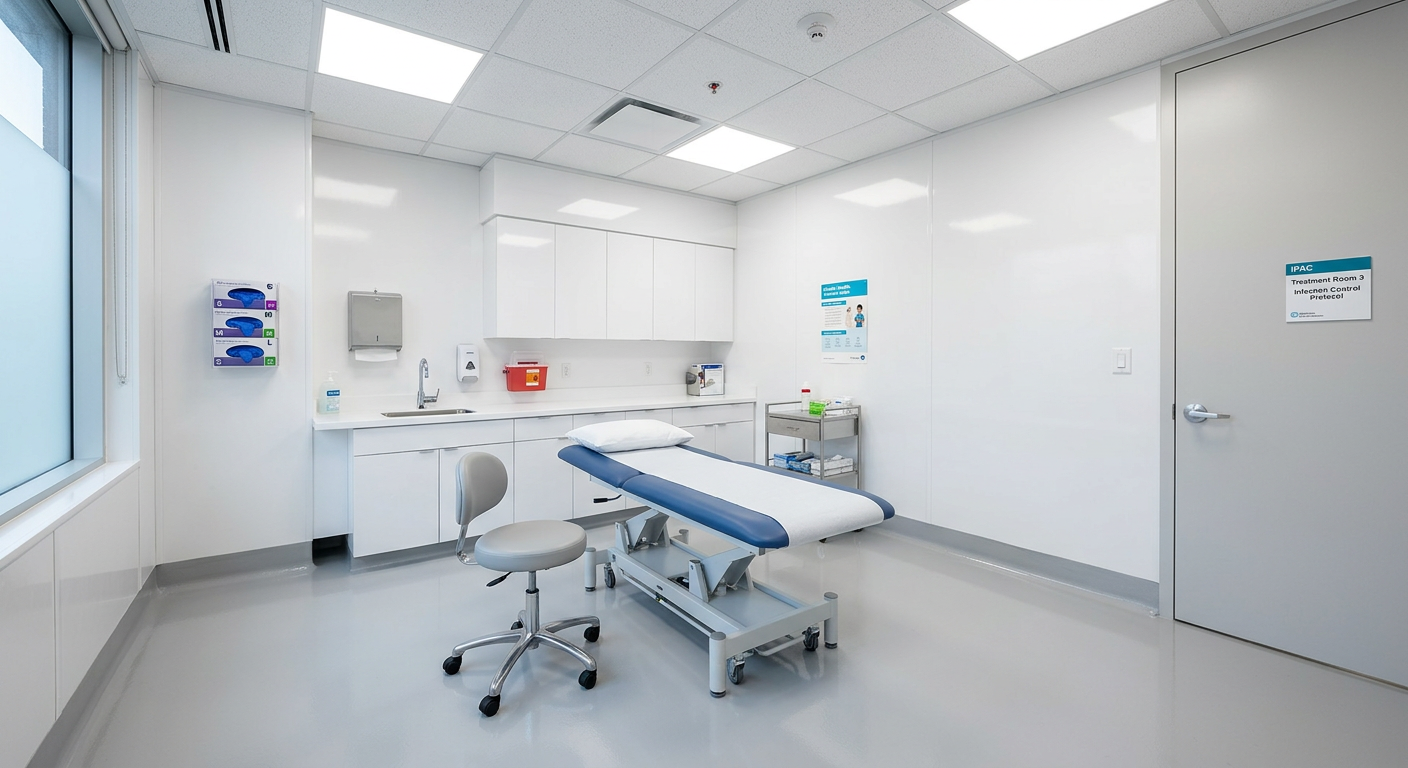
Renovating a medical office in Ontario goes far beyond selecting paint colors and installing new flooring. It’s a highly regulated process governed by multiple...
The Toronto Public Health inspector arrived at the Richmond Hill walk-in clinic six weeks after a patient filed a complaint.
The complaint wasn’t about clinical care. It was about the clinic’s cleaning practices — and the inspection quickly revealed why those practices were failing despite genuine effort: the materials specified in the clinic’s 2021 renovation were fundamentally incompatible with the cleaning and disinfection protocols required by Ontario’s IPAC guidelines. The ceramic tile grout lines in two treatment rooms were visibly stained despite daily disinfection — because quaternary ammonium disinfectant penetrates grout over time, breaking down the sealant and harbouring pathogens in pores that cannot be cleaned. The plastic laminate countertops adjacent to sinks had delaminated at the sink cutout, exposing particleboard that absorbed moisture and biological material. The lay-in acoustic ceiling tiles showed mould growth in a corner adjacent to an air supply diffuser.
The Public Health inspector issued four compliance orders. Three required material replacement — the ceramic tile treatment room floors, the countertops in two rooms, and the ceiling tiles in the affected area. The total remediation cost: $54,000. The cost of specifying correct materials in the original renovation: approximately $11,000 more than the non-compliant materials that were chosen. The specification error — choosing standard commercial materials instead of healthcare-grade IPAC-compliant materials — cost the clinic $43,000 more than doing it right, plus the reputational impact of the inspection finding.
This guide covers every material category in a healthcare renovation — flooring, walls, countertops, ceilings, doors and hardware — with specific products, specifications, and Ontario IPAC compliance standards for each. It is designed to prevent the scenario described above, for every clinic that reads it.
Healthcare material selection in Ontario is governed by two primary IPAC authorities whose requirements must be satisfied simultaneously:
Public Health Ontario publishes Best Practice Guidelines for IPAC in clinical settings. For material selection purposes, the key PHO guidance documents are: Best Practices for Environmental Cleaning for Prevention and Control of Infections in All Health Care Settings (3rd edition) and the setting-specific guidance documents for walk-in clinics, physician offices, dental practices, and veterinary settings. These documents specify that surfaces in patient care areas must be: non-porous (impermeable to water and contaminants), smooth without cracks, crevices, or joints that cannot be cleaned, and compatible with the disinfectants used in the setting at the concentrations required.
Each regulated healthcare profession has its own facility standards that incorporate IPAC material requirements:
The common thread: all Ontario healthcare college standards require materials that can be cleaned and disinfected effectively with the disinfectants used in clinical practice. The practical test for any material: can you wipe it with a quaternary ammonium or hydrogen peroxide disinfectant wipe at the approved concentration, and clean it completely with a single wipe? If the answer is “the surface gets stained, the joint absorbs the product, or the surface degrades over time,” the material fails the IPAC standard.
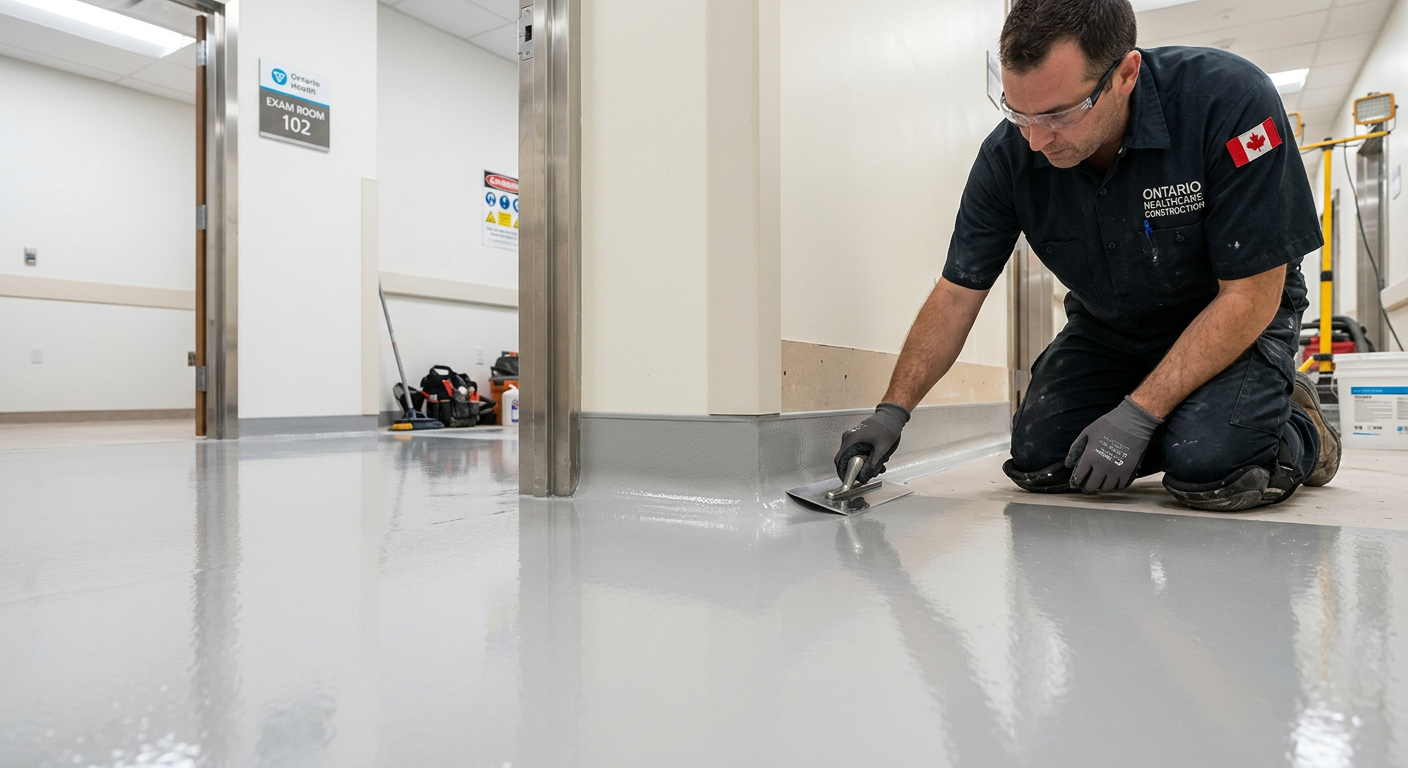
Flooring is the highest-priority IPAC material decision in any healthcare renovation because floor surfaces receive the greatest contamination load and are subject to the most frequent cleaning cycles. The IPAC flooring requirement is absolute: no joints, crevices, or pores where pathogens can accumulate between cleanings. This eliminates most standard commercial flooring categories and narrows the compliant options to three families of products.
Poured epoxy is the gold standard for clinical area flooring in Ontario healthcare renovation. Applied as a liquid system that cures into a single monolithic surface, it has no joints, no seams, and no pores. The coved base (turning up the wall a minimum of 100–150mm) eliminates the floor-to-wall junction that harbours pathogens in standard installations.
Specification details:
Variants and applications:
| Epoxy Type | Best Application | Cost (CAD/sq ft installed) | Notes |
|---|---|---|---|
| Standard seamless epoxy | Exam rooms, treatment rooms, corridors | $8–$15 | 72-hour cure before clinical use |
| Antimicrobial silver-ion epoxy | Surgical suites, high-risk procedure rooms | $10–$18 | Silver-ion additive provides residual antimicrobial activity |
| Methyl methacrylate (MMA) resin | Surgical suites, areas needing rapid return to service | $15–$25 | Full cure in 1–2 hours; strong chemical resistance; strong odour during cure |
| Polyurethane concrete system | Kennel areas, sterilization rooms (wet areas) | $12–$20 | Excellent impact resistance; copes with thermal shock from steam cleaning |
Sheet vinyl is an IPAC-compliant flooring option when installed correctly — specifically, when seams are heat-welded (using a hot-air gun and vinyl weld rod) rather than glued or click-locked. A welded seam creates a monolithic surface equivalent to seamless flooring for IPAC purposes. The critical failure mode: sheet vinyl installed with adhesive-only seams (no weld rod), which separates over time under cleaning traffic and creates joints where pathogens accumulate. Always specify and confirm heat-welded seams on every seam in clinical areas.
Healthcare-grade sheet vinyl products with IPAC-suitable specifications include Tarkett iQ, Forbo Marmoleum (linoleum-based, antimicrobial by nature of its linseed oil content), and Armstrong MEDINTECH. These products differ from standard residential or commercial vinyl in their biocide additives, higher wear layer thickness (2mm+ in healthcare grades), and dimensional stability that prevents seam separation. Cost: $8–$14/sq ft installed, including heat-welded seams and coved base.
| Material | Reason for Non-Compliance | Where It’s Acceptable |
|---|---|---|
| Ceramic or porcelain tile with grout | Grout lines harbour pathogens; cannot be adequately disinfected | Staff washrooms, non-clinical entry areas only |
| Click-lock LVT (luxury vinyl tile) | Click joints between tiles create pathogen-harbouring gaps | Reception waiting areas only |
| Carpet | Explicitly prohibited in all clinical areas by PHO and CPSO | Not acceptable anywhere in clinical spaces |
| Hardwood / engineered wood | Wood grain and finish joints harbour pathogens; not disinfectant-compatible | Not acceptable in clinical spaces |
| Polished concrete (unsealed) | Porous surface cannot be cleaned to clinical standard | Must be sealed with epoxy topcoat to be acceptable |
Wall finishes in clinical areas must withstand repeated disinfection with hospital-grade disinfectants without degradation, staining, or surface breakdown. The three compliant wall finish options for Ontario clinical spaces each have different cost, durability, and installation implications.
FRP panels are the most durable and most common clinical wall finish in Ontario healthcare renovation. Made from fibreglass-reinforced polyester resin, FRP panels are completely non-porous, disinfectant-resistant to full clinical concentrations, and mechanically robust — they resist impact from equipment carts, wheelchairs, and clinical carts that would damage painted drywall.
Installation specification for IPAC compliance: FRP panels must be installed with the correct trim system — H-trim at panel joints, J-trim at wall terminations, and corner trim at inside and outside corners. All trim joints must be sealed with silicone caulk to prevent moisture infiltration behind the panel. Panel-to-panel seams and trim channels are the most common installation failure point; a gap or unsealed joint at any seam creates a pathway for moisture and pathogen accumulation behind the panel that is invisible and impossible to clean. Specify and inspect: all seams silicone-caulked during installation.
Products and specifications:
Properly applied alkyd semi-gloss or epoxy paint over sealed drywall is acceptable for clinical areas in Ontario healthcare renovation — but only when specified and applied correctly. The critical failure mode (as seen in the Richmond Hill clinic at the opening of this guide) is latex paint applied to standard drywall: latex paint is disinfectant-compatible initially but degrades with repeated quaternary ammonium or accelerated hydrogen peroxide disinfection, losing its surface integrity and becoming porous over 2–4 years of clinical use. Latex paint is not an acceptable specification for clinical areas.
Compliant wall paint specification:
Cost: $3–$6/sq ft for wall area including substrate preparation, primer, and two-coat alkyd finish — significantly less than FRP panels, but appropriate only for low-splash clinical areas (not immediately adjacent to sinks, cuspidors, or instrument cleaning areas).
Vinyl wall covering (commercial-grade sheet vinyl applied with adhesive to drywall) is a mid-range option providing better durability and cleanability than paint at lower installed cost than FRP panels. Healthcare-grade vinyl wall covering from manufacturers like Genon, MDC Wallcoverings, or Innovations is tested for hospital disinfectant compatibility and rated by Type (Type II = 20 oz/yd², commercial heavy-duty; Type III = hospital-grade). Seams must be butted tightly (no gap) and sealed with matching adhesive caulk. Cost: $5–$9/sq ft installed for Type II/III healthcare vinyl wall covering.
Countertops in clinical areas fail IPAC requirements more frequently than flooring or walls because the failure is hidden: plastic laminate countertops look clean on the surface but have exposed particleboard substrate at sink cutouts, end caps, and back splashes — and particleboard absorbs moisture and biological material at every cut edge. Public Health Ontario IPAC best practices explicitly warn against plastic laminate countertops in clinical areas near sinks and patient contact surfaces. The three compliant countertop options for Ontario healthcare renovation are:
Solid surface countertops (acrylic or polyester resin composite, homogeneous through the full thickness) are the most common compliant countertop specification in Ontario clinical settings. Key IPAC advantage: the material is identical throughout its thickness, so a damaged area can be sanded smooth and resealed — there is no substrate to expose. Sinks can be integrally moulded (undermount or cove-back integrated sink) eliminating the gap between sink and countertop where pathogens accumulate in separate-sink installations. Cost: $180–$320 per linear foot installed for solid surface counter with integrated sink.
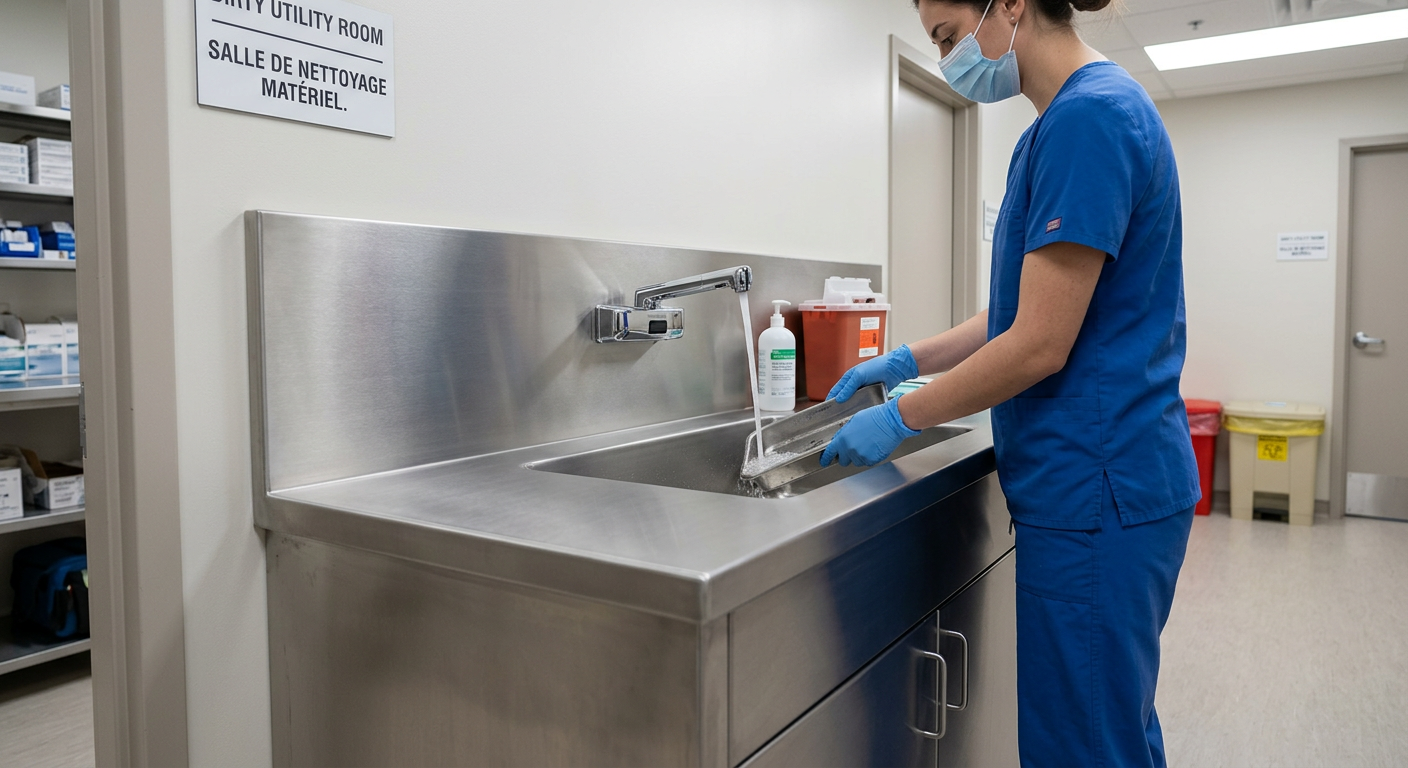
Stainless steel countertops are the highest-performance IPAC option for areas with heavy contamination exposure: sterilization rooms, instrument processing areas, sluice rooms, and veterinary procedure areas. Type 304 stainless steel (18/8 alloy) with a #4 brushed finish is the standard healthcare specification — polished or #8 mirror finish traps contamination in surface scratches that develop over time, while #4 brushed finish is more forgiving. Welded or integrally formed sinks eliminate the rim-to-counter junction gap. Cost: $280–$450 per linear foot installed for custom stainless counter with integral sink; prefabricated stainless units: $650–$1,800 depending on size.
Engineered quartz (Caesarstone, Cambria, Silestone quartz series) offers near-solid-surface performance at lower material cost. Non-porous, disinfectant-compatible, and highly durable. The key compliance consideration: quartz countertops require a standard undermount or drop-in sink with silicone-caulked rim — the caulk joint must be maintained and inspected regularly. Cost: $120–$220 per linear foot installed for quartz counter with undermount sink.
Ceiling systems receive the least attention in healthcare renovation material specifications — and the most citations in IPAC compliance reviews. The oversight is understandable: ceilings are visually above the “clinical action zone” and not frequently touched. But they are exposed to respiratory droplets, steam from autoclaves, and aerosols from high-volume evacuation equipment, and their surface properties determine whether this contamination remains cleanable.
| Ceiling System | Clinical Exam Rooms | Procedure Rooms | Surgical Suites | Sterilization Rooms |
|---|---|---|---|---|
| Sealed gypsum with epoxy paint | Yes | Yes | Yes (required) | Yes |
| T-bar with vinyl-faced wipeable tiles | Yes | Yes (sealed perimeter) | No | No |
| T-bar with standard fibrous acoustic tiles | No (PHO non-compliant) | No | No | No |
| Open ceiling (exposed structure) | No | No | No | No |
| FRP ceiling panels (T-bar frame) | Yes | Yes | Yes | Yes |
The standard fibrous acoustic tile — the beige perforated mineral wool tile found in most commercial offices — is the ceiling specification that most frequently generates IPAC compliance findings in Ontario healthcare settings. It is not cleanable: you cannot disinfect a porous fibrous tile surface. PHO best practices explicitly state that fibrous or mineral wool ceiling tiles are not acceptable in clinical areas. Yet they continue to be specified by contractors unfamiliar with healthcare construction because they are inexpensive, readily available, and the standard commercial specification in non-clinical settings.
Compliant T-bar alternative: vinyl-faced ceiling tiles — Armstrong World Industries, Rockfon, and USG all manufacture healthcare-grade ceiling tiles with vinyl-faced or plastic-coated surfaces that can be wiped down with disinfectants. Specify tiles rated for healthcare use with a cleanability specification (not just an acoustic specification) and confirm the tile face material is vinyl or plastic-coated, not bare mineral wool or fibrous composition. Cost premium over standard tiles: $0.80–$2.50 per sq ft for the tile upgrade alone (the T-bar grid system is identical).
Door hardware is a high-touch surface that represents a significant transmission pathway in clinical settings. Standard chrome or stainless steel door handles transmit pathogens between users unless disinfected after each contact — which is impractical in a busy clinic environment. Two hardware strategies address this in Ontario healthcare renovation:
Copper and its alloys (brass, bronze) are intrinsically antimicrobial — the metal surface kills 99.9% of bacteria within 2 hours through the oligodynamic effect (metal ions disrupt bacterial cell membranes). EPA-registered antimicrobial copper alloys include C11000 (pure copper), C26000 (cartridge brass), and C28000 (Muntz metal). For healthcare applications, the practical hardware products are unlacquered solid brass door levers (not brass-plated — the lacquer defeats the antimicrobial mechanism), solid copper push plates, and solid bronze kick plates. Cost: 40–80% premium over standard stainless hardware; $85–$180 per door set vs. $50–$100 for standard stainless.
The second strategy: eliminate the need to touch hardware. Hands-free door openers (push-plate actuators connected to automatic door operators) allow clinical staff to open doors with an elbow, hip, or back after hand washing without touching a handle. For AODA compliance, automatic door openers are required at accessible entrances — specifying them throughout the clinical flow adds $800–$2,500 per door for the operator and push-plate actuator system but provides both IPAC and accessibility benefits simultaneously. In high-traffic areas (exam room corridors, sterilization room door), hands-free openers reduce hand hygiene protocol breakdowns significantly.
Door surfaces themselves: solid-core doors with smooth factory-painted or laminated faces are acceptable; doors with recessed panel patterns (raised or sunken panels) harbour contamination in the panel edges. Specify flush solid-core doors throughout clinical areas.
| Element | Standard Commercial (Non-Compliant) | IPAC-Compliant Minimum | Premium IPAC Option | Cost Difference |
|---|---|---|---|---|
| Flooring (per sq ft) | Ceramic tile + grout: $8–$15 | Sheet vinyl (welded): $8–$14 | Poured epoxy: $10–$18 | $0–$8/sq ft more |
| Wall finish (per sq ft) | Latex paint: $1.50–$3 | Alkyd paint: $3–$6 | FRP panels: $4–$8 | $1.50–$5/sq ft more |
| Countertop (per lin ft) | Plastic laminate: $60–$100 | Solid surface: $180–$320 | Stainless: $280–$450 | $120–$350/lin ft more |
| Ceiling (per sq ft) | Fibrous acoustic tile: $1.50–$3 | Vinyl-faced tile: $2.50–$4.50 | Sealed gypsum: $8–$14 | $1–$11/sq ft more |
| Door hardware (per door) | Standard stainless lever: $50–$100 | Antimicrobial brass: $85–$180 | Auto-opener: $900–$2,700 | $35–$2,600/door more |
For a typical 1,500 sq ft Ontario medical clinic renovation with four exam rooms, the premium for IPAC-compliant materials over standard commercial materials is approximately $18,000–$35,000. The documented remediation cost when IPAC non-compliant materials require replacement after a PHO compliance order: $35,000–$120,000. The prevention premium is consistently lower than the remediation cost — often by a factor of 3–5×.
Understanding which material failures actually generate Public Health and college inspector compliance orders — as opposed to which failures are theoretically non-compliant — helps clinic owners and contractors prioritize correctly. Based on documented Ontario IPAC inspection outcomes, five material failure categories account for the majority of compliance orders issued in clinic renovation projects.
Ceramic and porcelain tile flooring with grouted joints remains the most frequently cited material failure in Ontario clinical inspection reports. The failure mechanism is consistent: grout lines, regardless of initial sealing quality, develop micro-porosity with repeated exposure to quaternary ammonium and accelerated hydrogen peroxide disinfectants. Within 18–36 months of installation, grout surfaces in high-frequency disinfection zones are no longer cleanable to a standard that satisfies PHO IPAC guidelines. Inspector compliance orders for this failure typically require full floor replacement — a $22–$48 per square foot remediation that could have been avoided with seamless flooring specified from the outset. A Vaughan multi-specialty clinic learned this at a cost of $38,000 in 2023 when its two-year-old treatment room tile floors were ordered replaced after an IPAC inspection triggered by a patient complaint.
Plastic laminate (Formica-style) countertops are the second most commonly cited failure. The failure occurs at the sink cutout: water infiltration beneath the laminate at the cutout edge causes delamination and particleboard substrate exposure within 1–3 years. Particleboard is non-cleanable once exposed — it absorbs biological material and moisture, and cannot be disinfected to any clinical standard. Compliance orders typically require full countertop replacement plus cabinet assessment. A Scarborough family health team had four countertops ordered replaced simultaneously in 2024 — a $24,000 remediation. Solid surface or stainless steel countertops with undermount or integrated sinks cost $400–$900 more per linear foot than laminate at installation, but do not carry this failure risk.
Standard mineral fibre acoustic ceiling tiles are porous, cannot be wiped or disinfected, and absorb moisture — conditions incompatible with clinical environments. PHO IPAC guidelines require cleanable, non-porous ceiling surfaces in any clinical area where aerosol-generating procedures occur or where HVAC delivers air into clinical zones. Inspectors consistently cite lay-in tile in procedure rooms, dental operatories, and treatment areas. Vinyl-faced or painted gypsum solutions cost $8–$22 per square foot more than standard lay-in but eliminate this failure category entirely.
Standard latex paint is not classified as a clinical surface finish. It is porous, not rated for repeated disinfection, and not resistance-tested against clinical disinfectants. PHO IPAC guidance specifies “washable, non-porous surfaces capable of withstanding repeated cleaning with approved disinfectants” — a standard that latex paint does not meet in wet zones or high-touch areas. Oil-based alkyd paint or semi-gloss eggshell finish with a certified clinical disinfectant compatibility rating is the minimum standard. Clinics that specify standard latex paint in treatment rooms, handwashing alcoves, or dirty utility rooms consistently receive IPAC compliance notices at first or second inspection.
Carpet in clinical areas generates compliance orders in 100% of cases when inspected — it is categorically non-compliant and has been since the 2009 IPAC revision. Yet renovation contractors unfamiliar with healthcare environments continue to install carpet in waiting areas directly adjacent to treatment zones, or in shared-use spaces that transition to clinical use. VCT (vinyl composition tile) is similarly problematic: it requires wax finishes that harbour pathogens, has mechanical seams that compromise cleanability, and is explicitly excluded from clinical zone specifications in current PHO guidance. Both materials must be replaced when cited, at full remediation cost, with no partial fix available.

Specifying IPAC-compliant materials on paper is only the first step. Procurement — ensuring that the materials that arrive on site match the specification — requires a different discipline than standard commercial construction procurement. Three common procurement failures cause compliant specifications to produce non-compliant results.
A specification that says “seamless flooring” without naming a manufacturer and product line allows a contractor to substitute any product they characterize as seamless — including products that are not clinically rated. For flooring, the specification must name the product line (e.g., Johnsonite Nora rubber flooring, Altro Whiterock sheet vinyl, Dur-A-Flex Cove-Base epoxy system) and the specific installation standard (heat-welded seams, 4″ integral coved base, no adhesive joints at wall terminations). The same principle applies to wall panels (name the FRP panel manufacturer and thickness specification), countertops (name the solid surface material and joint specification), and ceiling systems (name the rated tile and suspension system). Generic specifications are routinely exploited by value-engineering substitutions that nullify IPAC compliance.
IPAC-compliant materials must withstand repeated exposure to the specific disinfectants the clinic uses. The PHO IPAC guidelines reference approved hospital-grade disinfectants including quaternary ammonium compounds, accelerated hydrogen peroxide (AHP), and sodium hypochlorite (bleach) solutions. Not every product marketed as “cleanable” is compatible with all of these. Specification documents should require manufacturers to provide a disinfectant compatibility chart confirming resistance to the clinic’s specific disinfection protocol. Requesting this documentation at tender forces suppliers to verify compatibility rather than assuming it — and creates documentation that protects the clinic if a material performs inadequately after installation.
The most common installation failure in IPAC flooring is improperly welded seams in sheet vinyl, or inadequate substrate preparation that causes adhesion failure and edge lifting within 6–12 months. Both failures create the exact condition that renders seamless flooring non-compliant: a seam or gap where biological material can accumulate and resist disinfection. Acceptance testing for seamless flooring should include: visual seam inspection under raking light (reveals weld quality), pull-adhesion test at wall terminations (reveals cove base bond strength), and a documented substrate moisture reading prior to installation (moisture exceeding the manufacturer’s specified maximum causes adhesive failure). Clinics that include these acceptance criteria in their construction contract scope eliminate the most common seamless flooring installation failures before final occupancy.
The most effective approach to IPAC material specification involves three distinct roles: the architect or designer who selects and specifies materials on drawings, the contractor who procures and installs them, and an Infection Control Professional (ICP) — a role that larger Ontario health systems mandate but that small clinic renovations often omit. Engaging an ICP, even for a single half-day review, has documented value: ICPs identify specification errors before materials are ordered, validate substitution requests, and can provide documentation of IPAC compliance review that is valuable in any subsequent inspection.
In the GTA, ICPs with healthcare construction experience are available through infection control consulting firms, through hospital networks (some health systems offer ICP consulting to affiliated community clinics), and through the Community and Hospital Infection Control Association (CHICA-Canada). An ICP review session costs $800–$2,500 depending on project scope — a fraction of the cost of a single compliance order remediation.
The specification review process should occur at three stages: during the schematic design phase (when material categories are selected), during the design development phase (when specific products are named), and during construction (when substitutions are proposed). ICPs who review specifications only at the end of design — after materials have been approved and ordered — typically find errors that are expensive to correct. Early engagement prevents specification errors from becoming procurement errors, which become installation failures, which become compliance orders.
For clinic owners managing a renovation without a dedicated project manager, the simplest quality control approach is to require the general contractor to submit a materials submittal package — manufacturer’s cut sheets for every specified IPAC-impacting material — before any material is ordered. Review the cut sheet against the specification, confirm the disinfectant compatibility documentation is included, and document your approval in writing. This paper trail, combined with the acceptance testing criteria described above, provides a defensible record that the clinic exercised due diligence in material selection and installation quality — which matters significantly in any future IPAC inspection that questions material compliance.
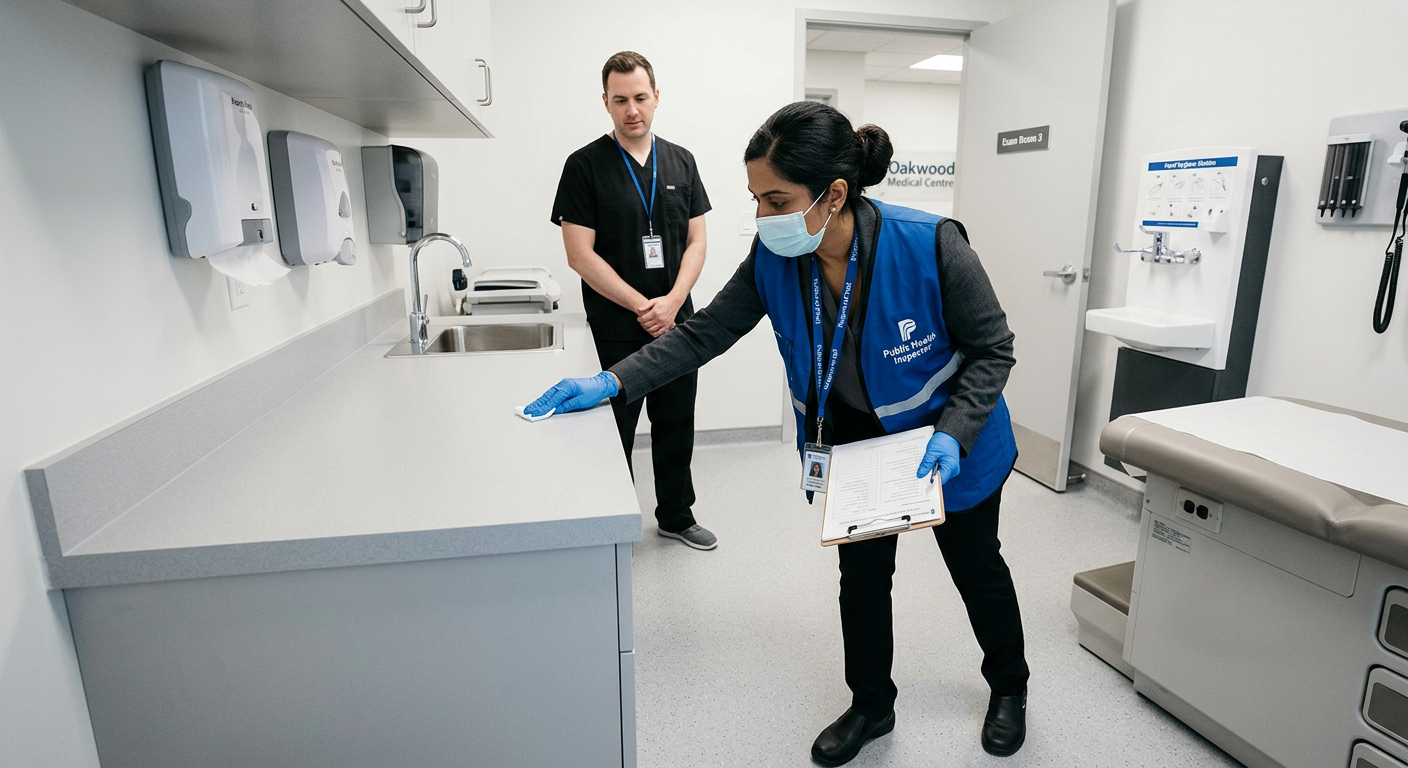
Ontario IPAC standards are provincial — the PHO guidelines apply equally in Toronto, Markham, Richmond Hill, Vaughan, Newmarket, and Mississauga. However, the inspection and enforcement process varies by municipality and by the regulatory body responsible for the clinic type. Understanding which inspector will visit your clinic, and what their inspection priorities are, helps clinic owners prepare correctly.
Toronto Public Health (TPH) inspects most clinic types in the City of Toronto under the Ontario Public Health Standards. TPH inspectors have increased IPAC inspection frequency following the post-COVID IPAC guidance updates in 2021–2022, and now conduct routine inspections of walk-in clinics, dental offices, and personal service settings on a 12–24 month cycle. TPH inspectors are particularly attentive to surface cleanability in high-contact areas and frequently issue compliance orders related to countertop delamination and grouted tile in treatment rooms. Toronto clinic renovations benefit from pre-renovation consultation with TPH — a free service available to clinic owners planning renovations that asks an inspector to review plans before construction begins.
York Region Public Health (YRPH) covers Richmond Hill, Markham, Vaughan, Aurora, Newmarket, and surrounding municipalities. YRPH conducts IPAC inspections of regulated health profession settings under provincial delegation. York Region has historically had a longer inspection cycle (24–36 months for low-risk settings) but has accelerated enforcement following complaints. Dental office inspections in York Region are typically triggered by RCDSO complaint referrals rather than routine inspection cycles — making college compliance the more immediate priority for York Region dental clinic operators. For walk-in and family health team settings in York Region, YRPH inspection priorities track closely with PHO guidance updates, with floor and countertop surface conditions receiving consistent attention.
Peel Public Health covers Mississauga and Brampton — two of the GTA’s highest-volume clinic markets. Peel has an active personal service settings inspection program and applies IPAC material requirements across a wide range of regulated settings. Clinic owners in Mississauga and Brampton should confirm which regulatory body has primary jurisdiction for their clinic type — for physician offices, CPSO compliance is the primary concern, while for dental offices RCDSO inspections supersede public health visits. Peel Public Health offers a pre-opening inspection service for new clinic builds and renovations, which provides material compliance confirmation before final occupancy.
Regardless of municipality, the consistent pattern across GTA inspection authorities is that material compliance issues generate remediation orders — not warnings — when identified. The cost of engaging a healthcare contractor who specifies correct IPAC materials from the start is always lower than the cost of the remediation orders that non-compliant materials generate.
Ceramic and porcelain tile with grout is not acceptable in patient care areas in Ontario healthcare settings — exam rooms, treatment rooms, procedure rooms, surgical suites, or any area where patient contact or biological contamination occurs. The grout lines between tiles cannot be effectively disinfected to clinical standards regardless of the grout sealer applied, because sealers degrade over time with repeated disinfectant exposure. PHO IPAC best practices and CPSO Health Facility Standards both specify non-grouted surfaces in clinical areas. Ceramic tile is acceptable in staff washrooms, non-clinical entry vestibules, and building exterior contexts — anywhere that clinical disinfection protocols do not apply. If your existing clinic has ceramic tile in exam rooms and you are renovating, the tile must be removed and replaced with a compliant seamless system. Do not attempt to seal or coat over existing tile — the joints remain non-compliant even with a surface coating applied over them.
Standard latex interior paint is not recommended for clinical areas in Ontario healthcare settings. Latex paint degrades under repeated application of hospital-grade disinfectants — quaternary ammonium compounds in particular — losing surface integrity and becoming porous over 2–4 years of clinical use. The compliant alternative is alkyd semi-gloss or gloss paint, which provides better chemical resistance and a harder, less porous surface. For the highest performance in areas adjacent to sinks, sterilization equipment, or heavy contamination zones, specify a two-component epoxy paint system. Epoxy paint is significantly more durable than alkyd under repeated disinfection and provides the highest cleanability of any painted surface. The cost difference between latex and alkyd paint on a 1,500 sq ft clinic is approximately $800–$1,500 in material costs — a minor additional expense for a material that determines your clinic’s long-term IPAC compliance status. If your existing clinic has latex-painted exam rooms, the paint does not need to be immediately stripped, but it should be replaced with alkyd or epoxy paint at your next renovation. Do not apply alkyd over latex — adhesion failures occur; sand and clean the surface and prime with alkyd primer before applying the new finish coat.
Ontario healthcare settings use four primary disinfectant categories for surface disinfection, and materials must withstand all of them at the concentrations used in clinical practice. The four categories are: quaternary ammonium compounds (QAC) — the most common hospital surface disinfectant, including products like Virox 5, PDI Sani-Cloth, and Clinell Universal; accelerated hydrogen peroxide (AHP) — products like Virox ATB and Oxivir TB at 0.5% concentration; sodium hypochlorite (bleach) — typically 1,000 ppm (0.1%) for general surface disinfection and 10,000 ppm (1%) for blood/body fluid spills; and alcohol-based products — 70% isopropyl or ethanol at specific concentrations. Each material in your clinical area should have manufacturer documentation confirming compatibility with all four categories at recommended use concentrations. Ask your flooring, wall covering, countertop, and hardware manufacturers for their disinfectant compatibility testing data before specifying any product. A product that is not tested is a product that may fail compliance when it matters most.
PHO IPAC best practices distinguish between clinical areas (where patient care occurs) and non-clinical areas (waiting rooms, staff offices, reception). The material requirements are more stringent for clinical areas — but waiting areas do carry specific IPAC considerations, particularly during the 2020–2023 COVID period that prompted additional guidance. For waiting areas: PHO recommends easily cleanable seating surfaces (vinyl or cleanable upholstery, not fabric) that can be disinfected between patients; non-porous flooring that can be cleaned with standard cleaning products; and avoidance of carpet or fabric wall coverings that cannot be disinfected. Standard commercial LVT with click-lock joints is acceptable in waiting areas (unlike clinical areas) because waiting area cleaning protocols do not require the same level of disinfection. Fabric upholstered seating is not recommended by PHO for healthcare waiting areas — specify vinyl-covered seating with a healthcare-grade vinyl that can be disinfected between patients.
If you have a limited renovation budget and must prioritize IPAC material upgrades, prioritize in this order: (1) Flooring in exam and treatment rooms — replace ceramic tile or standard LVT with seamless flooring; this single change addresses the most critical IPAC failure mode at a cost that is comparable to tile replacement. (2) Countertops adjacent to sinks — replace plastic laminate with solid surface at every sink location in clinical areas; this is typically 2–4 countertop sections at $180–$320 per linear foot, a manageable cost. (3) Ceiling in procedure rooms — replace fibrous acoustic tiles with vinyl-faced wipeable tiles; the tile replacement alone (keeping the existing T-bar grid) costs $1.50–$2.50 per sq ft premium over standard tiles. These three changes address the three most commonly cited IPAC material failures in Ontario healthcare compliance reviews and can be completed within a $15,000–$40,000 targeted budget depending on the size of your clinical space.
Written by the RenoEthics construction team — specialists in Ontario medical and healthcare clinic renovation. Last updated March 2026. RenoEthics has completed IPAC-compliant healthcare renovations across Richmond Hill, Markham, Vaughan, Newmarket, Aurora, Toronto, and the broader GTA. Request a materials specification consultation or get a quote for your healthcare renovation.
Renovating a medical office in Ontario goes far beyond selecting paint colors and installing new flooring. It’s a highly regulated process governed by multiple...
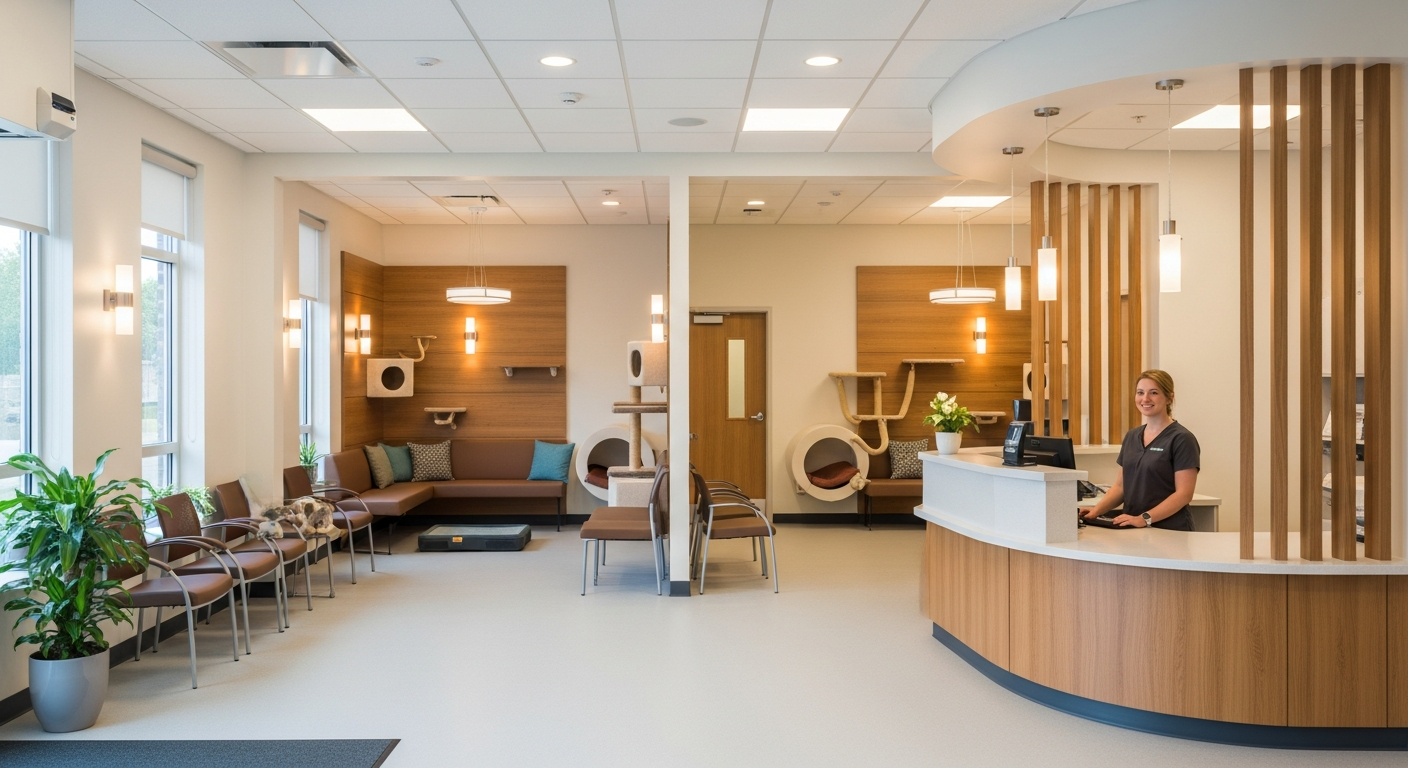
Renovating a veterinary clinic in Ontario? Discover 2026 costs, CVO compliance requirements, and Fear-Free design standards for animal hospitals across the GTA.
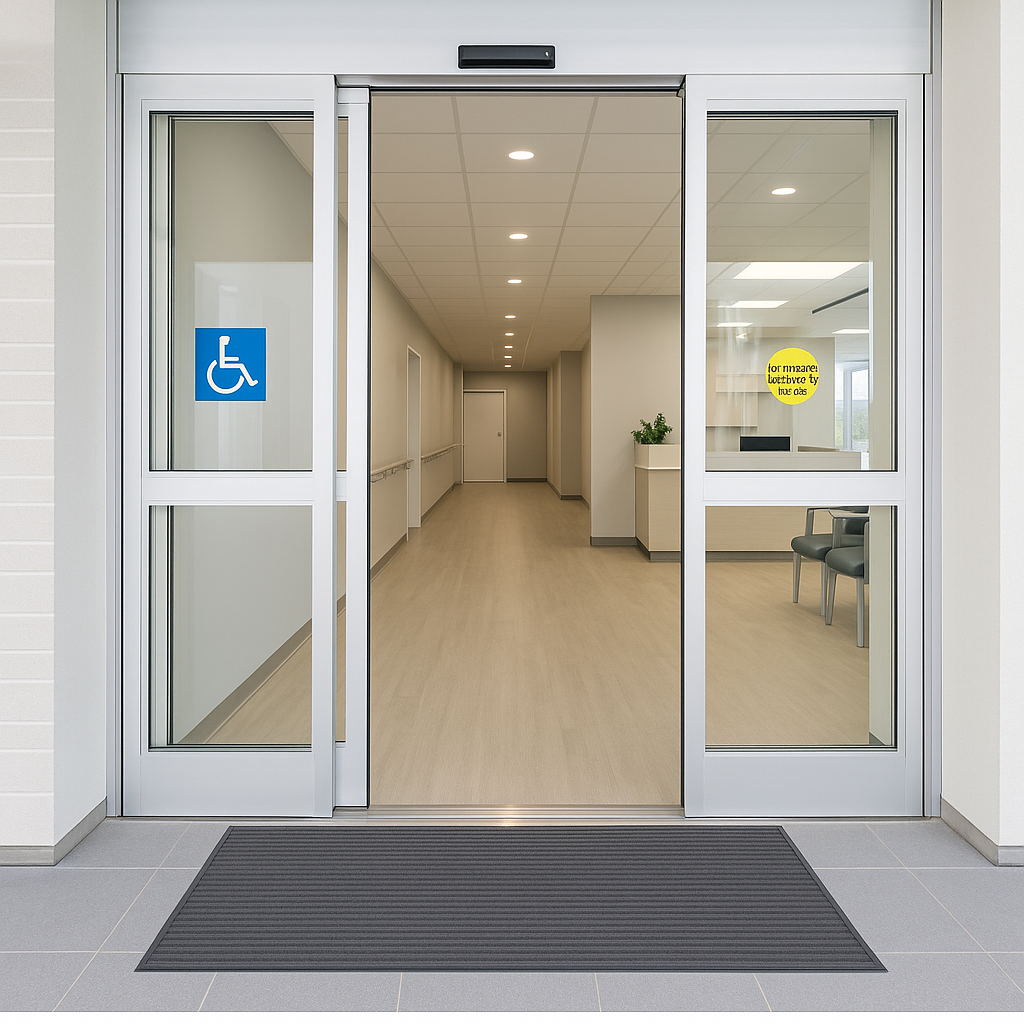
As of January 2025, AODA compliance is fully enforced for Ontario medical clinics. Here is what your renovation must include to meet accessibility standards...