
May 18, 2023

Choosing the right construction materials is critical for infection control in Ontario clinics. Learn what Toronto Public Health and IPAC inspectors look for in...
Renovating a medical office in Ontario goes far beyond selecting paint colors and installing new flooring. It's a highly regulated process governed by multiple layers of provincial building codes, healthcare-specific standards, accessibility requirements, and municipal regulations. Whether you're opening a new family practice, expanding your existing clinic, or modernizing a walk-in facility, understanding the mandatory permits and compliance requirements is essential to avoiding costly delays, failed inspections, and potential legal issues.
In 2026, medical office renovations in Ontario must satisfy requirements from the Ontario Building Code (2024 edition), CSA Z8000 healthcare facility standards, AODA accessibility regulations, IPAC infection prevention protocols, and municipal-specific bylaws. This comprehensive guide breaks down every permit, regulation, and compliance requirement you need to know—explained in clear language with practical timelines and actionable steps to ensure your project succeeds the first time.
Many physicians and healthcare professionals are surprised to learn that their medical office renovation cannot proceed with the same permitting process as a retail store or standard office space. Under Ontario's regulatory framework, medical clinics—including GP offices, specialist practices, walk-in clinics, and diagnostic facilities—are classified differently than typical commercial properties.
The Ontario Building Code classifies medical facilities based on the services provided and patient populations served. Most outpatient medical offices fall under Group D (Business and Personal Services Occupancy), but facilities providing certain medical procedures may be classified as Group B, Division 2 (Care or Detention Occupancy) depending on the level of patient care and mobility assistance required.
This classification impacts everything from required egress routes and fire separation to HVAC specifications and accessibility features. Unlike a standard office where the Ontario Building Code provides baseline requirements, medical facilities must additionally comply with CSA Z8000—the National Standard of Canada for healthcare facilities.
Hiring a contractor experienced in residential or standard commercial renovations is not sufficient for medical office projects. Healthcare-specialized contractors understand CSA Z8000 requirements, medical-grade HVAC filtration (MERV-13+), acoustical privacy standards (STC-50 minimum), infection control protocols, and accessibility nuances that general contractors miss—resulting in failed inspections and expensive rework.
Medical facilities receive enhanced regulatory oversight for several critical reasons:
The specific permits required for your medical office renovation depend on the scope of work, building occupancy classification, and municipal jurisdiction. Most projects require multiple permits that must be coordinated and submitted in the correct sequence.
Required for: Any structural changes, layout modifications, changes to building use, or work affecting load-bearing elements.
The building permit is your primary regulatory approval, issued by your local municipality's building department. This permit governs compliance with the Ontario Building Code and ensures your renovation meets structural, fire safety, accessibility, and health requirements.
Application requirements typically include:
Cost range: $2,500–$8,000 depending on project scope and municipality
Approval timeline: 3–6 weeks for initial review; complex projects may require 6–10 weeks
Required for: Any electrical work including new circuits, panel upgrades, lighting installations, or modifications to existing systems.
In Ontario, all electrical work is governed by the Electrical Safety Authority (ESA), not your municipality. Your licensed electrical contractor (holding an EC license) submits the permit application through the ESA portal and coordinates inspections.
Medical office electrical considerations:
Cost range: $150–$800 depending on scope
Approval timeline: Often same-day to 48 hours for standard work
Required for: Adding, relocating, or modifying plumbing fixtures including sinks, toilets, medical gas lines, or drainage systems.
Medical offices typically require multiple hand-washing sinks in exam rooms, procedure areas, and staff spaces. CSA Z8000 specifies hand-hygiene sink requirements including proper drainage, appropriate faucet types, and placement considerations.
Special medical plumbing requirements:
Cost range: $300–$1,200 (may be included in building permit)
Approval timeline: 1–3 weeks
Required for: Installation, modification, or upgrades to heating, ventilation, and air conditioning systems.
This is where many medical office renovations encounter compliance issues. CSA Z317.2 (Special Requirements for HVAC Systems in Health Care Facilities) mandates specific ventilation rates, filtration levels, and air change requirements that exceed standard commercial HVAC.
Medical office HVAC requirements include:
Cost range: $400–$1,500
Approval timeline: 2–4 weeks
Required for: Converting non-medical space into a medical clinic, or changing the type of medical services provided.
If you're converting retail space, office space, or residential property into a medical clinic, you'll need a Change of Use permit. This triggers a comprehensive review to ensure the building can accommodate medical occupancy including parking requirements, accessibility features, and emergency exits.
Cost range: Typically included in building permit costs
Approval timeline: 4–8 weeks (longer review process)
Required for: Medical facilities in some Ontario municipalities.
Certain municipalities require notification to the local public health unit when renovating or establishing medical facilities. This ensures compliance with infection control standards, medical waste disposal protocols, and public health regulations.
What health units review:
Cost range: Usually no fee, but early notification prevents delays
Timeline: Variable by municipality
The Ontario Building Code (OBC) provides the baseline regulatory framework for all construction in Ontario, including medical facilities. The 2024 edition—which came into effect January 1, 2024—introduced several updates relevant to healthcare construction.
Medical offices must provide safe egress for patients who may have limited mobility, require assistance, or use mobility devices:
The OBC incorporates accessibility requirements that work in conjunction with AODA standards:
While not always explicitly stated in the OBC, acoustical privacy is often enforced through CSA Z8000 requirements:
The Ontario Building Code sets minimum standards. Healthcare best practices often exceed OBC minimums to provide superior patient care environments. For example, while OBC may allow STC-40 walls in some applications, CSA Z8000 and PHIPA privacy considerations recommend STC-50 or higher for medical consultation rooms.
CSA Z8000-2024, titled "Canadian Health Care Facilities – Planning, Design and Construction," is the National Standard of Canada governing healthcare facility design and construction. This 500+ page document provides comprehensive requirements for all healthcare facilities in Ontario, from large hospitals to small medical clinics.
Published by CSA Group and developed with financial support from every Canadian province including Ontario, CSA Z8000 supersedes previous editions from 2018 and 2011. The 2024 edition introduces enhanced requirements for:
All CSA Z8000 requirements are built around five key design objectives known as the OASIS principles:
Efficient workflow design that supports healthcare delivery without unnecessary movement, delays, or workflow conflicts.
Barrier-free design that goes beyond AODA minimums to ensure all patients, regardless of ability, can access care with dignity.
Protection for patients, visitors, and staff from physical harm, security threats, and environmental hazards.
Design features and material selections that prevent healthcare-associated infections through proper ventilation, surfaces, and workflows.
Energy-efficient systems, environmentally responsible material choices, and long-term operational cost reduction.
CSA Z317.2 (companion standard to Z8000) provides specific HVAC requirements:
CSA Z8000 costs approximately $450 for a single-user digital copy from CSA Group. Most general contractors have never purchased or reviewed this document. Before hiring any contractor for your medical office renovation, ask: "Are you familiar with CSA Z8000 and can you provide references from recent healthcare projects?" Contractors claiming expertise without demonstrable experience will cost you far more in failed inspections than the premium charged by healthcare specialists.
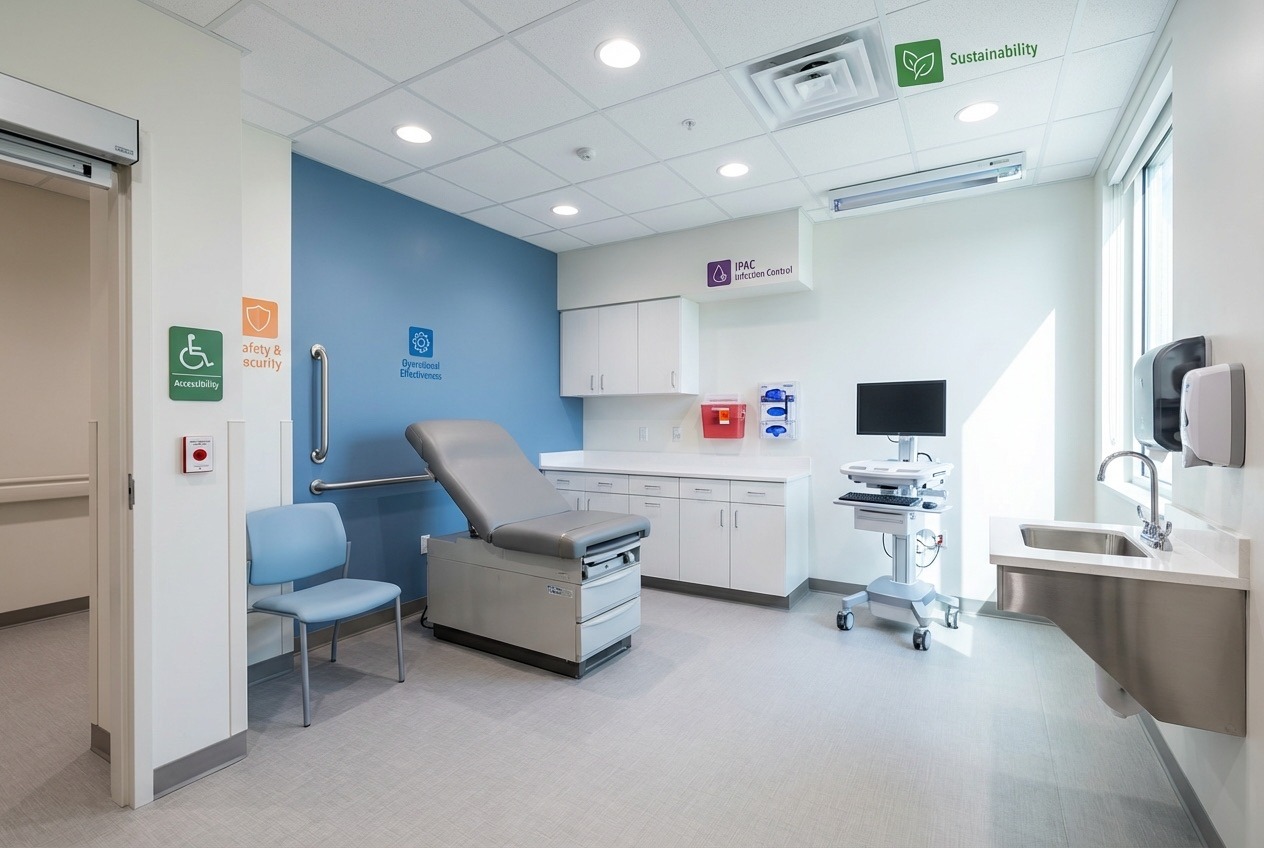
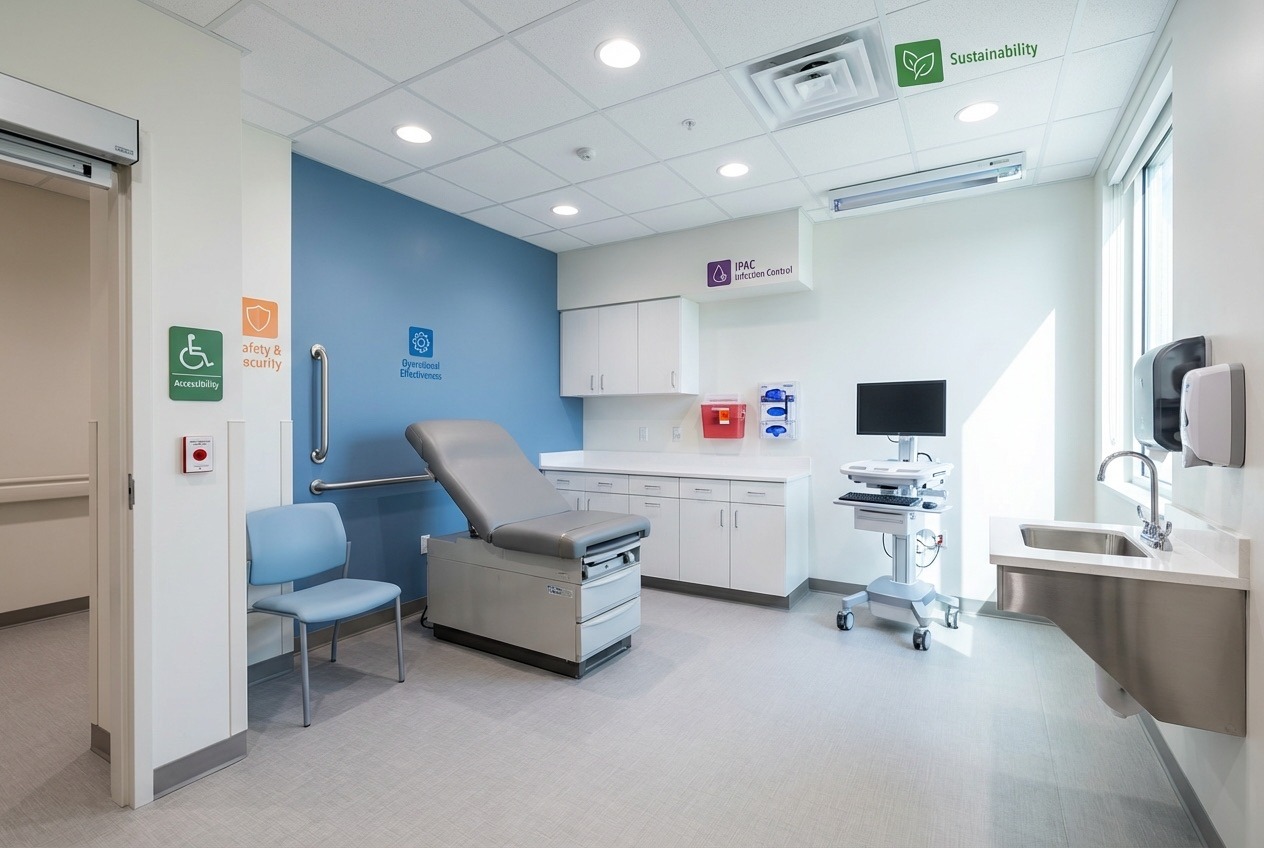
Modern medical exam room demonstrating CSA Z8000 OASIS compliance principles
The Accessibility for Ontarians with Disabilities Act (AODA) establishes accessibility standards that all Ontario organizations—including medical practices—must follow. For medical office renovations, both the Ontario Building Code accessibility provisions and AODA Design of Public Spaces Standards apply.
Healthcare facilities serve a patient population with higher rates of disability, mobility limitations, and accessibility needs compared to the general public. AODA enforcement agencies and accessibility advocates pay particular attention to medical office accessibility because inadequate design directly prevents people with disabilities from accessing essential healthcare services.
Organizations with 20+ employees must file AODA compliance reports. However, all medical clinics—regardless of size—must comply with accessibility standards. During your renovation, engage an accessibility consultant to review plans before construction begins. Retrofitting accessibility features post-construction costs 3-5 times more than incorporating them during initial design.
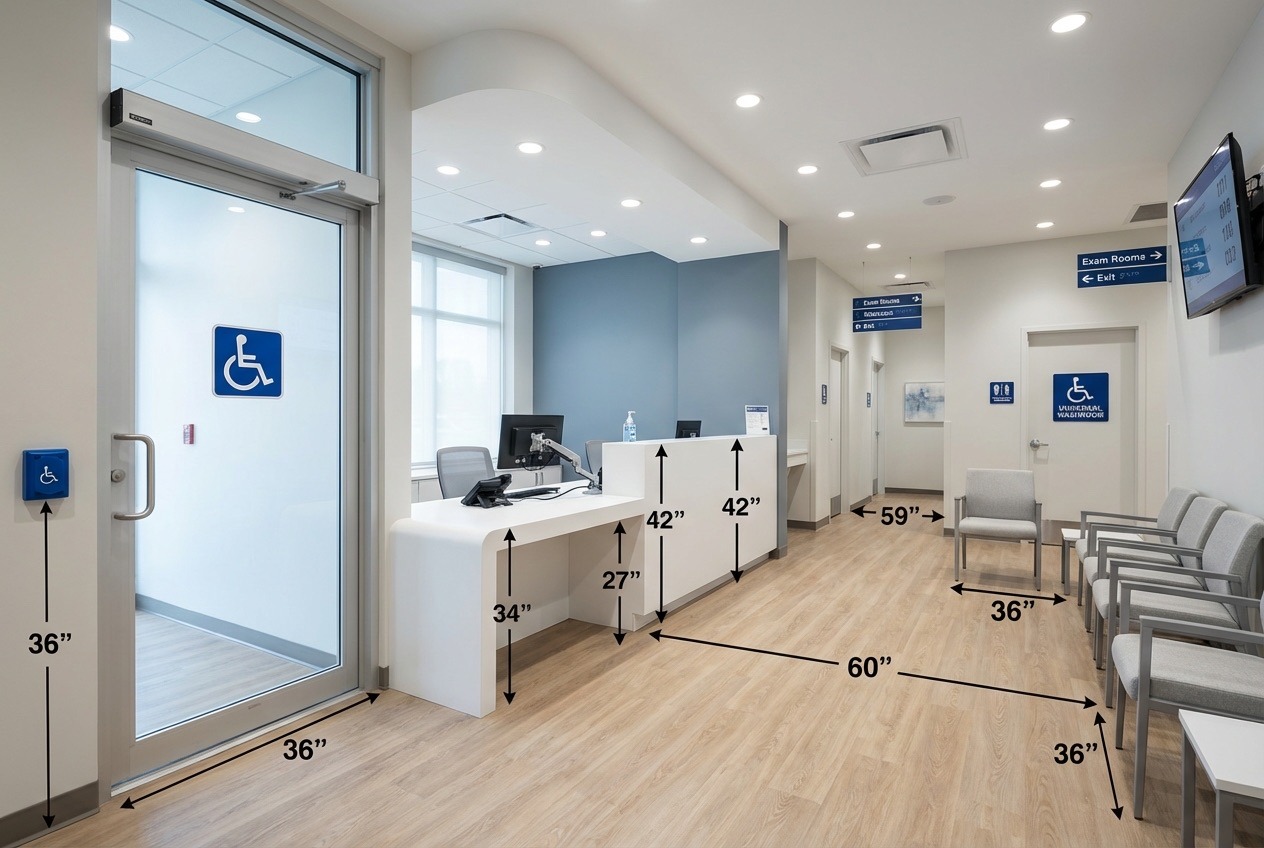
Professional medical clinic reception demonstrating Ontario AODA accessibility compliance
Infection Prevention and Control (IPAC) isn't just about your finished medical office—it's also about protecting patients, staff, and the public during construction. Ontario's Public Health guidelines and CSA Z317.13 provide requirements for infection control during construction, renovation, and maintenance of healthcare facilities.
CSA Z317.13-2017 outlines precautions and procedures to minimize infection risks during healthcare facility renovation and construction. Even small medical office renovations must implement IPAC measures to prevent:
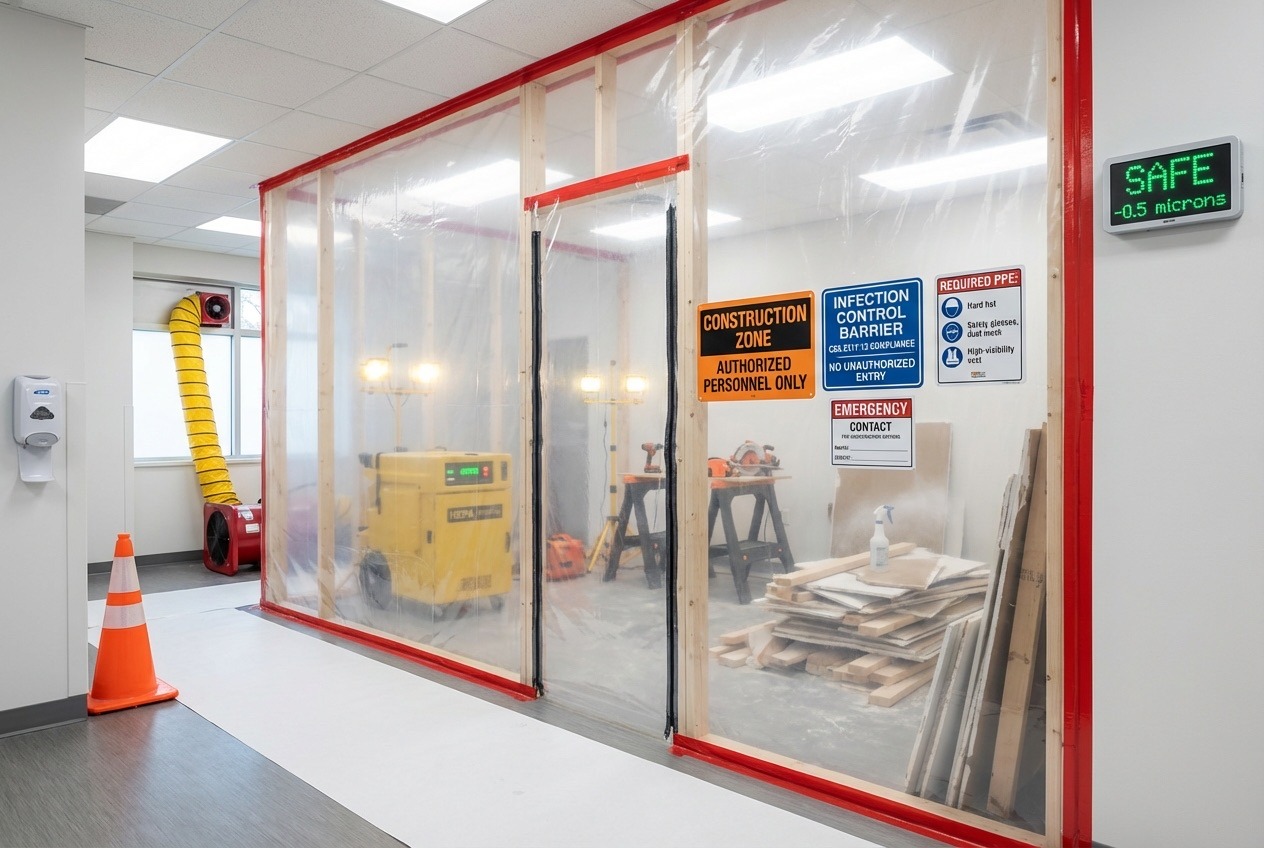
Professional IPAC infection control containment during active medical facility renovation
Navigating Ontario's permit system efficiently requires submitting applications in the correct sequence with complete documentation. Here's the proven process healthcare-specialized contractors follow:
Before any permit applications, assemble your project team:
Your architect prepares detailed construction documents including:
Submit your complete building permit application to the municipal building department. Most Ontario municipalities now accept electronic submissions through online portals.
Required documents:
While the building permit is under review, your contractors can submit:
Municipal building departments review your submission and typically provide comments requiring revisions. Common issues for medical offices include:
Your architect revises drawings, resubmits, and waits for final approval. This typically requires 1-2 revision cycles taking 2-4 weeks total.
Once approved, you'll receive your building permit(s). Post the permit prominently at the construction site as required by law. Your contractor can now begin work in accordance with approved plans.
Throughout construction, your contractor schedules mandatory inspections:
After passing all inspections, the municipality issues a Certificate of Occupancy (or Completion), legally permitting you to occupy and operate your medical clinic.
NEVER begin construction before permits are issued. Unpermitted work requires expensive demolition, even if compliant. Municipalities can issue stop-work orders, fine you up to $50,000+ for code violations, and require complete removal of unpermitted work regardless of quality or cost. "We'll get permits later" is an extremely expensive mistake that delays your clinic opening by 3-6 months.
Municipal building department plan review and permit approval process
Understanding realistic timelines prevents unrealistic expectations and allows proper scheduling of lease agreements, staff hiring, and patient communications. Here are typical permit timelines based on 2026 Ontario processing speeds:
| Permit Type | Typical Timeline | Factors Affecting Speed |
|---|---|---|
| Building Permit (Simple) | 3–6 weeks | Cosmetic updates, minor layout changes, no structural work |
| Building Permit (Standard) | 6–10 weeks | New exam rooms, plumbing/HVAC modifications, accessibility upgrades |
| Building Permit (Complex) | 10–16 weeks | Change of use, structural modifications, large-scale renovations |
| ESA Electrical Permit | Same day – 48 hours | Usually processed very quickly through online portal |
| Plumbing Permit | 1–3 weeks | Often bundled with building permit; separate if extensive work |
| HVAC Permit | 2–4 weeks | Mechanical engineer stamped drawings expedite approval |
| Change of Use Review | 4–8 weeks | Converting non-medical to medical space triggers comprehensive review |
| Public Health Notification | Variable (no fee) | Submit early to prevent delays; not required in all municipalities |
Permit processing speed varies significantly by municipality:
Incomplete submissions restart the review clock. Ensure all required drawings, calculations, and forms are included before submission.
Architects and engineers familiar with your municipality know exactly what reviewers require, preventing revision cycles.
Many municipalities offer pre-submission meetings to identify potential issues before formal application—highly recommended for complex projects.
Some municipalities offer expedited review for additional fees—worth considering if time-sensitive.
After completing hundreds of medical office renovations across Ontario, we've identified recurring permit mistakes that cause expensive delays. Avoid these pitfalls:
The mistake: Contractors begin demolition or rough-in work before receiving official permit approval.
The consequence: Stop-work orders, fines up to $50,000+, mandatory removal of unpermitted work regardless of compliance, and 3-6 month delays while correcting violations.
The solution: Wait for official permit issuance. Use the waiting period for ordering equipment, finalizing finishes, and preparing detailed construction schedules.
The mistake: Choosing contractors based solely on lowest bid without verifying medical facility renovation experience.
The consequence: Missed CSA Z8000 requirements, failed inspections, non-compliant HVAC systems requiring complete replacement, inadequate acoustical privacy, and change orders adding 30-50% to original costs.
The solution: Request 3+ recent healthcare project references. Ask specific questions: "Have you renovated medical facilities in Ontario?" "Are you familiar with CSA Z8000 and CSA Z317.2?" "Can you provide references from recent medical office projects?"
The mistake: Using standard commercial HVAC systems without medical-grade filtration, proper air changes, or zone control.
The consequence: Failed mechanical inspections, inability to achieve CSA Z317.2 compliance, poor indoor air quality, patient complaints, and $15,000-$40,000 system replacement costs.
The solution: Engage a mechanical engineer specializing in healthcare HVAC. Specify MERV-13+ filtration, minimum 6 ACH for exam rooms, and independent zone control.
The mistake: Using standard 3-5/8" metal stud walls with single-layer drywall between exam rooms.
The consequence: Patient conversations audible in adjacent rooms (PHIPA violation), failed CSA Z8000 compliance, patient complaints, and expensive post-construction acoustic retrofitting ($8,000-$25,000 per wall).
The solution: Design walls to STC-50 minimum (STC-60 preferred): staggered stud construction or resilient channels, acoustic insulation, sealed penetrations, and walls extending to structural deck.
The mistake: Treating AODA as afterthought or assuming OBC minimums are sufficient.
The consequence: Accessibility complaints, AODA enforcement actions, inability to serve patients with disabilities, expensive retrofits, and reputational damage.
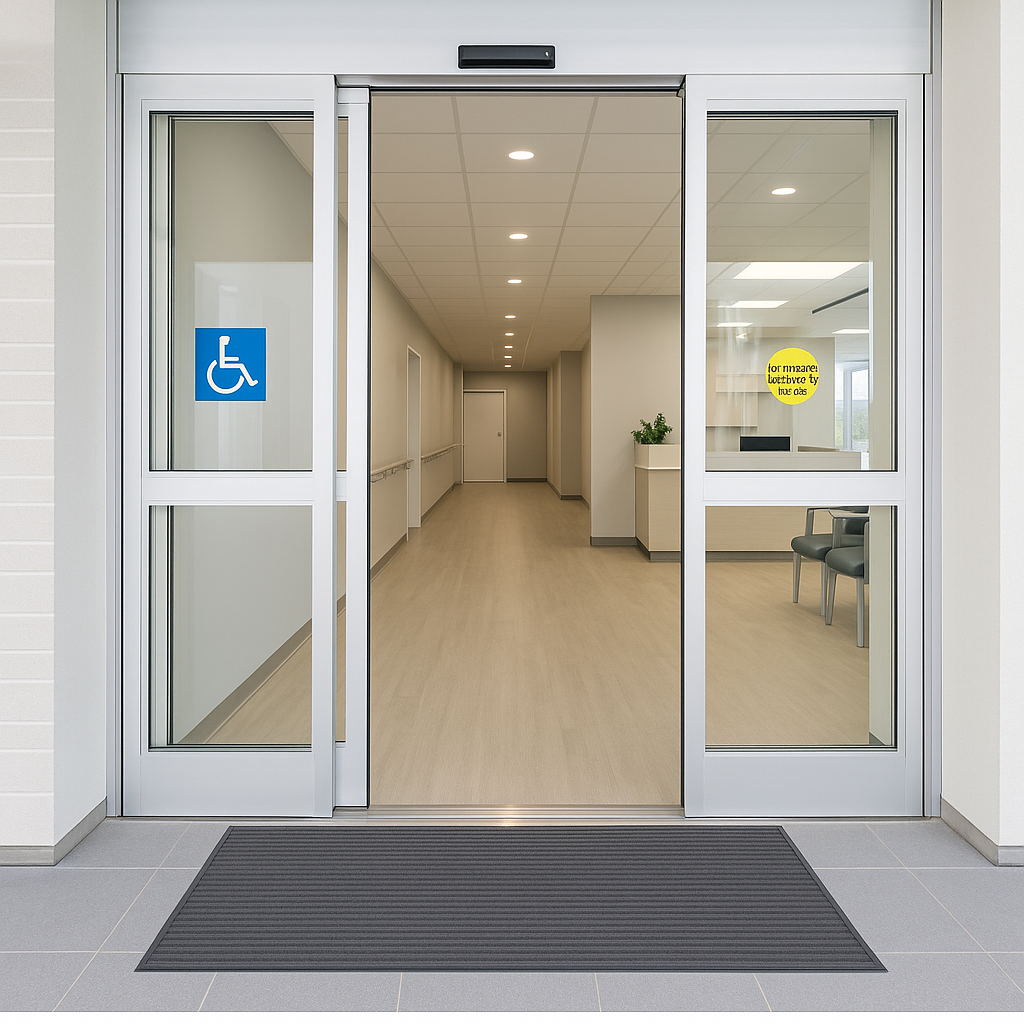
The solution: Engage accessibility consultant during design phase. Exceed minimums: 36" door widths (not 32"), power door operators at main entrance, height-adjustable exam tables, and clear wheelchair maneuvering space.
The mistake: Converting retail, office, or residential space to medical use without Change of Use permit.
The consequence: Occupancy prohibited, business license denied, lease violations, insurance issues, and 2-4 month delays obtaining proper permits.
The solution: Notify your municipality immediately if changing building use to medical. Budget extra time (4-8 weeks) for Change of Use review.
The mistake: Inadequate dust control and infection prevention during construction while clinic remains operational.
The consequence: Patient safety incidents, health unit closure orders, contamination requiring professional remediation ($10,000-$50,000), and lost revenue from temporary closure.
The solution: Implement CSA Z317.13 protocols: floor-to-ceiling barriers, negative air pressure, HEPA filtration, sealed construction zones, and phased work schedules avoiding patient hours.
The mistake: Assuming permit approval in 2-3 weeks; signing lease agreements or hiring staff based on unrealistic construction start dates.
The consequence: Paying rent on empty space for months, delayed revenue generation, staff resignation before clinic opening, and financial stress.
The solution: Budget 6-10 weeks minimum for standard medical office building permits. Add buffer time for revisions and complex projects. Don't commit to opening dates until permits are in hand.
Most medical office renovations require: (1) Building Permit from your municipality covering structural, layout, and fire safety compliance, (2) Electrical Permit from the Electrical Safety Authority (ESA), (3) Plumbing Permit for fixtures and medical sinks, (4) HVAC/Mechanical Permit for ventilation systems, and potentially (5) Change of Use Permit if converting non-medical space. Costs range from $3,000-$12,000 total depending on scope and municipality.
Standard medical office building permits take 6-10 weeks in most Ontario municipalities. Simple cosmetic updates may be approved in 3-6 weeks, while complex renovations involving Change of Use or structural work can take 10-16 weeks. Toronto typically requires 8-12 weeks due to higher application volumes. Plan for at least one revision cycle adding 2-3 weeks to initial timelines.
CSA Z8000 is the National Standard of Canada for healthcare facility design and construction. It applies to ALL healthcare facilities in Ontario regardless of size, including small medical offices, dental clinics, and specialty practices. CSA Z8000 specifies requirements for exam room sizes (minimum 3.0m x 3.0m), HVAC systems, acoustical privacy (STC-50+ walls), infection control, and accessibility beyond AODA minimums. Municipal building departments enforce CSA Z8000 compliance during permit review and inspections.
Absolutely not. Starting construction before permit issuance is illegal in Ontario and results in: immediate stop-work orders, fines up to $50,000+ for Building Code violations, mandatory demolition of unpermitted work (even if compliant), and 3-6 month delays while correcting violations and reapplying for permits. Always wait for official permit approval before any demolition, framing, or construction begins. Use the waiting period for equipment ordering and material selection.
AODA (Accessibility for Ontarians with Disabilities Act) requires medical clinics to provide barrier-free access including: (1) accessible entrance with power door operator, (2) 36-inch minimum door widths for exam rooms, (3) 1500mm wheelchair turning radius in patient areas, (4) at least one universal accessible washroom, (5) accessible reception counter (maximum 865mm height), (6) tactile and visual wayfinding signage, and (7) accessible route throughout patient care areas. Medical offices face enhanced scrutiny because they serve populations with higher disability rates.
Yes, medical offices require HVAC systems exceeding standard commercial specifications. CSA Z317.2 mandates: minimum 6 air changes per hour (ACH) in exam rooms (10-12 ACH for procedure rooms), MERV-13 or higher filtration (standard commercial uses MERV-8), independent zone control to prevent cross-contamination between exam rooms, temperature control (21-24°C), humidity control (30-60% RH), and adequate fresh air intake. Standard commercial HVAC systems fail medical office inspections and must be completely replaced at costs of $15,000-$40,000+.
CSA Z8000 and PHIPA privacy requirements recommend minimum STC-50 sound transmission class rating for walls between exam rooms (STC-60 preferred). Achieve this through: staggered stud wall construction or resilient channels, acoustic insulation filling wall cavities, walls extending to structural deck (not stopping at suspended ceiling), sealed electrical boxes and penetrations, and acoustically rated doors with proper seals. Standard 3-5/8" metal stud walls achieve only STC-35-40, allowing patient conversations to be clearly heard in adjacent rooms (PHIPA violation).
No, converting non-medical space to medical use requires a Change of Use permit and triggers comprehensive building department review. Change of Use applications verify: building occupancy classification compliance, adequate parking for medical use (higher requirements than retail/office), accessibility meeting AODA standards, HVAC systems capable of medical-grade air changes and filtration, plumbing capacity for required medical sinks, fire safety systems appropriate for healthcare occupancy, and zoning compliance. Change of Use review adds 4-8 weeks to permit timelines. Skipping this process results in business license denial and insurance issues.
Total permit costs for medical office renovations typically range: Building Permit $2,500-$8,000 (based on construction value and municipality), Electrical Permit (ESA) $150-$800, Plumbing Permit $300-$1,200 (may be included in building permit), HVAC/Mechanical Permit $400-$1,500, and professional drawings/engineering $8,000-$25,000. Total permit package for a standard 2,000-3,000 sq ft medical office renovation: $12,000-$35,000 including all fees and professional services. Municipality fee structures vary significantly—Toronto and GTA suburbs charge more than smaller municipalities.
Always hire healthcare-specialized contractors for medical office renovations. General contractors lack familiarity with: CSA Z8000 healthcare facility standards, CSA Z317.2 medical HVAC requirements, IPAC infection control protocols, medical equipment power specifications, acoustical privacy standards for exam rooms, and healthcare-specific permit processes. While medical specialists may charge 5-10% more upfront, they complete projects 20-30% faster, avoid costly compliance mistakes, prevent failed inspections, and deliver functional medical spaces. General contractors face steep learning curves resulting in change orders, delays, and costs exceeding any initial savings.
Avoid costly permit delays and compliance mistakes with RenoEthics' healthcare construction expertise. We handle all permitting, regulatory compliance, and inspections for medical facilities across the Greater Toronto Area—delivering compliant, efficient spaces that pass inspection the first time.
Get Your Free ConsultationNavigating permits and regulations for medical office renovations in Ontario can feel overwhelming, but proper compliance protects your practice, your patients, and your investment. The additional time and cost required for healthcare-specific permits, CSA Z8000 compliance, and AODA accessibility features pay dividends through:
While general contractors may promise faster timelines or lower costs, healthcare-specialized firms like RenoEthics understand the regulatory landscape and deliver projects that meet all Ontario requirements from day one. We coordinate permit applications, manage inspection schedules, ensure CSA Z8000 compliance, and handle the complex regulatory requirements so you can focus on providing excellent patient care.
Whether you're opening a new family practice, expanding your existing clinic, or modernizing your medical facility, investing in proper permits and expert guidance is the foundation for long-term success. Don't let permit mistakes delay your practice opening or compromise patient safety—work with professionals who understand medical facility construction in Ontario.
At RenoEthics, we've successfully navigated permits for dozens of medical office renovations across the GTA. Our team knows Ontario's regulatory requirements, municipal processes, and healthcare construction standards. We're here to make your medical office renovation smooth, compliant, and successful.
Choosing the right construction materials is critical for infection control in Ontario clinics. Learn what Toronto Public Health and IPAC inspectors look for in...
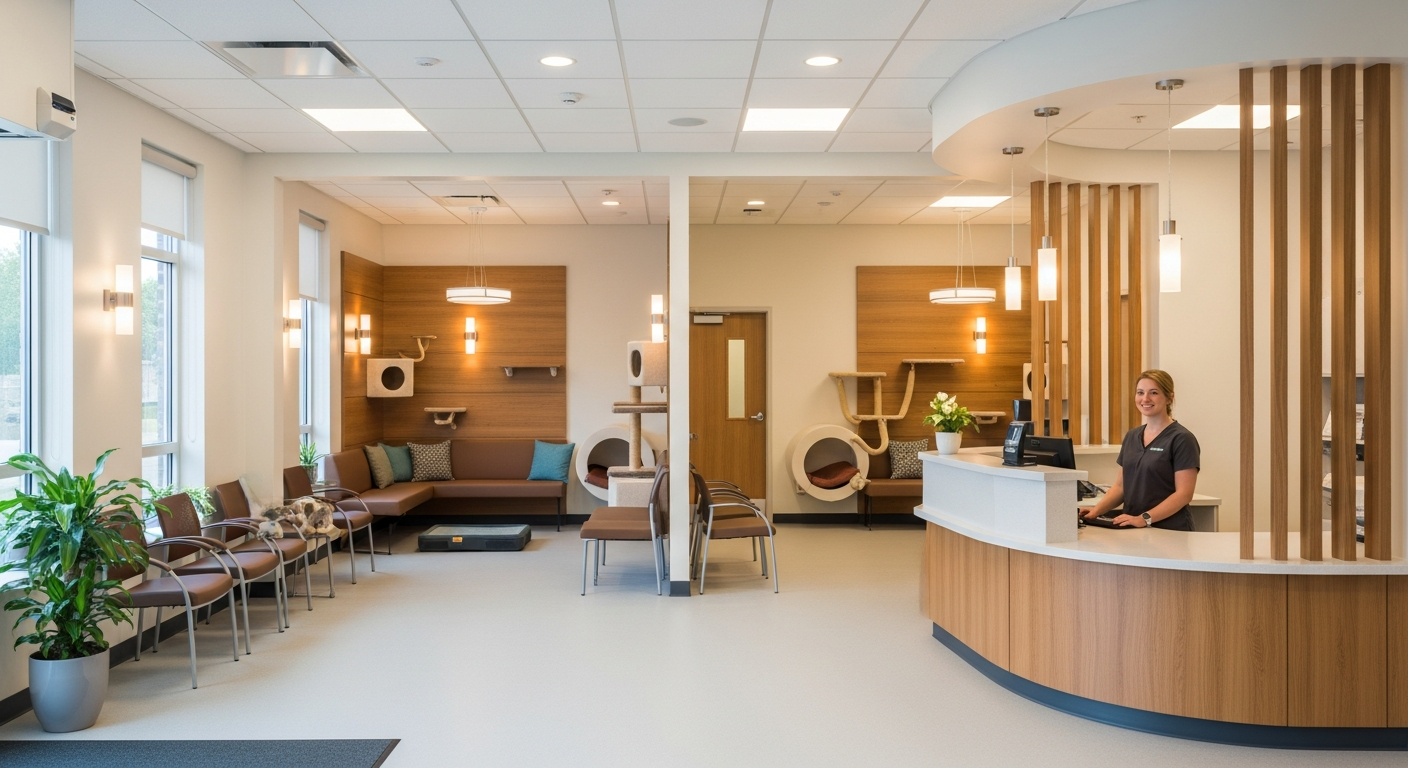
Renovating a veterinary clinic in Ontario? Discover 2026 costs, CVO compliance requirements, and Fear-Free design standards for animal hospitals across the GTA.
As of January 2025, AODA compliance is fully enforced for Ontario medical clinics. Here is what your renovation must include to meet accessibility standards...