
May 18, 2023

Renovating a medical office in Ontario goes far beyond selecting paint colors and installing new flooring. It’s a highly regulated process governed by multiple...
Dr. Sunita Mehta had been operating her Markham animal hospital for eleven years when the College of Veterinarians of Ontario inspector walked through her surgical suite door.
The clinic had been thriving — a full appointment book, three DVMs on staff, strong Google reviews. But the 2023 CVO Essential Standards update had introduced a requirement she hadn’t anticipated: sinks were no longer permitted inside the surgical suite itself. They had to be relocated to a separate scrub and prep area adjacent to the room. Dr. Mehta’s surgical space, renovated in 2019, had a sink built into the wall directly inside the surgical area — standard at the time, now non-compliant.
The CVO inspector flagged three items: the in-suite sink location, a HVAC system delivering 6 air changes per hour instead of the required 10–15, and surgical suite flooring with expansion joints at the wall base — a harbour for pathogens under Ontario Regulation 1093. The clinic was given 90 days to remediate or face suspension of its facility certificate.
The bill for bringing the surgical suite into compliance: $147,000. Not because any single item was catastrophic — but because the HVAC modification required a structural penetration for new ductwork, which triggered a full building permit in the City of Markham, which required engineered drawings, which added six weeks to the timeline. The clinic operated without surgical capacity for two months.
Dr. Mehta hired the wrong contractor the first time: a commercial general contractor with no healthcare experience who quoted $40,000 for the work. He didn’t know what a laminar flow ceiling was. He had never pulled a TSSA permit for specialty HVAC. The second contractor — a healthcare-specialist firm — completed the work correctly in seven weeks, but the delay from the first contractor’s failed attempt cost an additional $28,000 in remediation of his partial work.
This guide exists because Dr. Mehta’s situation is not unusual. Veterinary clinic renovations in Ontario sit at the intersection of four regulatory frameworks, three professional standards bodies, and one highly specialized construction discipline — and most general contractors know none of it. If you’re planning a vet clinic renovation in the GTA, this is what you need to know before you sign a single contract.
Veterinary clinic construction in Ontario is governed by a layered framework. Understanding each layer is essential before any renovation work begins — because non-compliance with any one layer can result in facility certificate suspension, even if the others are satisfied.
The College of Veterinarians of Ontario operates under the Veterinarians Act, R.S.O. 1990. Ontario Regulation 1093 (Facilities Standards) sets the minimum physical requirements for veterinary premises in the province. The CVO inspects all licensed facilities at least once every five years, with additional inspections triggered by complaints or changes to facility structure.
Critical October 2023 CVO Standards Update: The CVO Essential Standards were significantly revised effective October 1, 2023. The most consequential change for clinic design: sinks are no longer permitted inside the surgical suite. Any clinic with a sink inside its surgical room — previously standard practice — is now non-compliant. This single change has triggered remediation projects at dozens of Ontario veterinary clinics.
Key CVO O. Reg. 1093 physical requirements include:
Veterinary clinics are classified as Group D (Business and Personal Services) or Group B (Care or Detention Occupancy) under the OBC, depending on whether overnight boarding or 24-hour care is provided. The distinction matters significantly for fire separation requirements, means of egress, and sprinkler requirements. Most renovation projects for daytime veterinary clinics fall under Group D — but any practice adding boarding or overnight care must reassess occupancy classification with the local building department before finalizing plans.
All new construction and major renovations to veterinary clinics must comply with the Design of Public Spaces Standards (O. Reg. 413/12) under AODA. For vet clinics, this means:
The Technical Standards and Safety Authority (TSSA) governs fuel-burning HVAC equipment and boilers. Any vet clinic renovation involving specialty ventilation systems — including surgical suite HVAC or isolation ward negative-pressure systems — typically requires TSSA permits and inspection in addition to the municipal HVAC permit. This is frequently overlooked by general contractors unfamiliar with healthcare construction.
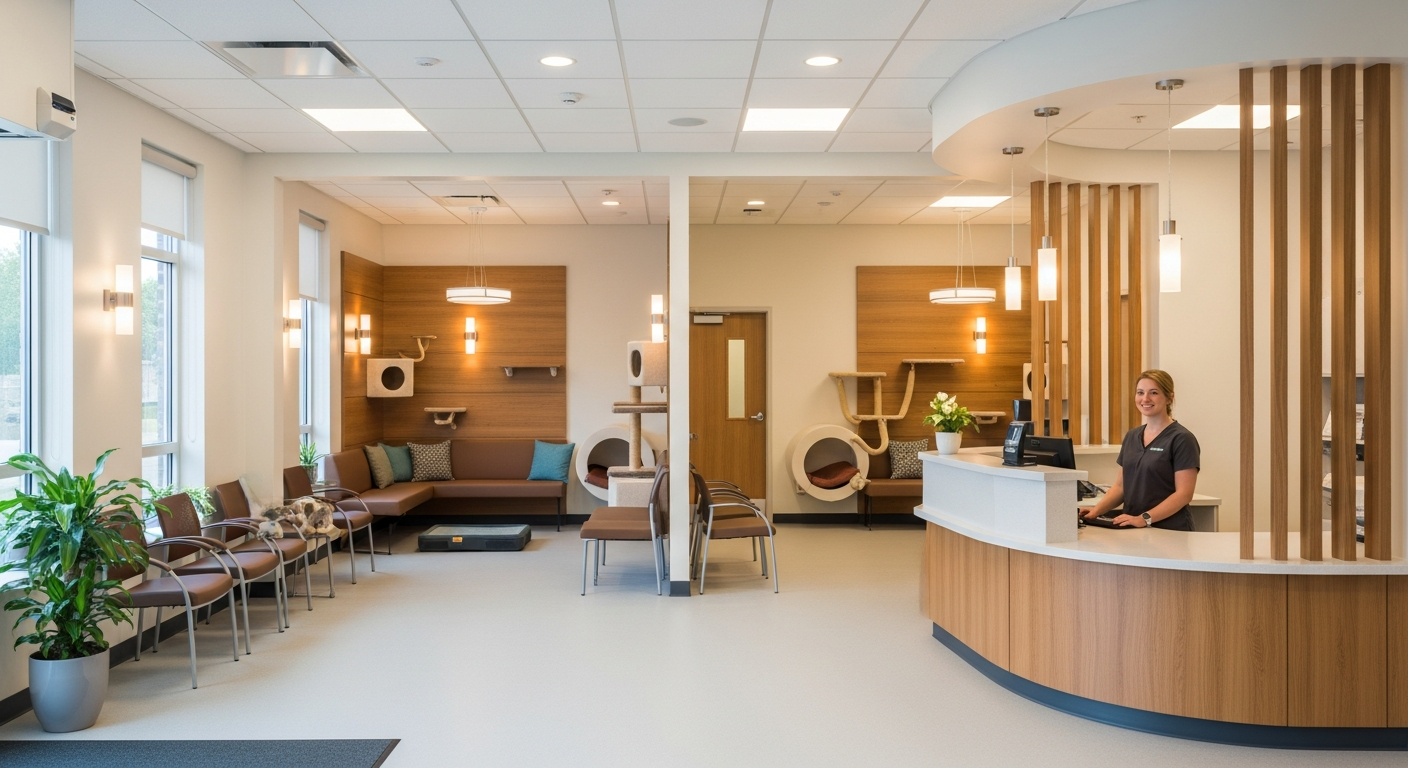
Fear Free certification has become the defining differentiator in veterinary practice quality — and it has direct, measurable implications for how a clinic must be physically designed. Introduced by Dr. Marty Becker and now adopted by thousands of practices across North America, Fear Free is not a vague philosophy. It has 27 mandatory protocol standards, and a significant number of them require specific construction features.
For a practice to achieve Fear Free Certified Practice status, a minimum of 25% of patient-facing staff must individually complete Fear Free certification (approximately $150–$300 USD per person), and the practice must demonstrate compliance with all 27 mandatory standards. The annual practice registration fee is $500 USD. Fear Free status is increasingly expected by pet owners in the GTA’s premium veterinary market — and it’s becoming a factor in lease negotiations as landlords recognize the added value of accredited practices.
The construction requirements for Fear Free compliance include:
The single most impactful Fear Free construction requirement: dogs and cats cannot share a waiting space. This means either a physical partition dividing the waiting area into two zones, or separate entrances leading to entirely separate waiting areas. For clinics being built out from shell space, this is straightforward. For existing clinics renovating in place, it typically means a $15,000–$35,000 partition addition with separate signage systems, pheromone diffuser zones (Feliway for cat areas, Adaptil for dog areas), and independent air pathways to prevent olfactory cross-contamination.
Fear Free standards require management of auditory stressors — specifically, dogs in kennels should not be audible in the cat waiting zone or exam rooms. This translates to acoustic wall assemblies with STC ratings of 50+ between kennel and clinical areas, solid-core doors with acoustic seals on all exam room doors, and HVAC duct lining to prevent sound transmission through ductwork. Specifying the right wall assembly — typically 3.5″ metal stud with two layers 5/8″ Type X gypsum each side, with Rockwool Safe’n’Sound batt insulation — is the difference between STC 44 (inadequate) and STC 55+ (compliant).
Fear Free requires non-slip flooring in all areas accessible to animals (including ramps and scales), sightline management between exam tables and kennel areas, and lighting systems that avoid overhead fluorescent glare at animal eye level. Construction implications: specify textured or slip-rated luxury vinyl in all clinical areas, design exam room layouts with exam tables positioned perpendicular to windows (not facing kennel area doors), and plan for indirect or cove lighting in waiting areas supplemented by recessed LED rather than surface-mounted fluorescent strips.
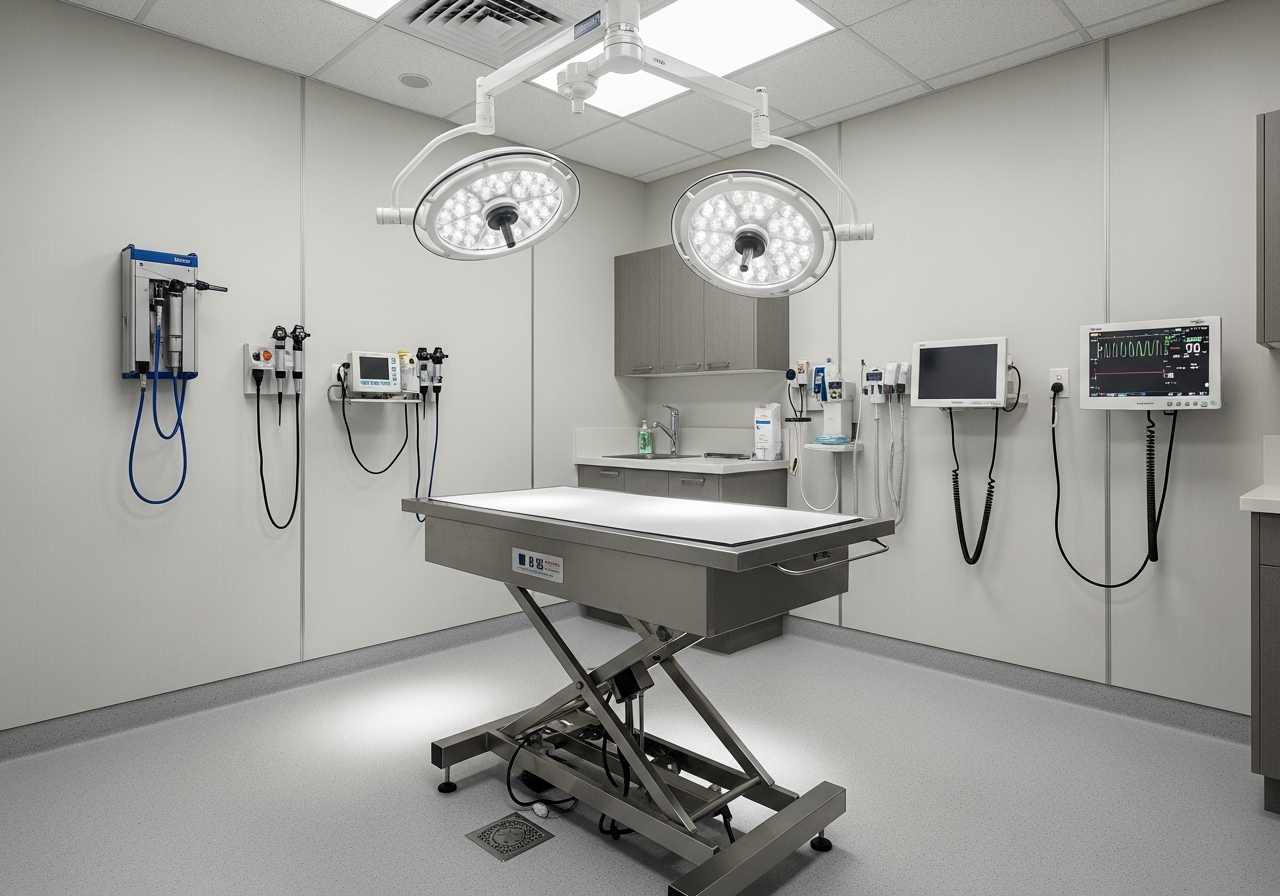
Every room in a veterinary clinic has distinct construction requirements. The following specifications reflect current CVO Essential Standards (October 2023), OBC Group D requirements, and Fear Free design principles.
Minimum specs: Species-separated zones (physical or separate entrance); AODA-compliant reception counter (865 mm lowered section); non-slip, cleanable flooring extending to wall with coved base; acoustic separation from kennel areas (STC 50+).
Flooring: Sheet vinyl or LVT with welded seams — no expansion joints at wall. Budget: $5–$12/sq ft installed. Coved wall base: add $8–$15 per linear foot.
Ventilation: Minimum 4–6 ACH; separate air supply for cat zone; pheromone diffuser mounts specified in electrical plan.
Cost to renovate (existing space): $18,000–$45,000 depending on partition requirements and AODA scope.
Minimum specs per CVO O. Reg. 1093: Minimum 9.3 m² (100 sq ft) floor area; non-porous walls and floor; dedicated hand-washing sink with gooseneck faucet; sufficient lighting for clinical examination.
Wall finish: FRP (fibre-reinforced plastic) panels or painted 5/8″ moisture-resistant drywall with semi-gloss/satin alkyd paint — minimum. Premium: full-height 4×8 FRP panels with moisture-proof adhesive and aluminum H-trim at seams. FRP: $4–$8/sq ft installed; full wall coverage of 100 sq ft exam room = $1,600–$3,200.
Flooring: Seamless sheet vinyl or LVT — no grout lines where bacteria harbour. Coved to wall base. Budget: $5–$12/sq ft.
Lighting: Minimum 1,000 lux at exam table surface for clinical examination. Recessed LED 4000K. Avoid fixtures with accessible gaps where animals can fall or lodge.
Cost to add one exam room (leasehold improvement): $35,000–$65,000 depending on plumbing run length, wall construction, and electrical scope.
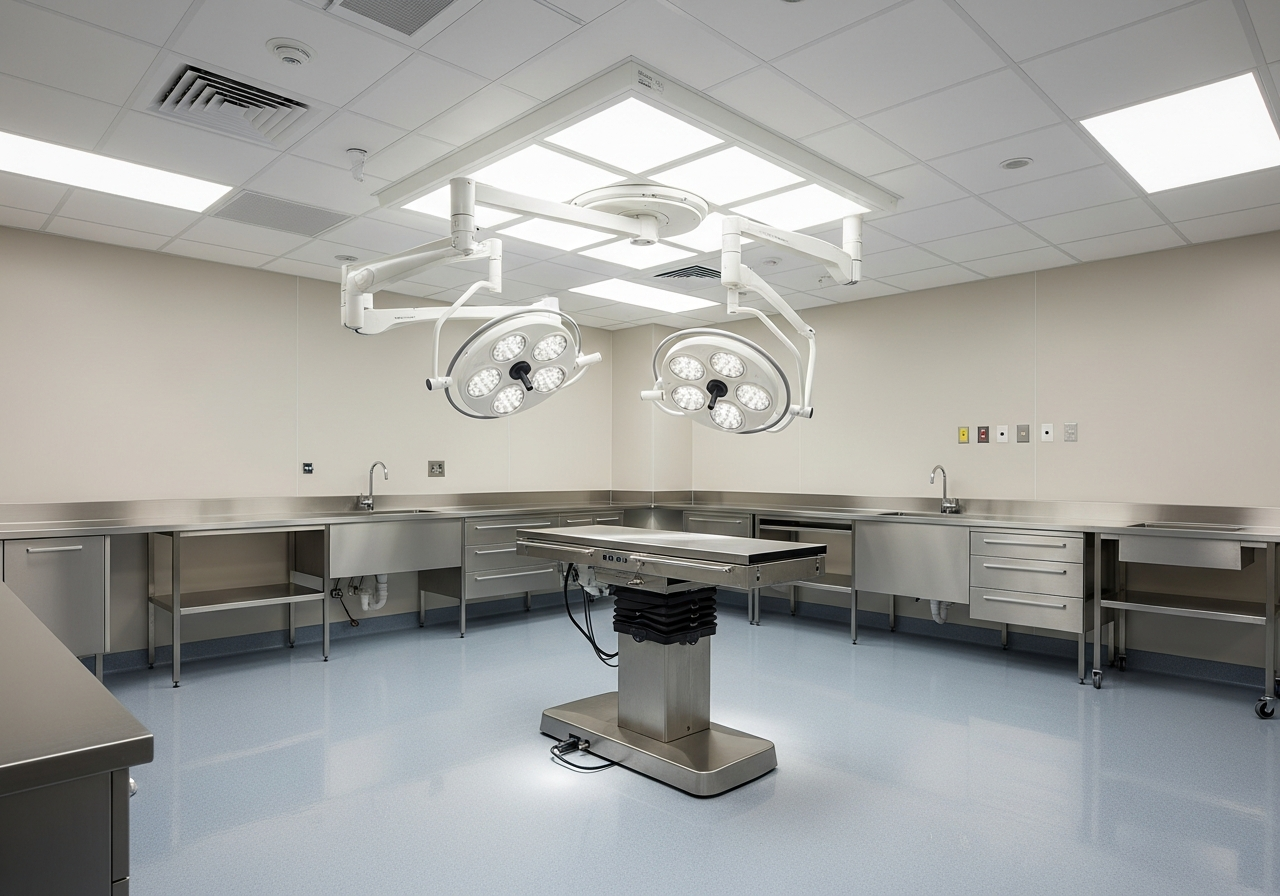
The surgical suite is the most regulated and most expensive room in any veterinary clinic renovation. It must meet CVO Essential Standards, OBC requirements, and HVAC specifications simultaneously — and since the October 2023 update, must have its sink in an adjacent prep area rather than inside the room.
Room minimum: 13.4 m² (144 sq ft), dedicated non-multipurpose room, non-porous surfaces on all six surfaces (four walls, floor, ceiling).
HVAC (critical): 10–15 air changes per hour (ACH); positive pressure relative to adjacent areas (+0.01 in. w.c. / +2.5 Pa); supply air from ceiling, exhaust low on walls — this directional airflow pattern prevents contaminants rising toward the surgical field. HEPA filtration on supply air (MERV 14 minimum, HEPA ideal). Laminar flow ceiling diffuser is the optimal solution — distributes air uniformly across the surgical field without turbulence.
Flooring: Seamless poured epoxy or methyl methacrylate (MMA) resin — no joints anywhere. Coved base minimum 6 inches up the wall, sealed. Standard seamless epoxy: $8–$15/sq ft CAD installed. Antimicrobial silver-ion epoxy: $10–$18/sq ft. MMA resin (fastest cure, best chemical resistance): $15–$25/sq ft.
Walls: FRP full-height, or epoxy-painted concrete masonry. All penetrations (pipes, conduit) sealed airtight with non-porous escutcheons.
Ceiling: Lay-in T-bar is not acceptable in surgical suites — pathogen harbour above tiles. Specify 5/8″ moisture-resistant drywall with high-gloss epoxy paint, or FRP ceiling panels. Sealed seamless gypsum ceiling: $8–$14/sq ft installed.
Lighting: Surgical illumination minimum 10,000–20,000 lux at field. Purpose-built surgical light (shadowless, adjustable) — not a general-purpose LED fixture. Surgical lights: $2,500–$12,000 depending on head configuration.
Cost to build surgical suite (new construction in existing shell): $60,000–$150,000 depending on HVAC complexity and finish specification.
Isolation is required for patients with suspected or confirmed contagious disease. The physical requirements are the inverse of the surgical suite: negative pressure (not positive) to prevent pathogen escape into the main clinic.
HVAC: 12+ ACH; negative pressure (−0.01 in. w.c. / −2.5 Pa relative to adjacent areas); exhaust must be HEPA-filtered before recirculation OR exhausted directly to the exterior. No recirculation of isolation air to other zones. Dedicated exhaust fan with backdraft damper. This system is entirely separate from the main clinic HVAC — it must never share ductwork with exam rooms, surgical suite, or waiting areas.
Access control: Physical separation from main clinical flow — not accessible through exam rooms or treatment areas. Typically requires a dedicated exterior access or dedicated internal corridor with pressure buffer (anteroom).
Finishes: Same non-porous requirement as surgical suite. Epoxy flooring with coved base; sealed gypsum or FRP walls; sealed ceiling.
Cost to build isolation ward: $45,000–$90,000. The HVAC system — dedicated negative-pressure exhaust with HEPA filtration and exterior exhaust routing — is typically 40–50% of this cost.
HVAC: 10–15 ACH, negative pressure to prevent kennel odours and airborne pathogens from reaching clinical areas. Separate exhaust from main system.
Flooring: Heavy-duty sealed concrete or epoxy with integrated floor drains — kennel areas see significant cleaning volume. Floor slope minimum 2% toward drains. Heavy-duty kennel epoxy: $12–$20/sq ft with drain integration.
Kennel units: Stainless steel or fibreglass — no galvanized steel (corrodes with repeated disinfectant exposure). Epoxy-coated wood cabinetry is not acceptable in kennel areas. Stainless modular kennel units: $800–$2,500 per run depending on size and configuration.
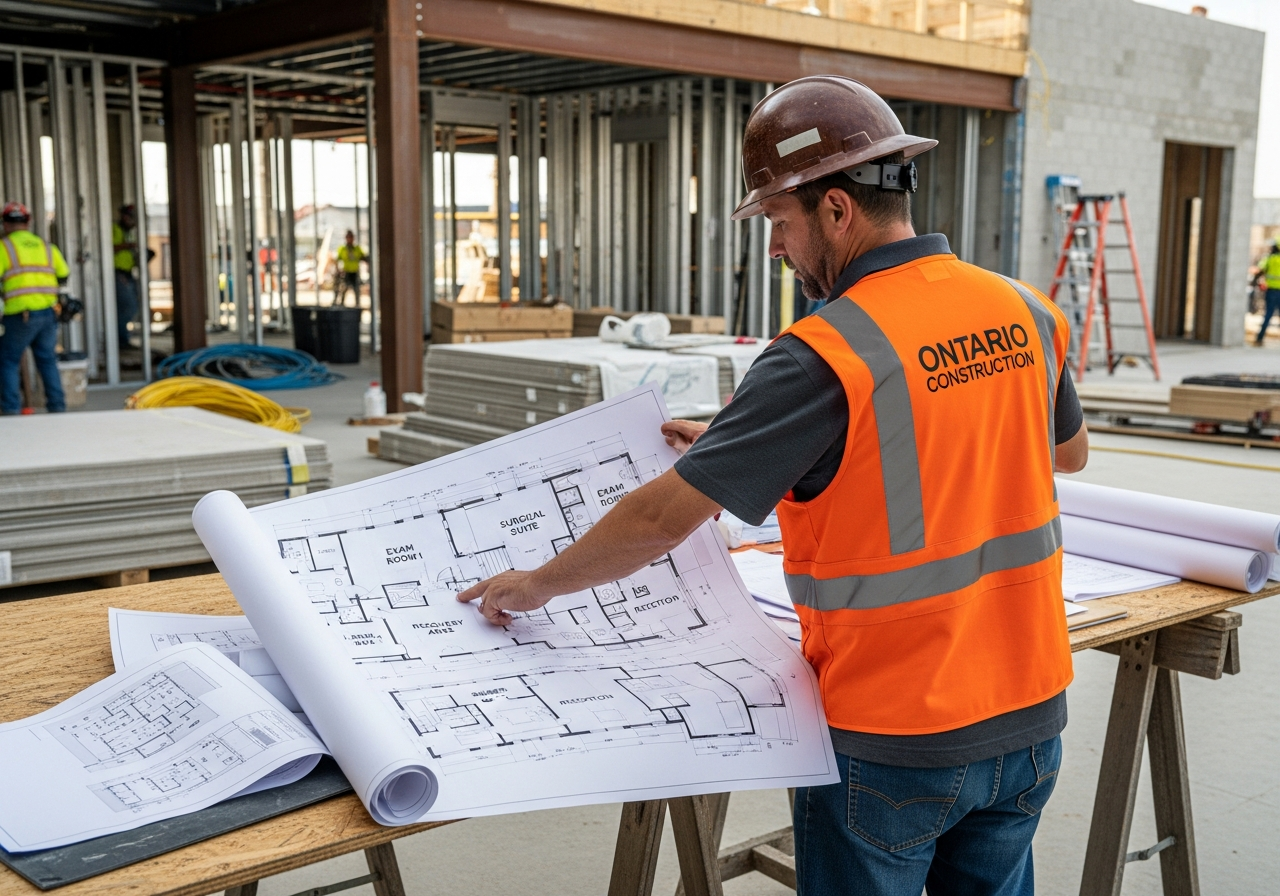
These three errors account for the majority of the costly remediation projects we see at Ontario veterinary clinics. All three are avoidable with proper contractor selection and early planning.
This is the most common Fear Free compliance failure — and the most visible one to clients. A clinic where dogs and cats share an open waiting area is flagged immediately during Fear Free certification review. The fix after the fact is dramatically more expensive than building it in from the start.
A Vaughan mixed-species practice tried to satisfy species separation with a single glass partition and directional signage — rejected at Fear Free review. Proper separation required a full-height demising wall, a second entrance door with AODA-compliant automatic opener, separate HVAC zones for pheromone management, and reorientation of the reception desk to serve both zones. Total cost: $67,000. The same work incorporated into the original renovation would have added approximately $18,000 to the project budget.
The rule: If you are pursuing Fear Free certification — or anticipate pursuing it within 5 years — build species separation into the design from day one. It is exponentially cheaper as part of the original scope.
This is the most expensive remediation category. The issue: most general HVAC contractors do not design to 10–15 ACH positive pressure for veterinary surgical suites. They install standard commercial HVAC delivering 3–6 ACH — which passes a standard commercial building inspection but fails CVO Essential Standards.
The remediation is expensive because fixing the HVAC after walls and ceilings are finished typically requires: opening ceiling assemblies to modify or replace ductwork, adding dedicated air handling equipment, and often cutting structural penetrations for new duct runs. In one Richmond Hill case, a clinic owner who had paid $38,000 for a “surgical suite renovation” by a general contractor spent an additional $89,000 to bring the HVAC to CVO standards — plus $22,000 in temporary closure costs while surgical services were unavailable.
The rule: Verify surgical suite HVAC specifications before any contractor begins work. Ask for the design engineer’s calculations showing ACH delivery, pressure differential, and filtration specification. If a contractor cannot provide these calculations, they are not qualified for veterinary surgical suite HVAC.
Standard commercial flooring — ceramic tile, standard LVT, or epoxy with expansion joints — fails in veterinary clinical areas because joints and grout lines harbour pathogens that cannot be disinfected. This is directly cited in CVO O. Reg. 1093: “non-porous surfaces that are able to be readily cleaned and disinfected.”
A Newmarket veterinary clinic had ceramic tile installed in its surgical suite by a general contractor — standard tile with grout lines at 12″ intervals and a 90° floor-to-wall junction. The CVO inspector flagged both the grout joints and the wall junction. Remediation required full demolition of the tile installation, moisture barrier preparation, and application of seamless poured epoxy with coved base. The replacement cost ($34,000) exceeded the original flooring installation ($19,000) due to the demolition scope and the need for MMA resin (rapid cure) to minimize closure time.
The rule: Specify seamless flooring systems (poured epoxy, MMA resin, or welded-seam sheet vinyl) in all clinical areas. Grout lines, expansion joints, and square floor-to-wall junctions are not acceptable in surgical suites, exam rooms, or isolation wards.
The following cost ranges reflect Ontario contractor pricing for healthcare-grade veterinary construction in 2025–2026. GTA pricing sits at the higher end of these ranges; smaller Ontario markets typically run 10–15% lower.
| Scope | Low Estimate (CAD) | High Estimate (CAD) | Key Variables |
|---|---|---|---|
| Single exam room addition (leasehold) | $35,000 | $65,000 | Plumbing run length, wall type |
| Surgical suite (new build in existing shell) | $60,000 | $150,000 | HVAC complexity, ceiling type |
| Isolation ward | $45,000 | $90,000 | Negative pressure system, HEPA exhaust routing |
| Species-separated waiting area | $18,000 | $55,000 | Partition vs. separate entrance required |
| Reception and lobby renovation | $15,000 | $45,000 | Millwork, AODA scope, flooring |
| Kennel/boarding expansion (per run) | $4,500 | $9,000 | Stainless unit spec, drain integration |
| Full clinic renovation (leasehold $/sq ft) | $175/sq ft | $325/sq ft | Specialty rooms, HVAC scope |
| New-build clinic fit-out (shell space $/sq ft) | $200/sq ft | $380/sq ft | Surgical suite, isolation, full HVAC design |
| Flooring Type | Cost Installed (CAD/sq ft) | Cure Time | Chemical Resistance | CVO Compliant |
|---|---|---|---|---|
| Standard seamless epoxy | $8–$15 | 24–72 hrs | Good | Yes |
| Antimicrobial silver-ion epoxy | $10–$18 | 24–72 hrs | Very good | Yes |
| Methyl methacrylate (MMA) resin | $15–$25 | 1–2 hrs | Excellent | Yes |
| Ceramic tile with grout | $8–$20 | N/A | Poor (grout) | No |
| Standard LVT (click-lock) | $5–$12 | N/A | Moderate | No |
| Welded-seam sheet vinyl | $8–$14 | N/A | Good | Yes (with coved base) |
Use this checklist to verify compliance before your CVO inspection. Each item corresponds to CVO Essential Standards (October 2023 revision) or O. Reg. 1093 requirements.
The following phased approach is designed to minimize disruption to ongoing operations while meeting CVO standards and permit requirements. Timeline assumes a GTA leasehold renovation of 2,000–3,500 sq ft.
Before any design work begins, commission a regulatory audit: a healthcare-experienced contractor or consultant reviews your current facility against CVO Essential Standards (October 2023), OBC occupancy classification, and AODA requirements. This produces a compliance gap analysis — the list of everything that must change — before you’ve spent a dollar on drawings.
Engage a licensed architect or designer with veterinary facility experience. Standard commercial designers do not know CVO requirements. The design package must include HVAC design calculations (ACH, pressure differentials), not just layout drawings — because without the HVAC engineering, the building department cannot approve mechanical permits for surgical suite and isolation construction.
Submit building permit, HVAC permit, plumbing permit, and electrical permit simultaneously where possible. GTA permit timelines for veterinary clinic renovations:
| Municipality | Standard ICI Review | With Structural/HVAC Engineering | Notes |
|---|---|---|---|
| City of Toronto | 2–4 weeks | 6–10 weeks | Full plan review if structural changes |
| Markham | 2–3 weeks | 4–7 weeks | TSSA permits additional 1–2 weeks |
| Richmond Hill | 3–4 weeks | 5–8 weeks | Similar to Markham |
| Vaughan | 2–4 weeks | 5–9 weeks | Specialty HVAC: TSSA approval required |
| Newmarket | 3–5 weeks | 6–10 weeks | York Region Public Health consultation for new clinics |
Important: Do not begin construction until all permits are issued. Veterinary clinic renovations that begin on a “permit application” basis — common with inexperienced contractors — can result in stop-work orders, demolition orders, and doubled permit fees.
This is the highest-disruption phase — existing ceilings, walls, and mechanical infrastructure are opened. For clinics renovating in place, this phase typically requires temporary clinic closure or significant operational restriction. Plan for 4–8 weeks of disruption.
Critical sequencing: HVAC ductwork rough-in must be completed and inspected before walls are closed. Plumbing rough-in (drain lines, supply lines for prep sink adjacent to surgical suite) must be completed and passed before concrete work. Electrical rough-in for surgical lighting circuits, isolation HVAC controls, and radiology room must be inspected before drywall.
Flooring installation in clinical areas requires proper substrate preparation — poured epoxy applied over improperly prepared concrete will delaminate, requiring complete removal and reinstallation at full cost. Specify primer coat, amine-cured epoxy base coat, and broadcast aggregate (anti-slip) before topcoat for any area with animal traffic. Allow 72 hours cure before any load for standard epoxy; 2 hours for MMA resin.
HVAC commissioning — pressure testing and ACH measurement — must be completed and documented before final inspection. This is the step most often skipped by non-specialist contractors. CVO inspectors request HVAC commissioning records; without documentation, the inspection will fail regardless of how the system appears to be functioning.
Before requesting a CVO inspection, conduct a full internal walkthrough against the 25-item checklist above. Common late-stage failures: missing sink in prep area adjacent to surgical suite, lay-in ceiling tiles in surgical suite (overlooked during design), isolation exhaust not connected to HEPA unit or exterior duct, and missing coved base at floor-to-wall junctions in exam rooms.
Budget 2–4 weeks for CVO inspection scheduling. If the inspection results in minor deficiencies (not suspension), CVO typically allows 30–90 days for remediation with a re-inspection. Major deficiencies — such as non-compliant surgical suite HVAC or missing isolation negative pressure — may result in facility certificate conditions that restrict practice scope until remediation is verified.
The CVO standards are province-wide and do not vary by municipality. But the permit process, review timelines, and local interpretation of OBC requirements differ meaningfully across the GTA — and these differences affect your project timeline and budget.
Toronto Building requires a full set of construction drawings stamped by an Ontario-licensed architect or professional engineer for any interior renovation involving changes to plumbing, HVAC, or structural elements. For veterinary clinics, this means the HVAC design engineer must be P.Eng. licensed in Ontario, not just an experienced HVAC contractor. Permit review for complete submissions runs 2–4 weeks for standard commercial; 6–10 weeks if structural drawings are included. Toronto’s zoning by-law classifies veterinary clinics under “animal clinic” use — verify zoning compliance before lease signing, as some commercial mixed-use zones restrict animal clinics due to noise and odour concerns.
York Region municipalities process permits through their own building departments. Both Markham and Richmond Hill have streamlined ICI (Industrial, Commercial, Institutional) permit processes for standard leasehold improvements — 2–4 weeks for straightforward projects. However, veterinary clinics with specialty HVAC (surgical suite, isolation) trigger TSSA involvement, adding 1–3 weeks to the approval timeline. York Region Public Health may be consulted on new veterinary clinic facility permits — primarily for waste disposal and water quality. The consultation typically adds no time if your design meets standard requirements, but failing to budget for it can cause unexpected delays.
Vaughan’s building department has been known to require additional detail on HVAC specifications for animal facilities — specifically documentation of odour management and exhaust routing. Bring HVAC design calculations and exhaust routing diagrams to your permit submission. TSSA permits for specialty HVAC are consistently required in Vaughan for any veterinary clinic with surgical or isolation HVAC. The City of Vaughan also has specific requirements for accessible parking related to their interpretation of the AODA DOPS standards — verify parking count and van-accessible space placement early in design.
Town of Newmarket and Town of Aurora both fall under the York Region umbrella for public health, but their building departments are separate. Newmarket processes permits through the Town’s building division — typically 3–5 weeks for veterinary clinic renovations. Aurora runs similarly. Both municipalities are generally familiar with the veterinary clinic use type; the key variable is whether your project triggers a change-of-use permit (if converting a space from a different prior use to veterinary) — which can add 4–8 weeks to the approval timeline and require OBC compliance across the entire unit, not just the renovated area.
The College of Veterinarians of Ontario updated its Essential Standards effective October 1, 2023. The most significant change for physical clinic design is the relocation requirement for surgical suite sinks: sinks can no longer be located inside the surgical suite itself. They must be in a separate, adjacent scrub and prep area. This change was driven by infection control evidence showing that hand-washing activity inside the surgical room introduces aerosolized contamination near the surgical field. Clinics that had surgical suite sinks installed before October 2023 are non-compliant and may be flagged at their next CVO inspection. If your surgical suite has an in-room sink and you’re planning any renovation in the next 2–3 years, addressing this should be part of your renovation scope — it is significantly cheaper to relocate the sink during a broader renovation than as a standalone project. Other 2023 updates tightened requirements around isolation area physical separation and documentation requirements for controlled substance storage.
Yes — Fear Free Certified Practice status has direct physical requirements, not just protocol requirements. The 27 mandatory standards include species-separated waiting areas (dogs and cats cannot share open waiting space), non-slip flooring throughout animal access areas, acoustic management between kennel and clinical areas (dogs in boarding must not be audible in cat zones or exam rooms), and dedicated pheromone diffuser placement. Additionally, exam room layouts must allow animals to be examined at floor level when appropriate, which means sufficient clear floor space (minimum 6′ × 6′ clear area per room). Sightline management — specifically that animals in reception cannot directly see animals in treatment — affects door placement and room orientation. If you are planning to pursue Fear Free certification, bring this checklist to your architect before design begins. Retrofitting species separation and acoustic separation after construction is consistently 3–4× more expensive than incorporating it into the original design.
Adding a single examination room to an existing leasehold veterinary clinic in Ontario costs between $35,000 and $65,000 in the 2025–2026 market, with GTA pricing at the higher end. The range is driven primarily by three variables: plumbing run length (how far the new exam room is from existing drain stacks — every additional 10 feet of drain run adds approximately $800–$1,500), wall construction type (existing demising walls that don’t require structural modification are cheaper than building new partition walls that do), and electrical scope (a room requiring new panel capacity or sub-panel installation adds $3,000–$8,000). The CVO-required minimum of 9.3 m² (100 sq ft) per exam room should be treated as a genuine minimum, not a design target — a 10′ × 12′ room (120 sq ft) provides meaningfully better clinical function for large-dog examinations than a code-minimum 10′ × 10′. Don’t optimize for the minimum when the added cost of an extra 20 sq ft is approximately $3,500–$6,500 — small relative to the total project cost and significant in daily use.
Partial operation during renovation is possible with careful phasing, but it requires explicit planning and contractor experience managing infection control in active healthcare environments. During HVAC rough-in phases (when ceilings are open), operating any clinical area is generally not appropriate — open HVAC systems introduce construction dust into clinical airspace, which is an infection control risk and a CVO compliance issue. During finish phases (flooring, drywall, paint), limited operation in areas clearly separated from active construction is feasible. The key requirement: physical separation between construction zones and operating clinical zones must be maintained with temporary dust barriers (6 mil poly sheeting, sealed to ceiling and floor), and HVAC must be isolated so construction dust cannot travel through shared ductwork. This phased approach adds approximately 15–25% to construction cost compared to a single full-closure renovation — but for practices that cannot afford 8–12 weeks of complete closure, it is the right strategy. Budget for a full-closure period of at minimum 2–4 weeks for mechanical rough-in regardless of phasing strategy.
CVO Essential Standards require the surgical suite to have adequate ventilation and temperature control, but do not specify exact ACH numbers — the CVO relies on professional engineering standards. The applicable standard in Ontario veterinary practice is the ASHRAE Standard 170 (Ventilation of Health Care Facilities) as adapted for veterinary use, which specifies 10–15 air changes per hour for veterinary surgical suites, positive pressure relative to adjacent spaces (+0.01 in. w.c. / +2.5 Pa), and HEPA filtration on supply air (MERV 14 minimum). Supply air should enter from the ceiling and exhaust should be located low on the walls — this directional pattern prevents contamination from rising toward the surgical field. The HVAC system must be designed and documented by a licensed P.Eng. For permit purposes, many GTA municipalities require the HVAC engineer’s stamped calculations to be included with the permit submission for veterinary surgical suite construction. A laminar flow ceiling diffuser — which distributes supply air in a smooth, even downward pattern across the entire surgical field — is the optimal solution and worth the additional cost ($4,000–$9,000 for the diffuser assembly alone) for any practice doing complex surgical procedures.
The CVO requires all veterinary facilities to have a means of isolating animals with suspected or confirmed contagious disease — but the physical standards vary by practice type and the CVO’s Essential Standards. The isolation area must be physically separated from the main clinical flow (not accessible through exam rooms or treatment areas), must have its own HVAC zone operating at negative pressure (minimum 12 ACH, −0.01 in. w.c. / −2.5 Pa relative to adjacent spaces), and must exhaust air either through a HEPA filter system or directly to the exterior. The exhaust from isolation must never be recirculated to any other area of the clinic. Practically, this means a separate exhaust fan, backdraft damper, and either a HEPA filtration unit or direct exterior duct penetration. For a small isolation room (100–150 sq ft), the HVAC system alone typically costs $18,000–$35,000 — a significant portion of the $45,000–$90,000 total isolation ward build cost. Clinics that attempt to satisfy isolation requirements with a regular room and a portable air purifier do not meet CVO standards.
This is the most consequential decision in a veterinary clinic renovation. Ask these five questions before hiring any contractor: First, ask for three completed veterinary clinic references in Ontario in the past three years — not medical clinic references, specifically veterinary. Second, ask who the HVAC design engineer is and request their credentials — the engineer should be P.Eng. Ontario with healthcare HVAC experience. Third, ask them to describe the October 2023 CVO surgical suite sink relocation requirement and how they handle it in their surgical suite designs — a contractor who doesn’t know what you’re talking about is not the right choice. Fourth, ask what CVO inspection failures they’ve had on completed projects and how they were resolved — any contractor who claims zero failures on complex projects is either inexperienced or not being truthful. Fifth, ask specifically about their experience with TSSA permits for specialty HVAC — this permit is required for surgical suite and isolation HVAC in most GTA municipalities and is frequently missed by non-specialist contractors. A contractor who can answer all five questions confidently, with documentation, is qualified. One who cannot is not — regardless of price.
A complete veterinary clinic renovation in the GTA — covering reception, multiple exam rooms, surgical suite, isolation, and kennel areas — runs 5–9 months from initial consultation to CVO inspection, broken down approximately as: design and regulatory pre-check (4–6 weeks), permit applications and approvals (4–12 weeks, highly variable by municipality and project complexity), construction (8–16 weeks), commissioning and inspection (2–4 weeks), and CVO facility inspection and certificate update (2–6 weeks including scheduling time). The single most common cause of project delay is incomplete permit submissions — specifically missing the HVAC engineer’s stamped calculations, missing the structural engineer’s drawings when structural work is involved, or missing the TSSA application for specialty HVAC. Experienced healthcare contractors submit complete packages and know what each municipality’s building department requires. First-time submissions by general contractors unfamiliar with veterinary clinic permitting are routinely sent back for resubmission, adding 4–8 weeks to the timeline. If you have a target opening date — lease expiry on current space, new associate joining practice, or other deadline — work backward from that date and add a 6-week contingency buffer. Veterinary clinic renovations that meet budget and timeline targets are almost always the ones where design and permit preparation were given adequate time upfront.
Before you invite contractors to quote your veterinary clinic renovation, understanding how renovations are priced — and what drives cost variation — puts you in a far stronger negotiating position. Most vet clinic owners who receive dramatically different quotes from different contractors are comparing incomparable scopes: one contractor priced to minimum CVO standards, another priced to full Fear Free specifications, a third priced without specialty HVAC engineering. Getting three quotes that actually compare the same scope requires a written specification document before contractors begin estimating.
A renovation specification document — sometimes called a scope of work or construction brief — lists every material, system, and finish requirement for your project. For veterinary clinics, this document should specify: flooring system type and installation method (seamless epoxy, welded-seam vinyl, etc.) with coved base details; HVAC system design parameters (ACH, pressure differentials, filtration grade) with commissioning requirements; wall finish type and coverage (FRP, sealed drywall, epoxy paint) by room; lighting levels at specified surfaces (lux values at exam table, at surgical field); plumbing fixture count and types; and all CVO Essential Standards compliance requirements. When every contractor quotes to the same specification, you can compare prices meaningfully. Without it, the lowest quote is almost always the most expensive project when remediation costs are included.
Full clinic renovations are capital-intensive — a complete 2,500 sq ft fit-out at $175–$325/sq ft represents a $437,000–$812,000 investment before equipment and technology. Most veterinary practices phase this investment over 2–4 years, completing the highest-value and most compliance-critical spaces first. A practical phasing sequence for established practices: Phase 1 — surgical suite and isolation (highest regulatory priority, greatest operational risk if non-compliant); Phase 2 — exam room additions and updates (direct revenue driver); Phase 3 — reception and waiting area, species separation, Fear Free compliance scope; Phase 4 — kennel and boarding expansion. This sequencing prioritizes CVO compliance risk first, then revenue-generating capacity, then client experience, then operational expansion. Financing options available to Ontario veterinary clinic owners include CRA-eligible leasehold improvement amortization (typically 5 years for tax purposes), equipment financing through major banks’ veterinary lending divisions, and vendor financing programs available through some specialty veterinary construction contractors for qualified practices.
Written by the RenoEthics construction team — specialists in Ontario medical and veterinary clinic renovation. Last updated March 2026. RenoEthics has completed veterinary and medical clinic renovations across Richmond Hill, Markham, Vaughan, Newmarket, Aurora, Toronto, and the broader GTA. Contact us for a complimentary facility assessment or request a quote for your veterinary clinic renovation project.
Renovating a medical office in Ontario goes far beyond selecting paint colors and installing new flooring. It’s a highly regulated process governed by multiple...
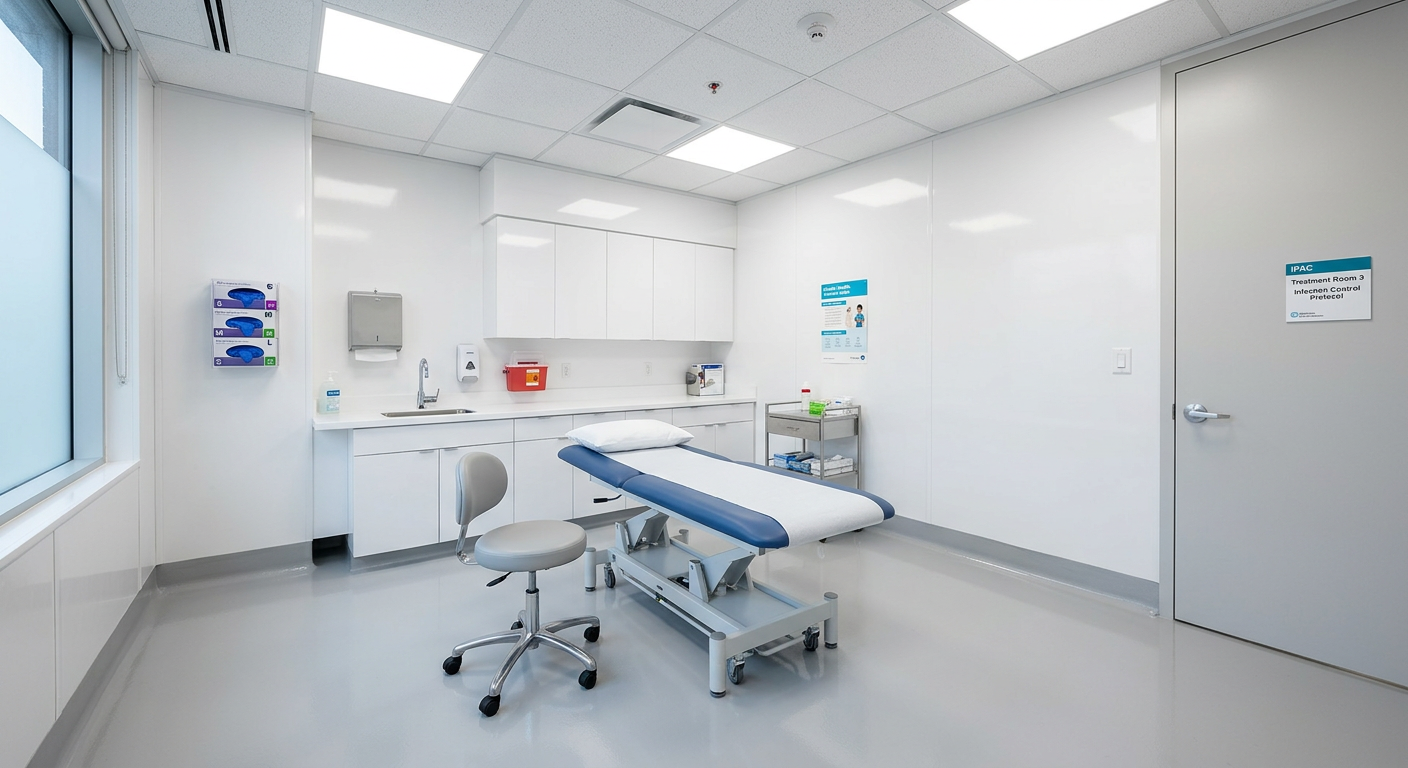
Choosing the right construction materials is critical for infection control in Ontario clinics. Learn what Toronto Public Health and IPAC inspectors look for in...
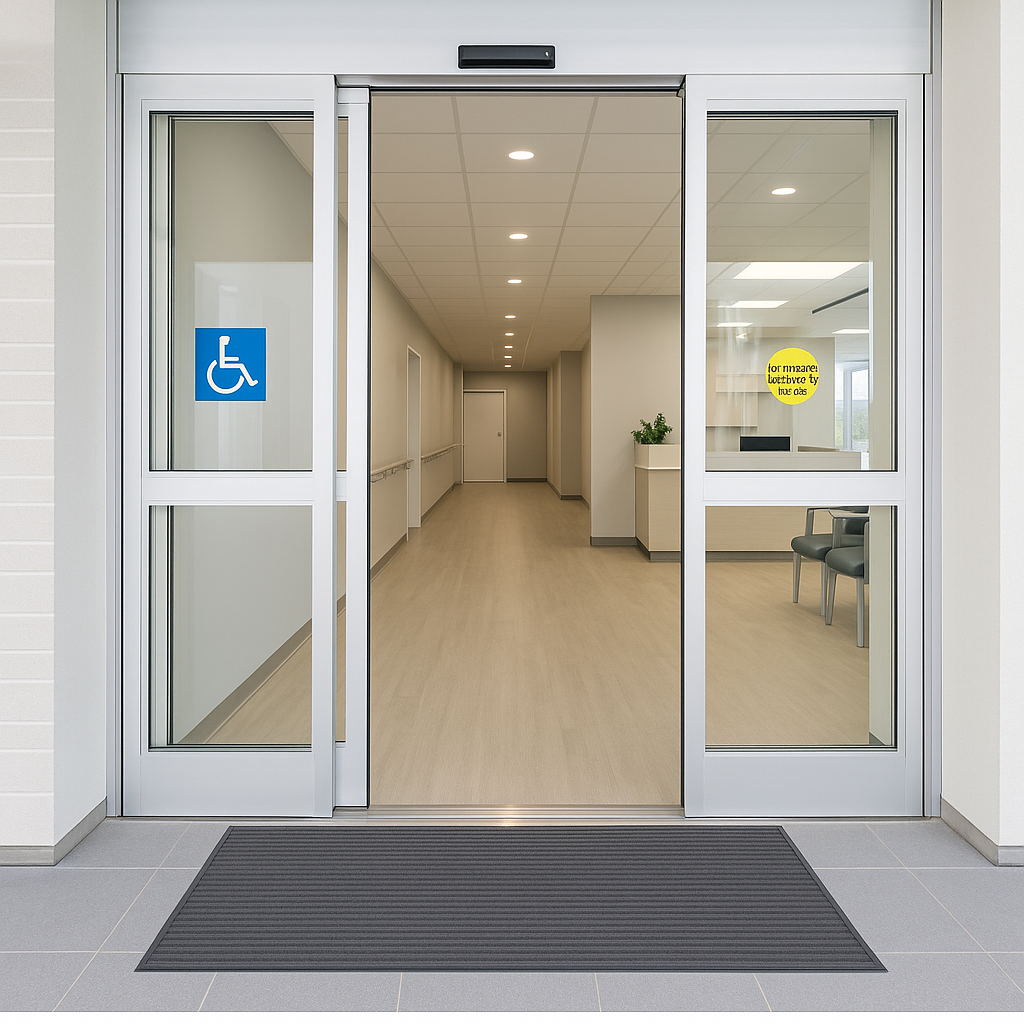
As of January 2025, AODA compliance is fully enforced for Ontario medical clinics. Here is what your renovation must include to meet accessibility standards...