

May 18, 2023

Renovating a pharmacy in 2026 goes far beyond fresh paint and updated shelving—it’s a strategic investment that transforms how you deliver patient care, optimize...
Planning a medical office renovation in Ontario is fundamentally different from renovating any other commercial space. The regulations are stricter, the materials are specialized, the permit requirements more layered, and the consequences of poor planning — for your patients, your staff, and your practice's finances — are far more serious. This is not a project where you can improvise as you go.
Whether you operate a family medicine practice, a walk-in clinic, a pharmacy, an audiology clinic, or a veterinary practice, this 2026 guide walks you through every phase of the planning process — from the initial needs assessment through permit approval, material selection, phased construction, and final sign-off. Follow this framework and your renovation will be compliant, on budget, and completed without shutting down your practice.

Expert planning from day one separates successful clinic renovations from costly, disruptive ones.
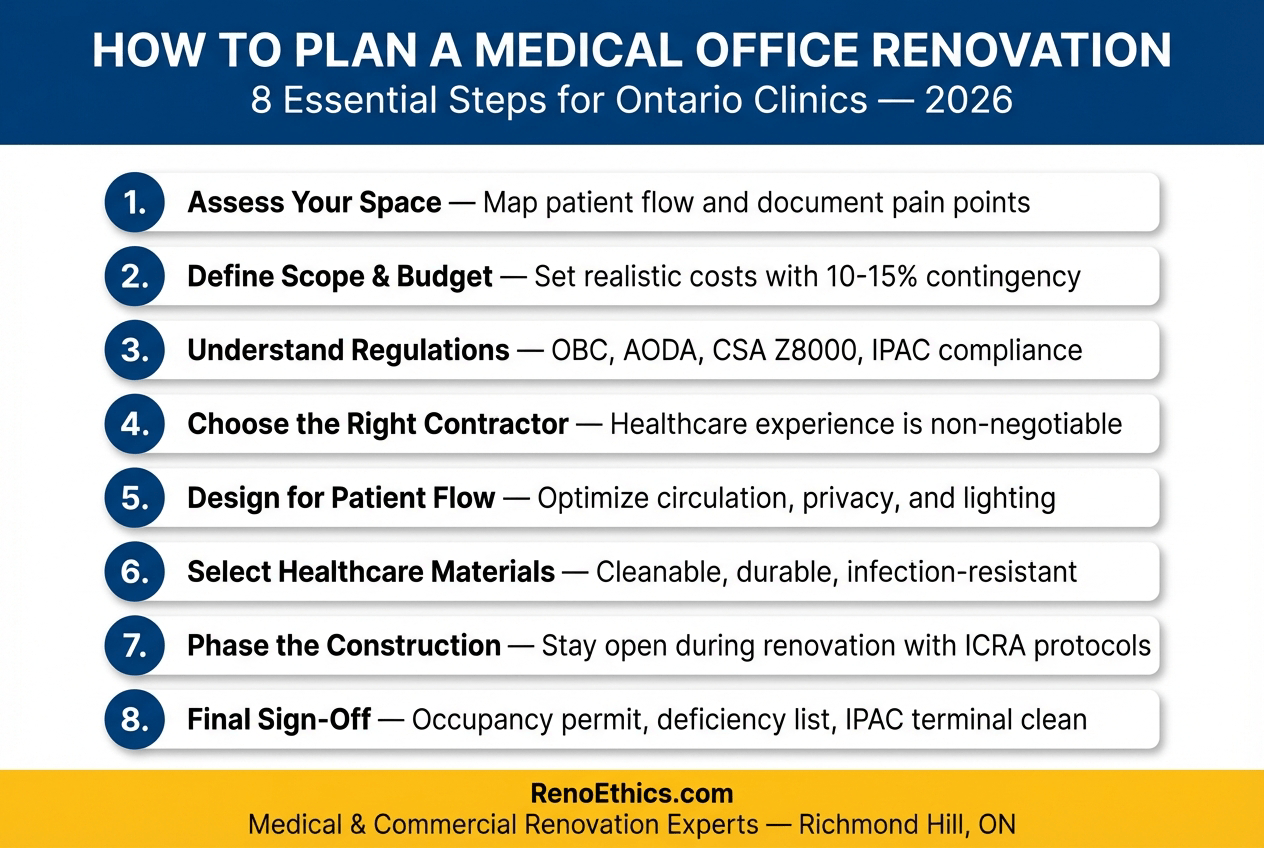
Save and share: The 8-step medical office renovation planning roadmap every Ontario clinic owner needs.
Before you contact a single contractor or look at a single floor plan, invest time in an honest diagnostic of your existing space. The goal is to identify the specific pain points your renovation must solve — not a wish list of aesthetic upgrades, but genuine operational problems that cost you efficiency, patient experience, and revenue every single day.
Walk through your clinic with fresh eyes — or better yet, ask a trusted colleague to walk through it as if they were a new patient. Notice where the bottlenecks are. Does the waiting room feel cramped even when only a few patients are present? Is the reception desk in the wrong position relative to the entrance? Do exam rooms lack adequate storage, forcing staff to leave the room mid-appointment?
Trace every step a patient takes from parking to exit. Note every friction point: unclear wayfinding, narrow corridors, long walks between reception and exam rooms, poor sightlines from staff stations.
Nurses, MAs, and front desk staff experience your space for 8+ hours a day. A structured 10-question survey about workflow friction, storage deficiencies, and privacy concerns will surface issues you've become blind to.
Google reviews, patient satisfaction surveys, and reception comment forms often contain space-specific complaints: "waiting room too loud," "couldn't find the washroom," "no privacy at check-in." These are renovation briefs written for free.
Measure every room. Locate existing plumbing stacks, electrical panels, and HVAC trunks. Note ceiling heights and structural walls. This baseline data becomes essential when evaluating design options and prevents costly surprises during construction.
A renovation driven by aesthetics — "we want a more modern look" — is far less effective than one driven by documented operational problems. Rank your pain points by frequency and financial impact before your first planning meeting. This will also keep scope creep in check when your contractor presents design options. If you need help making the business case for renovation investment internally, read our breakdown of the ROI of modernizing your medical office.
Once you've diagnosed your clinic's problems, you can determine what work is actually required — and what it will genuinely cost. The two most common planning failures at this stage are under-scoping (leaving critical work out of the initial contract, causing expensive change orders later) and under-budgeting (setting an aspirational number that forces painful mid-project compromises).
| Scope Category | What It Includes | Permit Required? | Typical Cost Range |
|---|---|---|---|
| Cosmetic Refresh | New paint, flooring in-kind, light fixture replacement, furniture | Usually No | $50–$100/sqft |
| Selective Renovation | New millwork/casework, tile replacement, some partition changes, accessibility upgrades | Sometimes | $100–$200/sqft |
| Partial Gut | Partition reconfiguration, new plumbing fixtures, electrical upgrades, HVAC balancing, full finish replacement | Yes | $200–$300/sqft |
| Full Gut Renovation | All of the above plus structural changes, new mechanical systems, full barrier-free redesign | Yes — Multiple | $300–$400+/sqft |
For a full gut renovation or significant partial renovation, here is how a well-planned budget typically allocates across categories. For a complete cost breakdown by clinic type and room, see our guide to medical office renovation costs in Ontario.
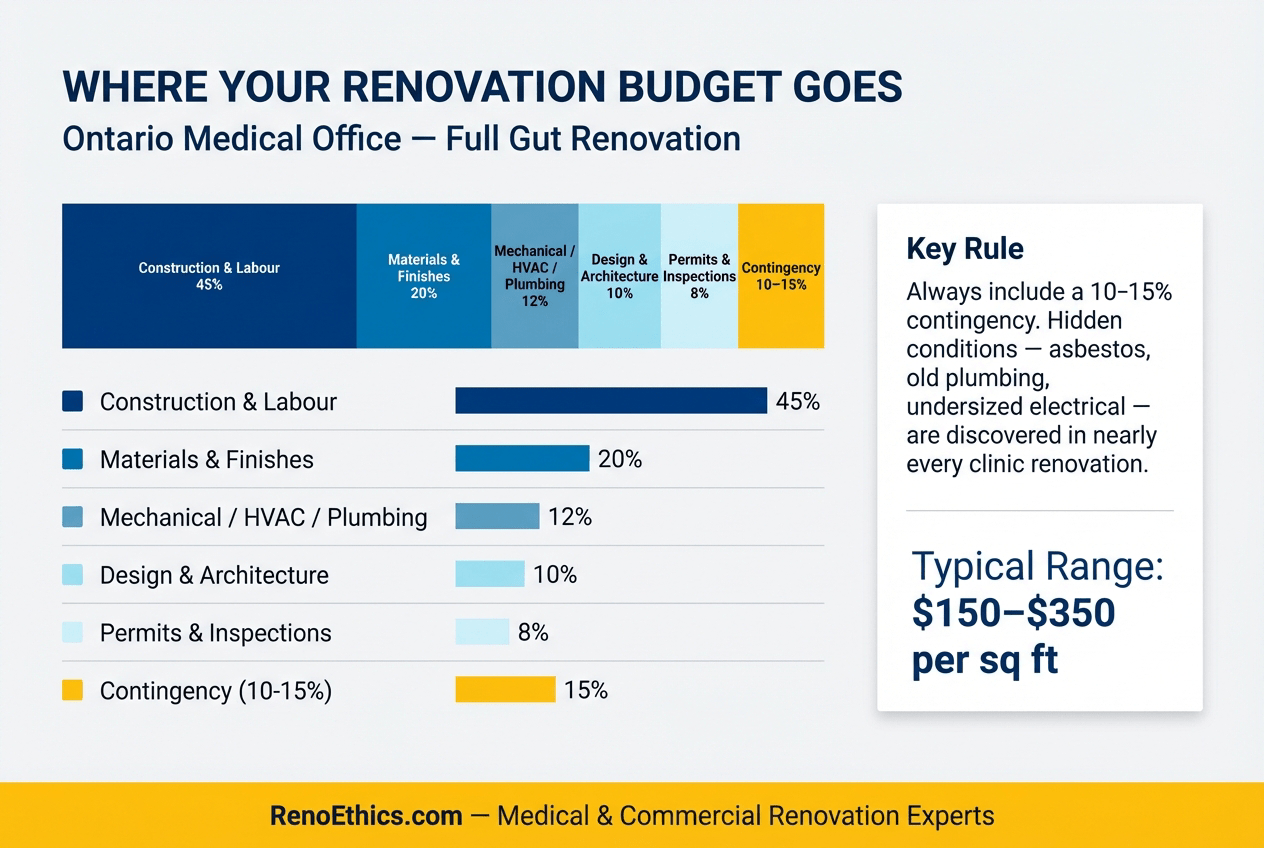
Budget allocation for a typical Ontario medical office renovation — percentages vary based on scope and condition of existing mechanical systems.
Medical offices frequently contain hidden conditions — asbestos in drywall compound (pre-1990 buildings), outdated electrical panels undersized for modern medical equipment, plumbing that hasn't been touched since original construction. Any of these discovered mid-project means immediate unplanned cost. A contractor who doesn't build contingency into your budget plan is setting you up to fail.
This is where many clinic owners make their most costly mistake: assuming a contractor will "handle compliance" without understanding what compliance actually requires. Your regulatory framework as an Ontario medical clinic spans four overlapping bodies of law and standards. You do not need to become a building code expert, but you must understand what each framework covers so you can verify your contractor is addressing all of them.
| Regulation / Standard | What It Governs | Enforcement | Applies When |
|---|---|---|---|
| Ontario Building Code (OBC) | Structural safety, fire protection, occupancy classification, barrier-free design minimums | Municipal building department — permit and inspection process | All work requiring a permit; barrier-free requirements triggered by any renovation |
| AODA — Design of Public Spaces Standard | Accessible entrances, washrooms, signage, waiting areas, service counters | Province of Ontario — fines up to $100K/day | All clinics as of January 2025 full enforcement |
| CSA Z8000 — Canadian Healthcare Facilities Standard | Room dimensions, ventilation rates, finishes, equipment clearances for clinical spaces | Referenced in OBC; insurer and accreditation bodies | New construction; best practice for renovations |
| IPAC — Infection Prevention and Control | Material selection, surface cleanability, sink placement, air handling in clinical zones | Public Health Ontario and MOHLTC inspection | All clinical spaces where patient care occurs |
AODA compliance deserves particular attention. Our detailed guide on understanding AODA compliance for medical clinics in Ontario covers the specific physical dimensions required for accessible entrances, washrooms, exam rooms, and reception desks — all the measurements you need to verify your renovation drawings comply before construction begins.
For a complete walkthrough of the permit process — what gets submitted, to whom, in what order, and how long to expect — see our permits and regulations guide for Ontario medical office renovations.
If your clinic occupies a leased commercial space, you must obtain landlord written consent before submitting any building permit application. Landlords may impose additional conditions on construction hours, contractor insurance requirements, and restoration obligations at the end of your lease. These must be negotiated and documented before your renovation planning goes further.
The single highest-leverage decision in your entire renovation is contractor selection. A general commercial contractor who has "done some office work" is not equipped to manage a medical facility renovation. The consequences of choosing wrong range from failed inspections and permit rejections to IPAC compliance failures and patient safety risks during construction. For a detailed breakdown of where healthcare renovations go wrong, read our post on the top 5 mistakes to avoid during healthcare renovations in Ontario.
Ask for photographs and references from at least three completed medical facility projects — not commercial offices, not retail fit-outs. Request contact information for those clinic owners and call them.
Non-negotiable requirementYour contractor must provide a current WSIB (Workplace Safety and Insurance Board) Clearance Certificate before any work begins. Without it, you — the property owner or tenant — can be held liable for workplace injuries on your premises.
Legal requirementAsk specifically: "How do you implement ICRA during an active clinic renovation?" A qualified contractor will describe barrier types, negative air pressure zones, HEPA filtration, and daily inspection procedures — without hesitation.
Patient safety requirementYour contractor should prepare or coordinate all permit applications, submit drawings to the municipality, schedule inspections, and address any inspection deficiencies — this must be included in your contract scope, not treated as an extra.
Included in contract scopeFor a complete framework on evaluating and vetting healthcare renovation contractors — including the specific interview questions that reveal whether a contractor truly understands clinical environments — read our guide on what to look for in a medical office renovation contractor.
The design phase translates your needs assessment into architectural drawings. A good healthcare interior designer or design-build contractor will propose solutions to the operational problems you identified in Step 1 — not just a space that looks nice in renderings. For clinic renovations, the most important design principles are patient flow, acoustic privacy, lighting quality, and accessibility.
In a well-designed medical clinic, a patient should move from entrance to check-in to waiting to exam room to check-out without ever backtracking, crossing staff-only zones, or navigating confusing corridors. The ideal layout separates three distinct circulation zones: public zones (waiting, reception, washrooms), clinical zones (exam rooms, treatment areas), and staff zones (offices, break room, storage, sterilization).
Placing reception with a direct sightline to the entrance and waiting area — and locating exam rooms directly off a clinical corridor accessed from reception — minimizes both patient wayfinding confusion and staff travel distance. Every unnecessary step a nurse or MA takes between rooms costs productivity across thousands of patient encounters per year. For a detailed look at how to design a waiting area that actually serves patients well, see our guide on designing patient-friendly waiting areas for clinics.
PHIPA (Ontario's Personal Health Information Protection Act) requires that patient health information not be inadvertently disclosed. In practice, this means conversations at reception and in exam rooms must not be audible in waiting areas or hallways. Construction solutions include STC-rated partition assemblies (minimum STC 45 for exam rooms), acoustic insulation in partition cavities, solid-core doors with proper gasketing, and sound-masking systems in waiting areas. This is a design decision, not a finish decision — it must be specified in your construction drawings.
Medical spaces require layered lighting: high-CRI (Colour Rendering Index 90+) task lighting in exam rooms for accurate clinical assessment, ambient lighting at 300–500 lux in corridors and waiting areas, and adjustable lighting in procedure areas. Patients in medical settings are already anxious — harsh institutional lighting amplifies that anxiety. Warm-white (3000K) ambient lighting in waiting areas combined with neutral-white (4000K) clinical task lighting creates a space that feels professional without feeling clinical-cold.
Accessibility features that are retrofitted after the fact are almost always more expensive and less effective than those planned from the beginning. Your design drawings must include accessible reception counter heights (820mm), correct exam room turning circles (1,500mm), accessible washroom layouts with correct grab bar positioning, and AODA-compliant entrance sequences. Your accessible washroom design is not a separate project — it is part of your clinic renovation from day one.
Material selection in a medical facility is not a question of personal taste — it is a clinical and regulatory decision. Every surface in a patient-facing area must be cleanable with hospital-grade disinfectants, resistant to physical damage, and free of features that harbour pathogens. The right infection-control materials also significantly reduce your long-term maintenance costs.
Healthcare-grade materials: every surface choice in a clinic environment must balance cleanability, durability, and patient comfort.
| Surface / Zone | Recommended Material | Key Requirements | What to Avoid |
|---|---|---|---|
| Flooring — Exam Rooms | Homogeneous sheet vinyl (Tarkett, Forbo, Armstrong) or LVT with welded seams | No seams or grout lines; chemical-resistant; slip-resistant coefficient 0.6+ | Ceramic tile (grout harbours pathogens), carpet, cork |
| Flooring — Waiting / Reception | Commercial LVT plank or polished concrete with epoxy sealer | Slip-resistant, cleanable, durable under wheeled traffic | Carpet, natural stone with porous grout |
| Wall Surfaces — Clinical | Moisture-resistant drywall with scrubbable paint (eggshell minimum); fibreglass-reinforced panels in wet zones | Impact-resistant at corners and high-traffic zones; compatible with hospital-grade disinfectants | Wallpaper, unsealed natural materials, latex flat paint |
| Counters / Work Surfaces | Solid-surface (Corian, LG Hi-Macs) or compact laminate (Wilsonart, Formica) | Seamless or integrated sink where possible; non-porous; heat-resistant | Natural stone with visible seams, open-grain wood, porous laminate |
| Cabinetry | Thermally fused melamine or PVC edge-banded MDF; full overlay doors with no exposed particle board edges | Moisture-resistant substrate; hardware rated for 100,000+ cycles; no exposed particle board edges | Standard residential cabinetry, open shelving in clinical zones |
| Ceilings — Clinical | Moisture-resistant drywall with eggshell paint OR wipeable acoustic tile (Armstrong BioBlock) | Washable; must permit inspection access to plenum above | Standard lay-in ceiling tile in procedure/exam rooms |
Closing your clinic for 4–6 months is not an option for most practices. Phased construction — renovating one zone at a time while the rest of the clinic continues operating — is the standard approach for active medical offices in Ontario. It requires more planning, more contractor expertise, and higher vigilance around infection control, but it is entirely achievable with the right team.
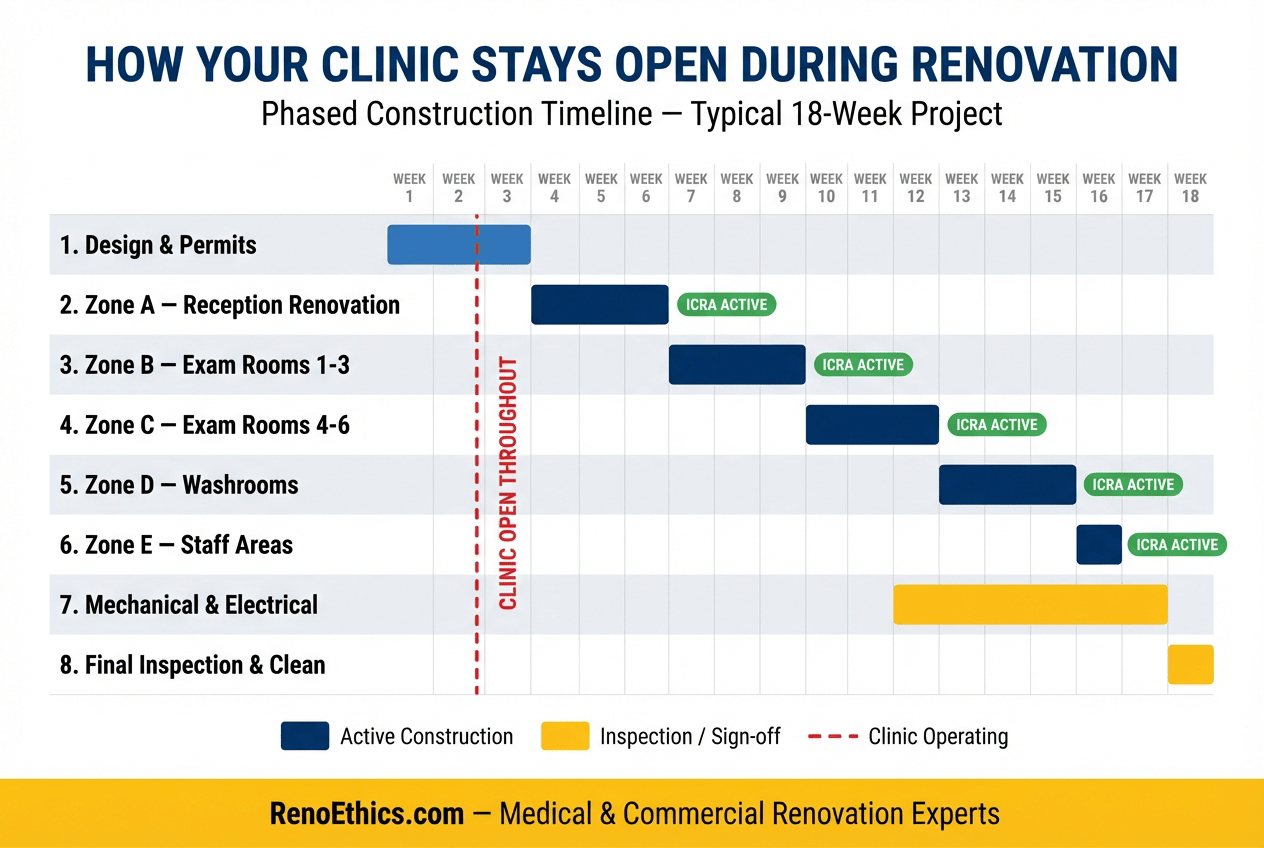
A phased renovation timeline — the key to staying open during construction. Each zone completes before the next begins.
Public Health Ontario's Infection Control Risk Assessment (ICRA) is the systematic process that must be completed before any construction begins in or adjacent to active patient care areas. ICRA classifies the risk of construction activities (dust generation, vibration, opening of ceiling plenum) against the vulnerability of nearby patients, then mandates specific barrier and containment measures based on that risk class.
For most active clinic renovations, ICRA requirements include: full-height rigid barriers between construction and clinical zones, negative air pressure in construction zones (maintained by HEPA air scrubbers exhausted outdoors), covered patient pathways when construction workers transit active areas, daily inspection of barriers for gaps or breaches, and tracked shoe covers or separate entry/exit routes for construction workers. Your contractor must have documented ICRA protocols and be willing to show them to you before signing a contract.
The most effective phasing approach for most clinics is zone-by-zone sequential construction: complete one area fully (including inspection and clean-up) before beginning the next. This minimizes the duration of ICRA-controlled construction zones and reduces patient disruption. Alternatives include after-hours and weekend construction — suitable for noise-sensitive work near active patient areas — and temporary relocation of specific services to a partner clinic while affected rooms are renovated.
Construction dust in a clinical environment contains Aspergillus and other fungal spores that pose genuine risk to immunocompromised patients — a population overrepresented in any medical waiting room. A contractor who dismisses ICRA as bureaucratic overhead is not equipped to work in a healthcare setting. This is non-negotiable.
The final phase of a medical office renovation is as important as any that preceded it. A rushed handoff — cleaning crews sweeping through before the paint is dry, equipment being moved in before the inspection is passed — creates problems that follow your clinic for years.
Your building inspector must conduct a final inspection and issue an Occupancy Permit (or equivalent sign-off) before patients can be seen in renovated areas. Your contractor is responsible for scheduling this and for correcting any deficiencies identified. Do not accept verbal clearance — obtain the written permit.
Walk through every area of the renovation with your contractor and a detailed punch list. Note every incomplete item, every paint touch-up needed, every piece of hardware not yet installed. Get a written commitment with a specific completion date for every deficiency — not "we'll get to it."
Before final payment, obtain your full documentation package: as-built drawings, HVAC commissioning report, warranty documents for all equipment and systems, permit inspection records, and WSIB clearance. This package is required for insurance, future permits, and lease-end restoration purposes.
Allow 1–2 days of staff orientation before seeing patients in a newly renovated area. Staff need to locate supplies in new storage locations, understand any new workflow paths, and identify any operational issues before they affect patient care. A mock patient run-through with staff catches problems before they become complaints.
A professional terminal clean by a healthcare-specialized cleaning company must be completed before patients return to renovated areas. This is different from a standard post-construction clean — it uses hospital-grade disinfectants, follows specific protocols for surface contact time, and should be documented for your IPAC file.
Use this checklist before signing your construction contract. Every unchecked item is a risk to your timeline, budget, or compliance status.
Needs Assessment & Scope
Budget & Finance
Regulatory & Permits
Contractor Selection
Design & Materials
Construction Phase
Most medical office renovations in Ontario take 10 to 22 weeks from permit approval to occupancy, depending on project scope. A cosmetic refresh of an existing space may take 6–8 weeks. A full gut renovation with new walls, mechanical upgrades, and new plumbing typically runs 16–22 weeks. Add 4–8 weeks for design, permit submission, and approval before construction begins. Total elapsed time from "decision to renovate" to "patients in the new space" is typically 6–9 months for a significant renovation.
Yes, in most cases. Any work that affects the structure, layout, plumbing, electrical, HVAC, or fire protection of a medical office in Ontario requires a building permit from your local municipality. Purely cosmetic work — repainting, replacing flooring in-kind without changing the subfloor — typically does not require a permit. Your contractor should confirm permit requirements with the municipality before any work begins. Operating without a required permit risks stop-work orders, mandatory demolition of unpermitted work, and problems when selling or leasing your practice.
Medical office renovation costs in Ontario typically range from $150 to $350 per square foot, depending on scope, finishes, and whether mechanical systems are being upgraded. A 1,500 sq ft clinic renovation might cost $225,000 to $525,000 in total. Cosmetic refreshes start around $50–100/sqft. Full gut renovations with new plumbing, HVAC, and casework reach $300–400/sqft. Always budget a 10–15% contingency on top of your construction estimate. For a detailed breakdown by room type, see our Ontario medical office renovation cost guide.
Yes, with careful phased planning. Most medical clinics renovate in phases — one room or zone at a time — while continuing to see patients in unaffected areas. Your contractor must implement ICRA (Infection Control Risk Assessment) protocols including construction barriers, negative air pressure zones, and HEPA air scrubbers to protect patients during active construction. Evening and weekend scheduling is also common for noise-sensitive phases. The key is selecting a contractor who has actually executed active-clinic renovations before — not one who claims they can.
ICRA stands for Infection Control Risk Assessment. It is a systematic process required during construction or renovation in healthcare settings to minimize the risk of airborne pathogens, dust, and mold reaching patient care areas. Ontario's IPAC (Infection Prevention and Control) guidelines require ICRA implementation during any construction that creates dust or disturbs existing building materials near patient zones. Construction dust in clinical areas can contain Aspergillus spores — a genuine health risk for immunocompromised patients. Only contractors with healthcare renovation experience properly implement ICRA. Always ask for their written ICRA plan before signing a contract.
A typical medical office renovation in Ontario requires a building permit from your municipality (based on architectural drawings), a plumbing permit (if plumbing is being modified), an electrical permit issued via the Electrical Safety Authority (ESA), and an HVAC/mechanical permit. If the clinic is in a leased space, you also need landlord approval before permit application. Permit timelines vary by municipality — 4 to 12 weeks is common across the GTA. For a complete permit process walkthrough, see our Ontario medical renovation permits guide.
RenoEthics brings 15+ years of healthcare facility construction expertise to every project across Richmond Hill, Vaughan, Markham, Aurora, and the GTA. We manage permits, ICRA protocols, AODA compliance, and all trades under one coordinated contract — so you can keep seeing patients while we build your clinic's future.
Get Your Free Renovation Consultation
Renovating a pharmacy in 2026 goes far beyond fresh paint and updated shelving—it’s a strategic investment that transforms how you deliver patient care, optimize...

Choosing a medical office renovation contractor is one of the most consequential decisions you will make for your practice. The wrong contractor means failed...